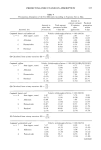
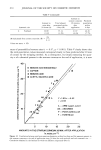
J. Soc. Cosmet. Chem., 38, 443-449 (November/December 1987) The descriptive analysis of skin care products by a trained panel of judges L. B. AUST, L. P. ODDO, J. E. WILD, O. H. MILLS, and J. S. DEUPREE, Hilltop Research, Inc., 7506 East Monterey Way, Scottsdale, AZ 85251. Received February 5, 1987. Synopsis This paper describes a sensory or skinfeel approach to evaluate creams and lotions. Perceived skinfeel attributes of products have been evaluated using a trained descriptive panel of nine judges. The panel is capable of identifying and defining attributes of test products through reference materials, and is able to reproducibly measure the relative intensities of product attributes on a numerical scale. Five currently marketed lotion products were evaluated for product appearance, rub-in, absorption, appearance of skin (shine), immediate and delayed afterfeel, and other notable attributes. Differences in perceived skinfeel attributes distinguish products from each other which may be equivalent in terms of dry skin efficacy. INTRODUCTION It is not uncommon for a skin care product to be clinically effective and yet be unaccep- table to consumers because of one or more of the product's skinfeel attributes. It is also not unusual for consumer information to be difficult for the product developer to un- derstand (1). Terms such as "rich" and "creamy" do not provide adequate insight as to why some products are not perceived to be as acceptable as others in the marketplace. The descriptive analysis method of evaluation has been widely used in the food and beverage industries (2) and has recently been adapted to skin care products. In our work we have screened and trained a group of individuals to evaluate the per- ceived attributes of dry skin care products. Their training consisted of three 3-hour sessions per week for six months. During this time they evaluated many currently marketed lotions and creams. They identified and defined attributes and low and high reference standards. The attributes were determined by evaluating a representative number of currently marketed cream and lotion products, and selecting those attributes in common. By using reference standards the panel was able to measure the relative intensities of each attribute on a numerical scale. The results of this work indicate there are significant differences in skinfeel perception among lotion products whose package labels indicate equivalent dry skin efficacy. 443

444 JOURNAL OF THE SOCIETY OF COSMETIC CHEMISTS EXPERIMENTAL DESIGN MATERIALS The test materials consisted of four oil-in-water lotion formulations (Products A, B, C, and D) and one water-in-oil lotion formulation (Product E). PROCEDURE Test products were transferred to plain 5-ounce white plastic squeeze bottles and iden- tified by A, B, C, D, or E prior to the start of the study. All judges followed the same washing procedure of their arms prior to each evaluation. Test products were dispensed at a prescribed amount from an Eppendorf repeater pipette to the inner surface of the judges' forearms. Products too viscous to be used in the repeater pipette were weighed out onto individual weight dishes immediately prior to the evaluation session. The attributes to be evaluated were determined by evaluating a representative number of currently marketed cream and lotion products and selecting ones in common. This was done as part of the training procedure. The phases and attributes evaluated were as follows (3): Product appearance. A uniform amount of each test product was visually evaluated for thickness, or the degree to which the test product retains its shape. Product rub-in. During the first 15 rotations each test product was evaluated for its spreadability, or the ease of moving the product over the skin. Product absorption. Each judge evaluated the rate of absorption by determining the point at which the product lost the wet, moist feeling and resistance to continued pressure was perceived. This was done by counting the number of rotations required for the product to reach the point of absorption, or 120 rotations, whichever comes first. Appearance of skin. Following absorption the test site was evaluated for shine, the amount of light reflected off the skin. Immediate aJ%rJ%/. Immediately following absorption the judges independently evalu- ated each product for (1) oiliness, greasiness, a fatty tacky residue (2) drag, the ease of moving the fingers across the skin and (3) residue, the quantity of product remaining on the skin. Delayed afterJ%l. Five, fifteen, and thirty minutes following application of the test product, the judges evaluated the quantity of product residue remaining on the skin. Other attributes. Other attributes perceived by the judges included oiliness/greasiness five minutes following absorption and "treated feeling," a term developed by the judges to describe a moisturized feeling lacking a distinct product residue. The term "moistur- ized" was considered as an attribute, but the judges were unable to agree on a defini- tion. Thus, "treated feeling" was chosen as a term which encompasses "moisturized" and is able to be defined. The panel was conducted in accordance with guidelines from other trained panels such as those for flavor and texture (4). All evaluations were conducted in an independent manner, with discussion among the judges restricted to a minimum during the actual evaluations. The identity of the test products was blinded from the judges and each was
Purchased for the exclusive use of nofirst nolast (unknown)
From: SCC Media Library & Resource Center (library.scconline.org)