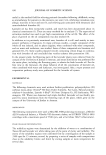
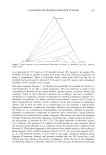
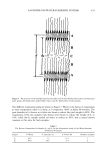
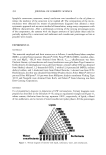
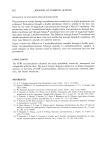
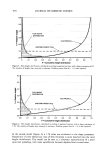
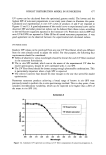
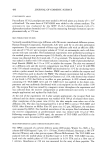
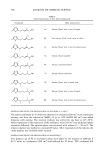
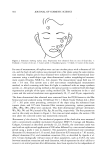
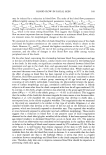
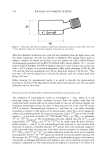
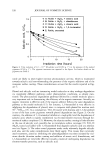
466 JOURNAL OF COSMETIC SCIENCE I-- I I I I t I i T• = I• / I 0 T 2 = 12 / I 0 Figure 1. Cross section of a step film geometry from O'Neill. Parent uniform film thickness: d Absorbance: A(x ) with f•, f2, fractions of unit area --0, and, as the model should preserve the quantity of applied sunscreen preparation, f• x h• + f2 x h 2 = 1 (2) with h•, h2, fractions of uniform parent film thickness --0. At each wavelength, the transmittance of a single homogeneous fraction, f• or f2, can be deduced through Beer-Lambert law application. The total transmittance of the basic O'Neill model is then given by the sum of the transmissions through the two fractions: (Ts)x: fl x 10 -h•xAX + f2 x 10 -hzxAX (3) Ax is the parent uniform film absorbance, and h•, h 2 are the residual thickness fractions of both deformed film sections, with unit area f• and f2. Absorbance Ax can be consid- ered as a simple variable (in the relationship with Tsx), or can be calculated according to UV filter composition of a sunscreen product. CALCULATION OF PARENT i•ILM ABSORBANCE Ax The irregular film model was originated from the deformation of a homogeneous film of sunscreen material of a certain thickness (d) and a horizontal extension, fl + f2, both data being normalized at 1 in our analysis. Although being only a speculative idea, such a perfect homogeneous film remains a useful tool, allowing one to establish a relationship between UV absorption of diluted UV filters on one hand and the final UV absorption of a sunscreen spread on an irregular substrate on the other. Absorbance Ax of this theoretical regular parent film can be calculated according to the Beer-Lambert law applied to the amount of UV filters deposited onto the unit area. If a formulation contains p UV filters, numbered from n = 1 to n = p, the parent uniform film absorbance resulting from a surface density application of w (in mg cm -2) is: n=2 Ax = w/100 x ZKK(n) x •/(r/) (4)

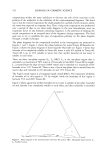
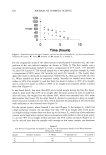
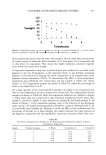
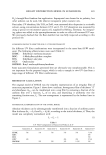
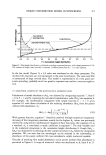
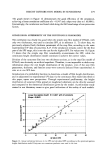
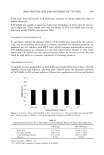
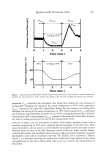
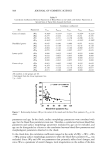
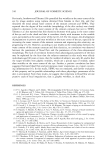
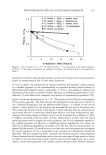
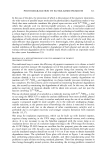
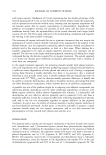
HEIGHT DISTRIBUTION MODEL IN SUNSCREENS 467 where KMn ) is the absortivity of the number n UV filter at wavelength X and a(n ) is its percentage in the sunscreen preparation. UV filter absortivities were determined once and for all, accoMing to the experimental protocol previously described. THEORETICAL CONTINUOUS MODELS OF IRREGULAR SUNSCREEN FILMS AccoMing to the simplifications previously defined, a more complex model of sunscreen film could be calculated, with an infinite number of individual thickness fractions. Therefore, previous equations 2 and 3 should be transformed into integrals. First, a "film thickness" function, h(v), should be proposed: h = function (F) (5) Variable F is the cumulative fraction of the unit area, which is a number between 0 and 1. Therefore, variable F can also be interpreted as being the cumulative height distri- bution of the sunscreen film. Function h is the local film thickness, calculated as a fraction of the uniform parent film thickness, accoMing to the variable F. A basic example of a continuous sunscreen distribution is the simple function h = a x F, which achieves a prism-shaped profile (presented in Figure 2). As previously, the model re- ß quires keeping the quantity of applied sunscreen constant: f •h(F) x dF = 1 (6) Resolution of equation 6 should be done to calculate function parameters. With the simple thickness function h = a x F, integration of 6 results in a = 2. HEIGHT DISTRIBUTION OF PRiS'M ........................................................ FUNCTION PRISM FUNCTION PROF ................ ................ .......... 7 .... 0,0 0,1 0,2 0,3 0,4 0,5 0,6 0,7 0,8 0,9 1,0 F = Cumulative height distribution Figure 2. Height distribution, according to the prism function. The number of height class intervals is arbitrary. Uniform parent film (h = 1) is also reported.
Purchased for the exclusive use of nofirst nolast (unknown)
From: SCC Media Library & Resource Center (library.scconline.org)