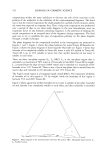
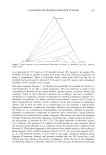
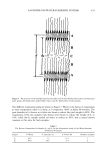
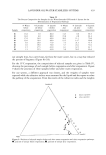
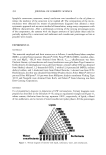
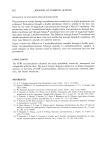
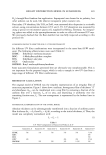
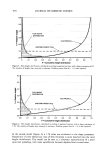
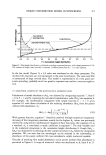
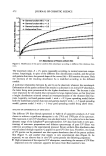
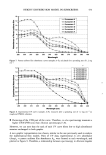
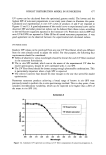
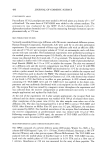
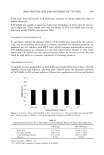
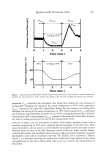
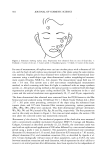
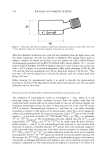
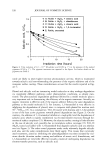
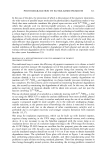
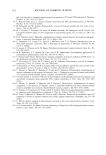
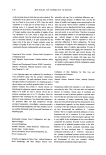
432 JOURNAL OF COSMETIC SCIENCE compositions within the same stabilizers to discover the role of the structure or the polarity of the surfactant in the solubility of the multicompound fragrance. The third was to run the control evaporation for small samples for a period of a few minutes, where the water was expected to evaporate first. Then a long-term evaporation was performed over a period of days to see what really happens in the true formulations, since an important factor in any formula containing fragrance is the potential of keeping the initial composition in an accepted ratio of the fragrance during evaporation. The final goal was to try to establish the type of evaporation pathway on the phase diagram through a simple technique. The phase diagrams for the compounds involved in the investigation are presented in Figures 1 and 2. Figure 1 shows the phase behavior for water/Tween 80/lavender oil. Figure 2 shows the phase diagram of water/Laureth 4/lavender oil. Figure 1 shows that lavender oil is completely soluble in Tween 80, water is only 9% soluble in Tween 80, Tween 80 is up to 25% soluble in water, but that neither lavender oil nor water is soluble in each other. There are three one-phase regions (L1, L2, HLC). L 2 is the one-phase region that is extended to a maximum of 28% water at 4% lavender oil and 68% Tween 80 by weight. L• is started from the edge of water (100% water) and is extended to a maximum of 6% lavender oil at 51% Tween 80. There is also a line of one-phase that is started from the water edge and extended to 6% lavender oil and 15% Tween 80. The liquid crystal region is a hexagonal liquid crystal (HLC). The maximum solubility of lavender oil in this region is 1% by weight, while the boundary of this region is between 55% and 68% Tween 80. Figure 2 shows again that neither lavender oil nor water is soluble in the other. Lavender oil and Laureth 4 are completely soluble in each other, and their solubility is extended Lavender Oil Water Tween80 Figure 1. Phase diagram of the water/lavender oil/Tween 80 system. HLC: Hexagonal liquid crystal. L•, L2: Solubility areas.

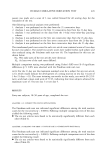
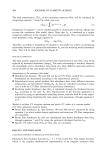
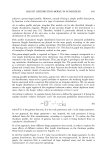
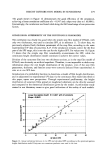
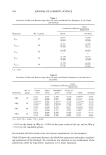
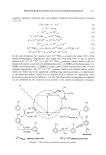
LAVENDER OIL/WATER/STABILIZER SYSTEMS 433 Lavender Off Water Laureth 4 Figure 2. Phase diagram of the water/Laureth 4/lavender oil system. L2: Solubility area. LLC: Lamellar liquid crystal. to a maximum of 17% water at 13% lavender oil and 70% Laureth 4 by weight. The solubility of water in Laureth 4 reaches 12% water, while the solubility of Laureth 4 in water is insignificant. There is a lameliar liquid crystal phase (LLC) on the line of distilled water and Laureth 4 between 51% Laureth 4 and 25 % water, with a maximum solubility of 8% lavender oil by weight. The phase diagrams (Figures 1, 2) illustrate the possibility for lavender oil, which is a multicompound, to act like a single compound. This was expected, as some of the constituents of lavender oil are cineol, linalool, geraniol, pinene, limonene, bornel, and coumarin. Some of their chemical structures are as follows: myrcene (7-methyl-3- methylene-l,6 octadiene), limonen (4-isopropenyl-l-methylcyclohexene), linalool (3,7- dimethyl 1,6-octadiene 3-ol, linalo), and amyl-vinylcarbinol (1-octen-3-ol) (1). Some of these compounds are alcohols, acetate, carboxylic acids, and saturated or unsaturated alkenes, and so they can easily act as cosurfactants and can resemble a typical phase diagram of surfactant, cosurfactant, and water. However, the real question was whether the whole oil, as a combination of hydrophobic and hydrophilic, aliphatic or aromatic, saturated or unsaturated compounds of unknown ratio, would have a phase behavior resembling the normal one for a single compound. The answer came from the literature through comparing some phase diagrams containing only a single compound similar to the one present in lavender oil (10-12,15). The phase behaviors of phenethyl alcohol (11), limonene (10), geraniol (15), linaloo (12) and lavender oil were compared. All of the previous contain Laureth 4 as a surfactant, except for geraniol when combined with Steareth 10. Their phase diagrams in the literature were mostly similar to the traditional phase diagram of the synthetic fragrance (Figure 3) (12-14), which had regions of LC, L2, L1, and emulsion regions. A closer look at the single compound fragrance phase diagram of limonene, linalool, and geraniol revealed that the LLC region has a well defined area that enhances the presence of fragrance, while the area in the phenethyl alcohol phase diagram is relatively reduced (11). The variation of commercial surfactant
Purchased for the exclusive use of nofirst nolast (unknown)
From: SCC Media Library & Resource Center (library.scconline.org)