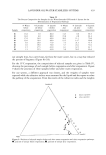
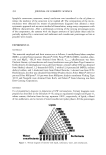
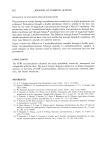
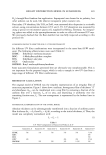
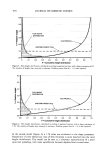
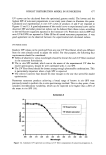
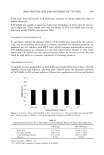
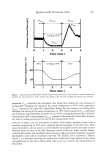
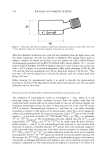
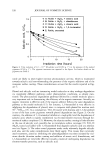
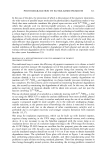
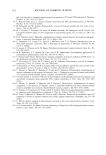
470 JOURNAL OF COSMETIC SCIENCE 6,0 :•4,0 ................ FILM HEIGHT i• / DISTRIBUTION /I 3,0 . . -. - ... - - -/- - _ _/_ 2,0 ................................... 0 0,1 0,2 0,3 0,4 0,5 0,6 0,7 0,8 0,9 1 F = Cumulative height distribution Figure 3. Film height distribution, calculated according to gamma function, with a shape parameter of 0.5. The number of height class intervals is arbitrary. Uniform parent film (h = 1) is also reported. 6,0 5,0 - 3,0 II FILM HEIGHT DISTRIBUTION UNIFORM PARENT FILM FILM 0,0 0,0 0,1 0,2 0,3 0,4 0,5 0,6 0,7 0,8 0,9 F = Cumulative height distribution Figure 4. Film height distribution, calculated according to gamma function, with a shape parameter of 1.50. The number of height class intervals is arbitrary. Uniform parent film (h = 1) is also reported. In the second model (Figure 4), a 1.50 value was attributed to the shape parameter. Repartition of every elementary class of film thickness is more matched into the total height distribution. This model can be seen as a schematic representation of a good sunscreen spreading, with some equilibrium between depleted and covered areas.

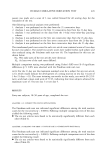
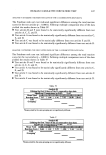
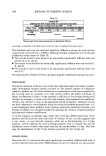
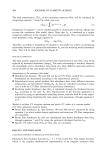
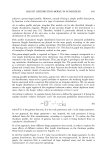
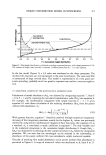
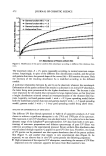
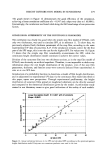
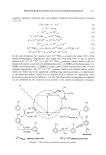
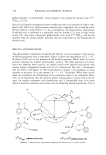
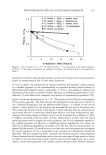
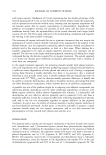
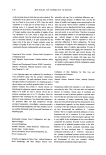
HEIGHT DISTRIBUTION MODEL IN SUNSCREENS 471 5,0 • FILM HEIGHT It/ DISTRIBUTION FILM PROFILE 2,0 .................................................................. 1,0 0,0 0,1 0,2 0,3 0,4 0,õ 0,6 0,7 0,8 0,9 1,0 F = ½u•ul,,ti•e height distribution In the last model (Figure 5), a 3.0 value was attributed to the shape parameter. The thickest film fractions are overrepresented in the total distribution. The sunscreen film is constituted of large covered areas. This model is representative of a very good sun- screen spreading, probably much too good to represent any realistic sunscreen applica- tion. UV ABSORPTION ACHIEVED BY THE MATHEMATICAL SUNSCREEN FILMS Calculation of model absorbance (As•x was achieved by integrating equation 7, from F = 0 to F = 1, and by reporting the calculated transmittance value (Ts)x into equation 8. For example, the mathematical integration with simple function h = 2 x F gives equation 10, with direct calculation of the resulting absorbance (As)x from the parent uniform film absorbance Ax: (As)x=_log( 1--10-2xAx '• 2 -• •47 • 1-•0 ] (10) With gamma function, equation 7 should be resolved through numerical integration. Accuracy of the integration procedure, mainly for the highest Ax values, was previously checked by using known mathematical integrals of basic functions, like equation 10, as a standard. Ax is considered a simple coefficient in equation 7. The only variable used in the numerical integration is the cumulative height distribution F. Graph (As)x = f(Ax) was obtained by attributing discrete numerical values to Ax before the integration procedure. We can note that the wavelength can be omitted in the relationship, as absorbance of the parent uniform film was considered a simple numerical variable. The plot of resulting film model absorbance versus parent uniform film absorbance is presented in Figure 6. A range of numerical values was attributed to A, from 0 to 25.
Purchased for the exclusive use of nofirst nolast (unknown)
From: SCC Media Library & Resource Center (library.scconline.org)