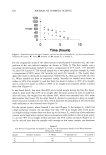
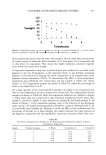
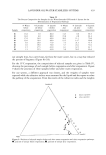
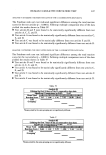
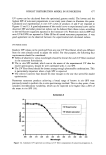
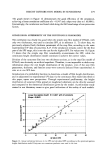
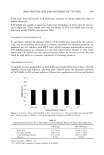
480 JOURNAL OF COSMETIC SCIENCE 120 i ß Calculated SPF with Gamma height distribution model 1øø 11 ii O Calculated SPF with the step film model -- Linear Correlation 80 -' 40. ß ß ß ß ß 10 20 30 40 50 60 20. 0 0 In Vivo SPF Figure 15. Comparison between in vivo SPF and calculated SPF through the two different models: the continuous film model (black triangles) and the simple step film model (empty squares). ACKNOWLEDGMENTS The authors thank Christine Bezot (Lab. Physique Mati•re Condens,e, UNSA-CNRS UMR 6622, Parc Valrose, Nice, France) and Olivier Brack (K.S.I.C. Statistique Indus- trielle, Neuvitec 95, 1 mail Gay Lussac, Neuville, 95015 Cergy Pontoise Cedex), for their excellent support in preparing this publication. REFERENCES (1) (2) (3) (4) (5) (6) (7) (8) (9) (10) (11) S. Brown and B. L. Diffey, The effect of applied thickness on sunscreen protection: In vivo and in vitro studies, Photothem. PhotobioL, 44, 509-513 (1986). A.D. Pearse and C. Edwards, Human stratum corneum as a substrate for in vitro sunscreen testing, Int. J, Cosmet. Sci., 15, 234-244 (1993). K.A. Kelley, P.A. Laskar, G. D. Ewing, S. H. Dromgoole, J. L. Lichtin, and A.A. Sakr, In vitro protection factor evaluation of sunscreen products, J. Sot: Cosmet. Chem., 44, 139-151 (1993). M. Stockdale, Sun protection factors, Int. J. Cosmet. Sci., 7, 235-246 (1985). R. M. Sayre, In vitro sunscreen testing: The vehicle effect, Cosmet. Toiletr., 107, 105-112 (1992). J. O'Neill, Effect of film irregularities on sunscreen efficacy, J. Pharm. Sci., 7, 888-891 (1983). L. Ferrero, A.M. Orcet, and L. Zastrow, Spectroscopy of sunscreen products: How to explain the special shape of UV curves obtained from in vitro SPF tests, Proceedings of the 20th IFSCC Congress, Cannes, France, Poster P028 (1998). L. Ferrero, M. Pissavini, and L. Zastrow, Spectroscopy of sunscreen products: How to use basic absorbance data, European UV Sun Filters Con•brence, Paris, November 3-4, 1999, pp. 52-64. B. L. Diffey and J. Robson, A new substrate to measure sunscreen protection factors throughout the ultraviolet spectrum, J. Sot: Cosmet. Chem., 40, 127-133 (1989). D. F. Tunstall, A mathematical approach for the analysis of in vitro sun protection factor measurements, J. Cosmet. Sci., 51,303-315 (2000). B. Herzog, Prediction of sun protection factors by calculation of transmissions with a calibrated step film model, J. Cosmet. Sci., 53, 11-26 (2002).

HEIGHT DISTRIBUTION MODEL IN SUNSCREENS 481 (12) L. Ferrero, M. Pissavini, S. Marguerie, and L. Zastrow, Sunscreen in vitro spectroscopy: Application to UVA protection assessment and correlation with in vivo persistent pigment darkening, Int. J. Cosmet. Sci., 24, 63-70 (2002). (13) T. R. Thomas, Rough Surfaces, 2nd ed. (Imperial College Press, 1998), pp. 91-104. (14) N. A.J. Hastings and J. B. Peacock, Statistical Distributions: A Handbook for Students and Practitioners (Butterworth Group, London, 1975), pp. 68-72. (15) B.L. Diffey, "Indices of Protection From In Vitro Assay of Sunscreens," in Sunscreens: Development, Evaluation, and Regulatory Aspects, 2nd ed., N.J. Lowe, N. A. Shaath, and M. A. Pathak, Eds. (Marcel Dekker, New York, 1997), pp. 589-600. (16) M. W. Brown, The sun protection factor: Test methods and legal aspects, S(SFW, 128, 10-18 (2002).
Purchased for the exclusive use of nofirst nolast (unknown)
From: SCC Media Library & Resource Center (library.scconline.org)