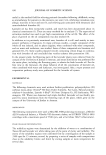
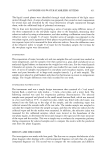
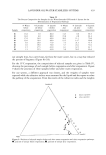
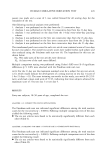
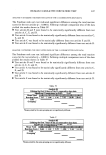
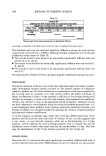
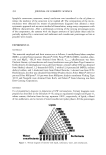
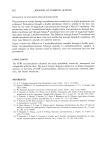
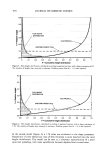
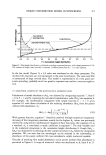
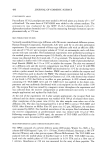
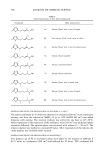
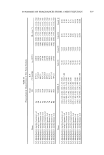
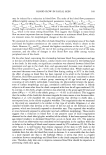
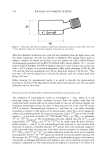
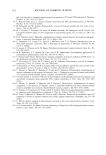
494 JOURNAL OF COSMETIC SCIENCE /•CHO R• 1 /•CHO R• CHO OH- Figure 1 O OH- Figure 2 NaBH4 NaOH/MeOH NaBH4 NaOH/MeOH Figure 3 2a-c 2a: Rl = H, R2 = CH3 2b: R• = H, R2 = C2H5 2c: R• = CH3, R2- CH3 3a,b 3a' R• = H 3b ß R• = CH3 4a-c 4a: R1 = H, R2 = CH3 4b: R1 = H, R2 = C2H5 4c: R1 = CH3, R2 = CH3 5a,b 5a:R• = H 5b: R• = CH3 These aldehydes were subjected to Claisen condensation with propanal, butanal, or 2-butanone to yield corresponding unsaturated aldehydes 2 (Figure 1) and ketones 3 (Figure 2). They were then reduced with NaBH 4 and converted to corresponding alco- hols 4 and 5 (Figure 3). Another group of alcohols was produced by first hydrogenating aldehydes 2a and 2c with the use of Pd/C (cyclohexene as hydrogen donor) to corresponding saturated alde- hydes 6 (Figure 4) and then by converting them into alcohols 7 by means of NaBH 4 (Figure 5), or by subjecting them to the Grignard reaction with CH3Mg J (Figure 6). The new synthesized furan alcohols possessed intensive floral fragrances with interesting side notes (Table I).

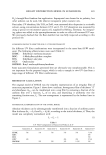
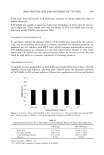
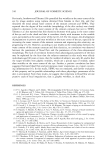
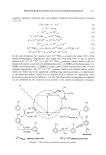
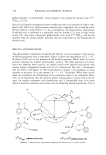
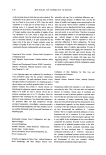
SYNTHESIS OF FRAGRANCES FROM 2-METHYLFURAN 495 /"•••CHO R• 2 Pd/C cyclohexene Figure 4 /••L•cH O R• 6a,b 6a:Rl=H 6b: Ri = CH3 /"•••'••CHO R• 6 NaBH4 NaOH/MeOH Figure 5 7a,b 7a: R1 = H 7b:R1 = CH3 /'•••CHO R1 CH3MgJ Figure 6 8a,b 8a:Rl=H 8b: Rl = CH3 EXPERIMENTAL The purity of the obtained new compounds reached 98% and their structures were confirmed by IR and Z H-NMR spectra. IR spectra were obtained with a Perkin-Elmer spectrometer (Model SP-1000). Gas chromatographic analyses were performed using a Perkin-Elmer chromatograph (Model 900) [column 1.8 m, LAC 2R, 15% on chromo- sorb WAW 60/80 mesh, temperature 80ø-195øC, argon as carrier gas]. Z H-NMR spectra were obtained with a Hitachi-Perkin-Elmer spectrometer R24A (80 MHz, CC14, TMS). The reactions were controlled by TLC developed with a 9:1 hexane-acetone mixture. The physicochemical characteristics of the new compounds are collected in Table II. GENERAL PROCEDURE FOR PREPARATION OF ALDEHYDES 2 AND KETONES 3 One cubic centimeter (1 cm 2) of KOH solution (1 g KOH + 6 cm 3 water) was slowly added to the mixture of selected aidehyde 1 (0.25 mole) and aliphatic carbonyl com- ponent (propanal, butanal, or 2-butanone, 0.35 mole), with intense cooling of the reactor. After the first exothermic reaction period, the remaining part of the KOH solution was slowly added to the reaction mixture. The temperature was kept under 30øC. The reaction medium was stirred for one hour at 30øC. After that time, water (50 cm 3) was added, and phase separation followed. The aqueous phase was extracted with toluene (2 x 50 cm•). The toluene solution was washed to a neutral pH value. The solvent was evaporated and the crude product was distilled under vacuum.
Purchased for the exclusive use of nofirst nolast (unknown)
From: SCC Media Library & Resource Center (library.scconline.org)