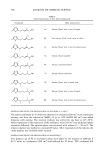
498 JOURNAL OF COSMETIC SCIENCE conversion of the initial aidehyde. The solid catalyst was filtered and the obtained solution was evaporated. The crude product was distilled under vacuum. GENERAL PROCEDURE FOR PREPARATION OF ALCOHOLS 8 The solution of aidehyde 7 (0.07 mole) in toluene (20 cm 3) was added dropwise to the solution of methylmagnesium iodide in THF (15 wt%, 60 cm 3) and toluene (60 cm3). The temperature of the reaction mixture was kept under 30øC. Stirring was continued over one hour at room temperature. Hydrolysis was carried out by means of 20% wt of aqueous acetic acid (25 cm3). The phases were separated. The aqueous phase was ex- tracted with toluene (25 cm3). The combined organic phases were washed to a neutral pH value and dried with anhydrous MgSO 4. After evaporation of the solvent, the crude product was distilled under vacuum. REFERENCES (1) J. Nowicki and J. G6ra, Po/ishJ. Chem., 65, 2263 (1991). (2) J. Nowicki and J. G6ra, Po/ishJ. Chem., 65, 2267 (1991). (3) J. Nowicki and J. G6ra, PolishJ. Chem., 67, 2073 (1993). (4) J. Nowicki and J. G6ra, Perfum. Flavor, 17, 29 (1992). (5) J. Nowicki and J. G6ra, J. Cosmet. Sci., 50, 91 (1999). (6) J. Nowicki and J. G6ra, J. Cosmet. Sci., 50, 99 (1999).

j. Cosmet. Sci., 54, 499-511 (September/October 2003) Relationship between physical parameters and blood flow in human facial skin KAZUE TSUKAHARA, YOSHINAO NAGASHIMA, SHIGERU MORIWAKI, TSUTOMU FUJIMURA, MICHIHIRO HATTORI, and YOSHINORI TAKEMA, Biological Science Laboratories, Kao Corporation, Tochigi (K. T., S.M., T.F., Y.T.), Health Care Products Research Laboratories II, Kao Corporation, Tokyo (Y.N.), and Skin Care Products Research Laboratories, Kao Corporation, Tokyo (M.H. ), Japan. Accepted for publication January 6, 2003. Synopsis We evaluated the association between the cutaneous blood flow and the three-dimensional morphology of the skin by measuring various aspects of blood flow (resting blood flow, mean blood flow during cooling, minimum blood flow during cooling, mean blood flow after cooling, and maximum blood flow after cooling) of the cheeks and foreheads of 40 healthy women (aged 60-77 years). We also analyzed the three-dimensional morphology of the skin surface (sWa, sWp, sWt, sWq) in replicas obtained from foreheads, cheeks, and other sites on the faces of those subjects. In addition, we measured the skin elasticity and water content of the stratum comeurn on the cheeks of those women. No correlation was observed between the parameters of the blood flow and the surface morphology of the forehead. On the cheek, however, significant negative correlations were observed between those parameters. Among the blood flow parameters, the resting blood flow and the mean blood flow during cooling showed particularly high correlations. Concerning the surface morphology parameters, high correlations were observed in parameters related to local changes such as sWp and sWt. None of the cutaneous properties examined (including the skin elasticity and water content of the stratum corneum) correlated with the blood flow or the surface morphology parameters of the cheek. Facial wrinkles are classified into linear grooves, which develop at the corner of the eye and on the forehead, and glyphic wrinkles, which develop as deep grooves in areas such as the cheek. These results suggest that a reduction in blood flow is one of the putative causes of local irregularities observed in the cheek, that is, the glyphic wrinkles, of elderly women. INTRODUCTION The morphology of the cutaneous surface has been studied by a number of investigators in the past (1-3). Those studies were carried out primarily to quantitatively evaluate age-associated changes in microreliefs or site-specific changes in the surface morphology Address correspondence and reprint requests to Yoshinori Takema. 499
Purchased for the exclusive use of nofirst nolast (unknown)
From: SCC Media Library & Resource Center (library.scconline.org)