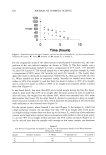
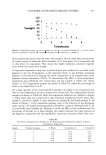
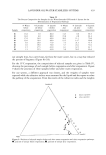
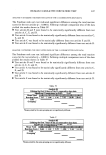
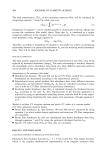
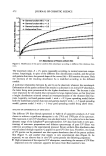
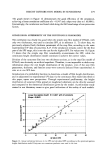
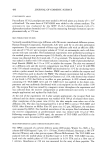
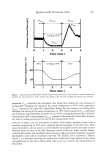
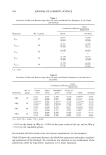
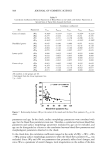
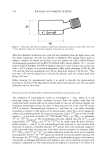
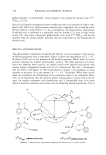
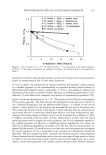
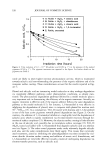
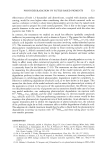
508 JOURNAL OF COSMETIC SCIENCE Table V Correlation Coefficients Between Parameters of Blood Flow in the Cheek and Surface Parameters at Several Sites of Facial Skin Around the Cheek Correlation coefficient# Site Parameters Fr•t F•nt•r_ L Frei n Fm• x Fpost_ L Corner of mouth sWa -0.382* -0.335* -0.237 -0.369* -0.322* sWp -0.279 -0.224 -0.130 -0.241 -0.195 sWt -0.290 -0.251 -0.158 -0.298 -0.241 sWq -0.363* -0.315' 0.214 -0.394* -0.398* Nasolabial groove sWa -0.045 -0.100 -0.089 -0.071 -0.032 sWp -0.110 -0.158 -0.173 -0.145 -0.118 sWt -0.084 -0.110 -0.100 -0.089 -0.055 sWq -0.055 -0.100 -0.095 -0.077 -0.045 Lower eyelid sWa 0.000 -0.032 -0.045 0.032 0.000 sWp -0.032 -0.063 -0.055 0.000 0.000 sWt -0.055 -0.095 -0.095 0.000 -0.032 sWq 0.000 -0.032 -0.055 0.032 0.000 Corner of eye sWa -0.063 -0.095 -0.095 0.032 -0.045 sWp -0.264 -0.253 -0.176 -0.212 -0.228 sWt -0.130 -0.126 -0.110 -0.032 -0.077 sWq -0.071 -0.100 -0.095 0.000 -0.045 All numbers in the groups are 40. # Calculated from the linear regression line. *p 0.05. y = 110.03 * 10^(4.1485e-3x) 200 r=- -0.394 150 ß ß • 50 o• 0 20 40 60 80 100 120 Blood flow parameterFm•, Figure 7. Relationship between sWq at the corner ofthe mouth and the blood flow parameter FE• in the cheek. parameters and age. In the cheek, surface morphology parameters were correlated with age, but the blood flow parameters were not. Therefore, a correlation between blood flow parameters and surface morphology parameters mediated by age can be excluded, and age can be disregarded as a factor in the correlation between blood flow parameters and morphological parameters observed in the cheek. In the cheek skin, the correlation coefficients ranged in the order of sWp sWt sWa sWq among surface morphology parameters when the blood flow parameter Fmi n was excluded. Since sWp and sWt are parameters that primarily reflect local changes, and since sWa is a parameter of overall changes, local irregularities on the surface of the skin

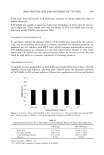
BLOOD FLOW IN FACIAL SKIN 509 may be induced by a reduction in blood flow. The order of the blood flow parameters differed slightly among the morphological parameters, being Finter_ L Fmi n Fres• Fpost_ L Fma x for sWp Finter_ L Frest Fmi n Fpost_ L Fma x for sWt and Frost Finter_ L Finax Fpost_ L Finin for sWa. Finter_L, which is the mean blood flow during cooling, showed high correlations with all morphological parameters. Fin•_ L was followed by F•s• , which is the mean resting blood flow. This suggest that changes in mean blood flow are more important than are changes in maximum or minimum blood flows, which are transient states, for morphological changes at the skin surface. We examined the extent of the effect of cheek blood flow at peripheral areas of the cheek and found the highest correlation at the corner of the mouth, which is closest to the cheek. However, Fr•s• and Fma x showed the highest correlations at this site. Fm• x is the maximum blood flow between the end of the cooling period and the end of the mea- surement, and the effect of changes in skin blood flow may differ among various peripheral sites of the cheek. On the other hand, concerning the relationship between blood flow parameters and age in the skin of elderly female subjects, similar results were obtained in the forehead and in the cheek. In this study, no significant correlation was observed between blood flow parameters and age in the cheek skin, and age-associated decreases were observed in blood flow parameter Fma x (p 0.05) only in the forehead skin. While marked age- associated decreases were observed in blood flow during cooling at 10øC in the cheek, the effect of aging on blood flow has been reported to be small in the forehead (15). Therefore, blood flow parameters in the forehead and in the cheek are considered to show different changes between a subject group consisting of all age levels and a group consisting of only elderly individuals. Concerning the relationship between the param- eters of surface morphology and age, correlation coefficients were smaller in elderly subjects in all areas other than the cheek compared with those for all ages combined (10). In contrast, in the cheek, a high correlation was observed in the group aged 60 years and above (sWp: r = -0.385 in the elderly group r = -0.433 in all subjects). This suggests that the surface of the cheek skin becomes irregular for some reason as one becomes older. Kligman et al. (24) classified the criss-cross patterns that develop in cheek skin, a sun-exposed area, in the elderly as glyphic wrinkles. The irregularities that we measured in this study are considered to be similar to that type of wrinkle. Kligman et al. also classified wrinkles that develop at the corner of the eye and on the forehead as linear grooves, which are chronically exposed to ultraviolet rays. They reported that wrinkles at sites chronically exposed to ultraviolet rays had a different morphology. These results suggest that a reduction in blood flow is one putative cause of local irregularities observed in the cheek skin (glyphic wrinkles) of the elderly. It has been reported that an age-related tendency to decreased blood flow occurs in facial skin (15). The putative cause of such an observation was considered to be hyperplasia in the capillary walls due to delays in the healing of blood vessel injuries caused by UV irradiation (25,26). On the other hand, it is well known that chronic exposure of the skin to UV leads to the appearance of wrinkles (27-29). Therefore, in facial skin exposed to UV, not only do wrinkles form but also the blood flow tends to decrease. It is conceivable that the cheek is a more exposed site than is the forehead. Hence, it seems that there is a higher correlation between morphology and blood flow in the cheek compared with other facial sites. Therefore, daily skin care to improve cutaneous blood flow should be important in preventing cheek skin aging.
Purchased for the exclusive use of nofirst nolast (unknown)
From: SCC Media Library & Resource Center (library.scconline.org)