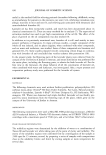
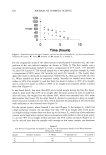
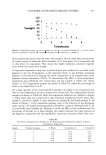
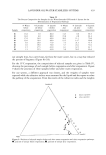
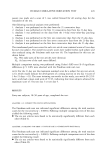
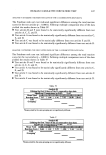
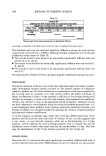
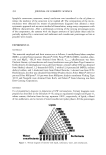
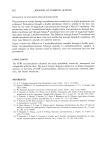
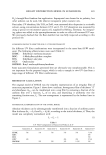
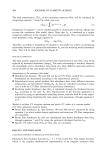
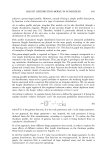
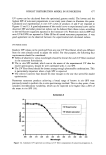
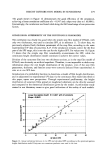
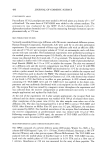
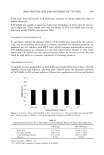
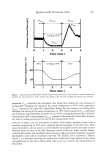
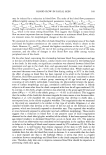
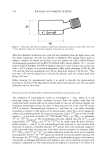
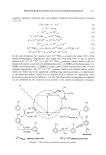
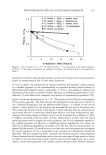
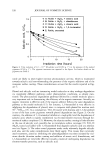
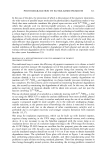
PHOTODEGRADATION BY RUTILE-BASED PIGMENTS 519 1.5 0 1.o _ 0 A: Rutile + AI203 + stearic acid ß • B: Rutlie + AI202 + dimethicone O C: Rutlie + AI203 + stearic acid -k D: Rutlie + AI203 + 1,3-butanediol ß E: Rutlie, uncoated O ,, ' ' • ' I • • ' ' I ' ' ' • I [ • ' • I ] ' ' ' I 0 5 10 15 20 25 Irradiation time [hours] Figure 2. Time evolution of 5.3 x 10- 4 M phenol (0.050 g 1 •) in the presence of the studied pigments (0.500 g 1 •). The pigment treatments are reported in the figure. For further details on the pigments see Table I. much more evident in that the photocatalytic activity of the stearic acid-coated pigments might be underestimated due to poor water dispersion. At least in theory, the combination of organic treatment and inorganic surface coating is a valuable approach in the manufacturing of pigments showing limited ability to photocatalytically degrade organic compounds (7). In fact, this approach combines the advantages of the organic treatment [higher efficiency in inhibiting photocatalytic deg- radation (7)] with those of the inorganic one [absence of degradation by-products (15)]. Figure 3 shows the degradation of 3.6 x 10 4 M salicylic acid (0.050 g/l) in the presence of the various pigments. The time scale for the degradation of salicylic acid is similar to that of phenol degradation, but the difference from Figure 2 is evident. In the case of Figure 3, naked futile (E) is the pigment that degrades salicylic acid at the lowest rate. The comparison between Figure 2 and Figure 3 clearly indicates that the treatments are much more effective in protecting phenol than salicylic acid from photocatalytic deg- radation. The results shown in Figure 2 and 3 can be accounted for as follows: (i) TiO 2 E (Aldrich untreated futile) has lower intrinsic photocatalytic activity than the naked futile specimens used to prepare the other pigments, and (ii) the treatments applied to the studied pigments are effective in inhibiting phenol degradation, but much less effective in inhibiting degradation of salicylic acid. The fact that the uncoated futile we adopted (Aldrich futile, E) would be less active than the futile specimens used to prepare the coated pigments (A-D) is reasonable if one considers the distribution of particle diameters. The data reported in Table I indicate that Aldrich uncoated futile (pigment E) has a bimodal particle distribution with a relevant percentage of large particles, which are likely to be less active than smaller particles due to lower surface area. As a conse- quence, futile-based pigments with smaller particle diameter than Aldrich uncoated

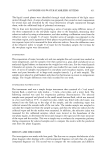
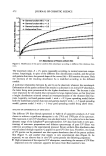
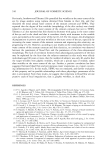
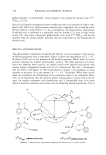
520 JOURNAL OF COSMETIC SCIENCE 1.5 ..• 1.0 ._o o 0.5 o A: Rutile + AI203 + stearic acid ß • B: Rutile + AI203 + dimethicone o C: Rutlie + AI20 • + stearic acid -k D: Ruffle + AI=Oa + 1,3-butanediol ß E: Ruffle, uncoated Irradiation time {hours} Figure 3. Time evolution of 3.6 x 10 -4 M salicylic acid (0.050 g 1 •) in the presence of the studied pigments (0.500 g 1-•). The pigment treatments are reported in the figure. For further details on the pigments see Table I. rutile are likely to show higher intrinsic photocatalytic activity, which is maintained towards salicylic acid notwithstanding the presence of the organic additives and of the inorganic surface coating. These considerations account for the results reported in Fig- ure 3. Phenol and salicylic acid are interesting model molecules as they undergo degradation via completely different pathways under photocatalytic conditions, as already men- tioned. The photocatalytic degradation pathway followed by a model molecule plays a very important role in determining the efficiency of the organic treatment. Actually, an organic treatment is effective only if the organic additive follows the same degradation pathway as the model molecule (15). For instance, 1,3-butanediol is very effective in inhibiting the degradation of phenol, since it competes with phenol for reaction with Ti•v-'OHs•rf (15). As a consequence, TiO 2 D (coated with alumina and 1,3-butanediol) is one of the least active pigments towards phenol degradation (see Figure 2). On the contrary, the addition of 1,3-butanediol inhibits at a negligible level the degradation of salicylic acid, which is mainly transformed via electron-transfer reactions through for- mation of surface complexes (15). Moreover, the alumina surface coating is little effective in the case of salicylic acid, possibly due to incomplete surface coverage (15). TiO 2 D (A1203-coated and added with 1,3-butanediol) thus degrades salicylic acid at a relevant rate (see Figure 3). The other coated pigments under study relevantly degrade salicylic acid also, and the same considerations most likely apply. This means that commonly used treatments, aimed at inhibiting the photodegradation reactions initiated by tita- nium dioxide (alumina surface coating and addition of stearic acid, dimethicone, and 1,3-butanediol) are very little effective towards a molecule undergoing degradation via electron-transfer processes, such as salicylic acid.
Purchased for the exclusive use of nofirst nolast (unknown)
From: SCC Media Library & Resource Center (library.scconline.org)