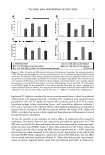
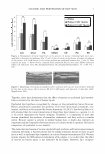
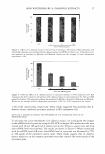
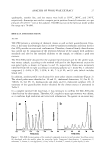
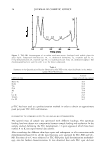
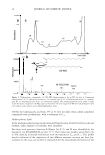
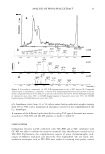
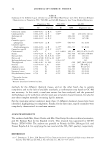
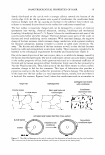
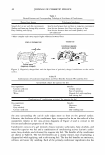
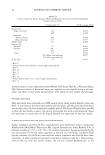
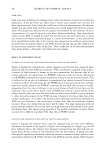
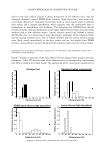
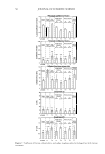
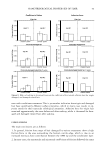
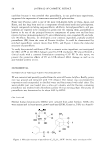
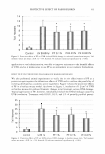
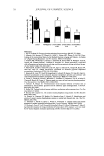
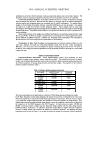
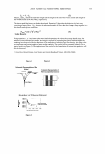
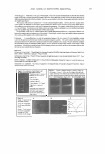
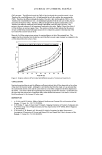
ANALYSIS OF WOOL-WAX EXTRACT 27 quadrupole, transfer line, and ion source were held at l 50°C, 280°C, and 230°C, respectively. Ammonia was used as a reagent gas in positive chemical ionization, at a gas pressure of 14.8· 10- 5 torr at the analyzer. The MS was run in the full-scan mode within the range m/ z 7 0-800. RES UL TS AND DISCUSSION TLC-FID TLC-FID permits a screening of chemical classes as well as their quantification. How- ever, it has some disadvantages due to its low-to-moderate resolution and from the fact that FID provides no structural confirmation. Therefore, chemical family identification was carried out by comparison of the retention behavior of the sample with authentic standards and also by the standard addition to the sample, to confirm a peak area increase. The TLC/FID profile obtained for the standard lipid mixture and for the amber wool- wax extract sample, according to the method indicated in the Experimental section for non-polar lipids, is shown in Figures la and 1 b, respectively. Peaks were tentatively identified from left to right according to increasing polarity as 1: mono-ES 2: unknown compound 3: di-ES 4: TG 5: FFA 6: AL 7: S 8: PL and 9: salts (which includes S-Sul) (23). In addition, another profile was obtained for more polar elution conditions (Figure 2). The eluted peaks were identified as: 10 and 11, cholesterol derivatives 12, Cer II 13, 7OH-S 14, Cer VI 15, hydroxyacids and diols and 16, cholesterol sulphate (23). A summary of the quantification results obtained for the chosen extract is presented in Table I. In a complex mixture like wool wax, it was necessary to confirm the TLC-FID peak identification by other means. Therefore, GC coupled to mass spectrometry was chosen, as it combines high resolution and structural information. To operate in an easier way, a 3 0.0 0.1 6 0.2 0.3 Time (min) 7 0.4 0.5 2j fi "C C :::, b o.o 0.1 0.2 0.3 Time (min) 9 0.5 Figure 1. TLC-FID chromatograms of the standard compound mixture (a) and an amber wool-wax extract (b) developed with the mobile phase for non-polar lipids. Compound identification: 1, monoesters 2, unknown 3, diester 4, triacylglycerol 5, fatty acids 6, alcohols 7, sterols 8, polar lipids 9, salts.

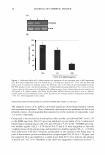
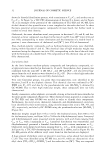
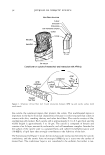
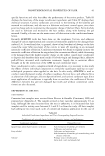
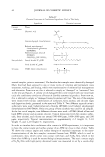
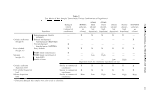
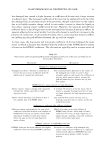
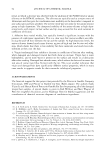
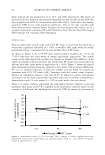
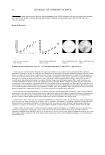
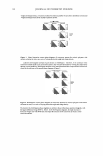
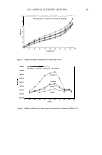
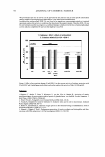
28 0.0 JOURNAL OF COSMETIC SCIENCE 10 11 D.1 0.2 0.3 T1me (min) 0.4 16 0.6 Figure 2. TLC-FID chromatogram of an amber wool-wax extract developed with mobile phase for polar lipids. Compound identification: 10, 11, cholesterol derivatives 12, ceramide type II 13, (7)-hydroxycholesterol 14, ceramide type VI 15, hydroxyacids and dials 16, cholesterol sulphate. The chromatogram has been scaled in order to see the minor compounds. Table I Summary of the Quantification Results Obtained by TLC-FID of the Identified Peaks in the Amber (polar) Wool-Wax Extract Chemical class Mono-Es Di-Es TG FFA AL s Cer II 70H-S Cer VI Content (mg/g of wool wax extract) 39.5 50.8 81.5 93.4 79.9 69.0 24.5 99.6 56.7 p-TLC has been used as a prefractionation method in order to obtain an approximate peak per peak TLC-FID confirmation. PREPARATIVE TLC COMBINED WITH TLC-FID AND GC-MS DETERMINATION The spotted mass of sample was optimized with different loadings. The optimum loading level was chosen as a compromise between sample loading and resolution. In the sample studied, following the TLC development, 11 spots appeared, which have been named A to K (see experimental data above). After scratching the different thin-layer spots and subsequent to silica extraction with chloroform/methanol (2/1), all the lipid fractions were analyzed by TLC-FID and GC- MS. Fractions A to C were subjected to TLC-FID polar lipid determination methodol- ogy, also for further characterization. It was observed that each TLC spot did not
Purchased for the exclusive use of nofirst nolast (unknown)
From: SCC Media Library & Resource Center (library.scconline.org)