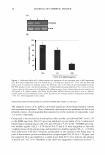
8 JOURNAL OF COSMETIC SCIENCE deficient mice display normal barrier repair kinetics, indicating that signalling pathways independent from IL 1-alpha predominate the barrier repair response, including stimu- lation of lipid synthesis (30). Taurine inhibits the activity of potassium ion channels (31). It has been shown that potassium ions inhibit permeability barrier repair (32). Therefore, taurine might regu- late barrier function by altering the intraepidermal transport of potassium ions. It has been shown that glycerol accelerates barrier recovery after acute disruption (33). However, the effect of taurine appears to be much more prominent because in this study a significant effect was observed at 1 % taurine in the presence of 2.5% glycerol. In contrast, the vehicle containing 2.5% glycerol alone had no significant effect on SDS- induced barrier perturbation. UV irradiation also triggers skin inflammation, barrier lipid synthesis, and taurine accumulation (7 ,34}. Therefore, future studies will focus on the effects of taurine on UV-induced skin irritation. CONCLUSION Our data suggest a role for taurine in preventing surfactant-induced dry and scaly skin by modulating the proinflammato ry response and stimulating epidermal lipid synthesis. Because barrier repair is diminished in aged epidermis (3 5 ), taurine might be especially useful to prevent surfactant-induced dry and scaly skin in the elderly. ACKNOWLEDGMENTS We thank Mrs. Christiane Bossmann-Tesch and Dr. Daniela Kessler-Becker from Hen- kel KGaA (Duesseldorf, Germany) for their excellent support with skin lipid analysis and in vitro skin irritation. We also thank Dr. Vera Meienschein, Dr. Thomas Gassen- meier, Dr. Ruediger Graf, and Dr. Michael Kock from Phenion GmbH & Co KG (Frankfurt, Germany) for their helpful discussions. REFERENCES (1) R.R. Warner, M. C. Myers, and D. A. Taylor, Electron probe analysis of human skin: Determination of the water concentration profile,]. Invest. Dermatol., 90, 218-224 (1988). (2) P. J. Caspers, G. W. Lucassen, E. A. Carter, H. A. Bruining, and G. J. Puppels, In vivo confocal Raman microspectroscopy of the skin: Noninvasive determination of molecular concentration profiles,]. Invest. Dermatol., 116, 434-442 (2001). (3) M. B. Burg, Molecular basis of osmotic regulation, Am. J. Physiol., 268, 983-996 (1995). (4) F. X. Beck, A. Burger-Kentischer, and E. Muller, Cellular response to osmotic stress in the renal medulla, Pflugers Arch., 436, 814-827 (1998). (5) M. V. Lobo, F. J. Alonso, A. Latorre, and R. Martin del Rio, Taurine levels and localisation in the stratified squamous epithelia, Histochem. Cell Biol., 115, 341-347 (2001). (6) G. Janeke, W. Siefken, S. Carstensen, G. Springmann, 0. Bleck, H. Steinhart, P. Hoger, K. P. Wittern, H. Wenck, F. Stab, G. Sauermann, V. Schreiner, and T. Doering, Role of taurine accumu- lation in keratinocyte hydration,]. Invest. Dermatol., 121, 354-361 (2003). (7) U. Warskulat, A. Reinen, S. Grether-Beck, J. Krutmann, and D. Haussinger, The osmolyte strategy

TAURINE AND PREVENTION OF DRY SKIN 9 of normal human keratinocytes in maintaining cell homeostasis,]. Invest. Dermatol., 123, 516--521 (2004). (8) H. Pasantes-Morales, C. E. Wright, and G. E. Gaull, Taurine protection of lymphoblastoid cells from iron-ascorbate induced damage, Biochern. Pharrnacol., 34, 2205-2207 (1985). (9) T. Arakawa and S. N. Timasheff, The stabilization of proteins by osmolytes, Biophys. ]., 47, 411-414 (1985). (10) P. M. Elias and G. K. Menon, Structural and lipid biochemical correlates of the epidermal permeability barrier, Adv. Lipid Res., 24, 1-26 (1991). (11) D. T. Downing, Lipid and protein structures in the permeability barrier of mammalian epidermis,]. Lipid Res., 33, 301-313 (1992). (12) M. Denda,J. Sato, Y. Masuda, T. Tsuchiya,]. Koyama, M. Kuramoto, P. M. Elias, and K. R. Feingold, Exposure to a dry environment enhances epidermal permeability barrier function,]. Invest. Dermatol., 111, 858-863 (1998). (13) I. R. Harris, A. M. Farrell, C. Grunfeld, W. M. Holleran, P. M. Elias, and K. R. Feingold, Perme- ability barrier disruption coordinately regulates mRNA levels for key enzymes of cholesterol, fatty acid, and ceramide synthesis in the epidermis,]. Invest. Derrnatol., 109, 783-787 (1997). (14) W. M. Holleran, K. R. Feingold, M. Q. Man, W. N. Gao, J.M. Lee, and P. M. Elias, Regulation of epidermal sphingolipid synthesis by permeability barrier function, j. Lipid Res., 32, 1151-1158 (1991). (15) P. G. van der Valk, J. P. Nater, and E. Bleumink, Skin irritancy of surfactants as assessed by water vapor loss measurements,]. Invest. Derrnatol., 82, 291-293 (1984). (16) L. C. Wood, S. M. Jackson, P. M. Elias, C. Grunfeld, and K. R. Feingold, Cutaneous barrier pertur- bation stimulates cytokine production in the epidermis of mice,]. Clin. Invest., 90, 482-487 (1992). (17) L. C. Wood, P. M. Elias, C. Calhoun, J. C. Tsai, C. Grunfeld, and K. R. Feingold, Barrier disruption stimulates interleukin-I alpha expression and release from a pre-formed pool in murine epidermis,]. Invest. Derrnatol., 106, 397-403 (1996). (18) S. Kondo, D. N. Sauder, T. Kono, K. A. Galley, and R. C. McKenzie, Differential modulation of interleukin-I alpha (IL-1 alpha) and interleukin-I beta (IL-1 beta) in human epidermal keratinocytes by UVB, Exp. Derrnatol., 3, 29-39 (1994). (19) J. N. Barker, R. S. Mitra, C. E. Griffiths, V. M. Dixit, and B. J. Nickoloff, Keratinocytes as initiators of inflammation, Lancet, 337, 211-214 (1991). (20) M. Denda, L. C. Wood, S. Emami, C. Calhoun, B. E. Brown, P. M. Elias, and K. R. Feingold, The epidermal hyperplasia associated with repeated barrier disruption by acetone treatment or tape strip- ping cannot be attributed to increased water loss, Arch. Derrnatol. Res., 288, 230-238 (1996). (21) T. Mosmann, Rapid colorimetric assay for cellular growth and survival: Application to proliferation and cytotoxicity assays,]. Irnrnunol. Methods, 65, 55-63 (1983). (22) P. W. Wertz, M. C. Miethke, S. A. Long, J. S. Strauss, and D. T. Downing, The composition of the ceramides from human stratum corneum and from comedones, j. Invest. Derrnatol., 84, 410-412 (1985). (23) M. K. O'Banion, V. D. Winn, and D. A. Young, cDNA cloning and functional activity of a gluco- corticoid-regulated inflammatory cyclooxygenase, Proc. Natl. Acad. Sci. USA, 89, 4888-4892. (1992). (24) H. Guizouarn, R. Motais, F. Garcia-Romeu, and F. Borgese, Cell volume regulation: The role of taurine loss in maintaining membrane potential and cell pH,]. Physiol., 523, 147-154 (2000). (25) G. K. Menon, K. R. Feingold, and P. M. Elias, Lamellar body secretory response to barrier disruption, J. Invest. Derrnatol., 98, 279-289 (1992). (26) M. Mao-Qiang, P. M. Elias, and K. R. Feingold, Fatty acids are required for epidermal permeability barrier function,]. Clin. Invest., 92, 791-798 (1993). (27) G. K. Menon, K. R. Feingold, A.H. Moser, B. E. Brown, and P. M. Elias, De novo sterologenesis in the skin. II. Regulation by cutaneous barrier requirements,]. Lipid Res., 26, 418-427 (1985). (28) M. M. Man, K. R. Feingold, C. R. Thornfeldt, and P. M. Elias, Optimization of physiological lipid mixtures for barrier repair,]. Invest. Derrnatol., 106, 1096--1101 (1996). (29) C. 0. Barland, E. Zettersten, B. S. Brown, J. Ye, P. M. Elias, and R. Ghadially, Imiquimod-induced interleukin-I alpha stimulation improves barrier homeostasis in aged murine epidermis, J. Invest. Derrnatol., 122, 330-336 (2004). (30) J. M. Jensen, S. Schutze, M. Forl, M. Kronke, and E. Proksch, Roles for tumor necrosis factor receptor p55 and sphingomyelinase in repairing the cutaneous permeability barrier, j. Clin. Invest., 104, 1761-1770 (1999).
Purchased for the exclusive use of nofirst nolast (unknown)
From: SCC Media Library & Resource Center (library.scconline.org)