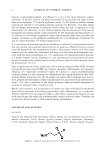
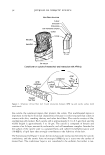
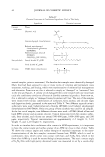
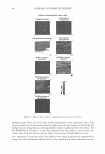
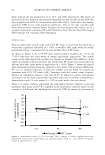
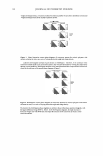
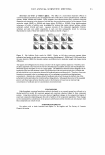
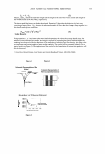
84 JOURNAL OF COSMETIC SCIENCE THE PHYSICAL CHEMISTRY OF HAIR FIBER ARRAY-WATER INTERACTIONS The problem Miklos M. Breuer, Ph.D. 1501 Beacon Street, Brookline, MA 02446 mbreuer@msn.com Fiber to fiber interactions are known to affect the behavior and esthetic attributes ofhair-do-s (coiffures). Whereas the effects of atmospheric on properties of single hair fibers have been extensively studied, the influence of humidity on inter-fiber interactions is still not well understood. Although wet-combing has being widely used as an empirical technique for evaluating hair damage and hair conditioning product efficacy, the physical chemical factors linking the experimentally measured combing forces with characteristic quantities of water-hair surface interactions, are still unknown. Similarly, the reasons for the tendency of long, straight hair to clump into unseemly, streaky bundles at high humidity are still unclear. In a recent publication in Nature, Jose Bico et al. 1 outlined a quantitative model linking the physical properties of fiber assemblies to their macroscopic behavior. I developed this model further and to applied it to specific practical problems that cosmetic scientists, who work on hair product development, encounter in their day to day work. Thus, in this paper I propose to describe the quantitative relationships that exist between the characteristic physico-chemical properties of single hair fibers ( e.g. fiber-surface energy, fiber- coarseness, fiber-rheology, hair fiber density, etc), and the behavior of hair fiber assemblies. In particular, I propose to discuss the effects of single fiber properties on a.) the wet-combing forces b.) the extent of clumping (i.e. splitting into bundles, average bundle size, etc.) that occurs especially when coiffures of long straight hair are exposed to atmospheric humidity, and c.) the amount of inter-fibrillar water that hair arrays absorb and retain at various humidity conditions. The Model Initially model looks at the behavior of two adjacent fibers with square cross-sections that are brought into contact with water (Figure l , 2). The fibers are made ofan elastic material having a bending stiffness ofK, and a surface energy ofy,. When brought into contact with water, owing to capillary forces, the two fibers will absorb inter-fibrillar water and stick together. (Fig 2) The length of the inter-fiber water column will be determined by an equilibrium between the capillary forces that pull the fibers together and the counteracting elastic bending forces that try to restore the fibers to their original configurations. (the magnitude of gravitational forces is negligible in this instance). The length of the inter-fiber water column will also depend on the thermodynamic potential (humidity) of the water in the surrounding atmosphere. The equations describing this model can be written as: (1) Where K, d, p, My, 9, R,T, hare the bending stiffness, the inter-fiber distance, the density of water, the surface energy of water, the contact angle of water on the fiber surface, the molecular weight of water, the gas constant, the absolute temperature and the atmospheric humidity, respectively. Furthermore, Ld, the length of dry section of the fiber is defined by

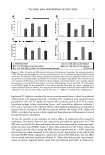
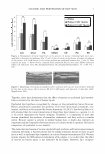
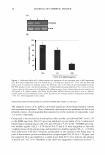
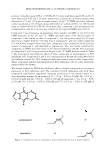
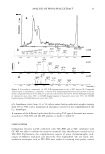
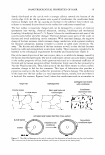
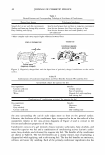
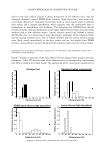
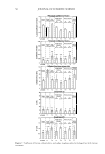
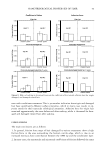
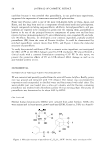
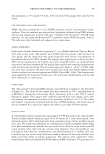
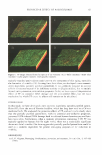
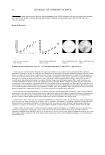
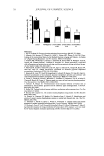
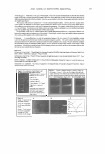
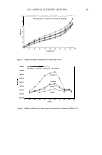
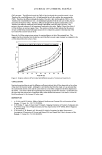
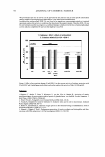
2005 ANNUAL SCIENTIFIC MEETING Ld = L-Lw (2) where L, and Lw denote the total fiber length and the length of the inter-fiber water column (the length of the wetted section of the hair fiber), respectively. The above model has been even further developed. Equation (3) describes the behavior ofa hair array consisting of many fibers. Nmax, denotes the maximum number of fibers that that clumps clump together in a hair bundle under given conditions: Nmax = (16 L 4 d2 y/9K) 113 Some Results (3) Using equations 1, 2, 3 and some other more detailed equations, the values the average bundle sizes, the amount of water absorbed per bundle, the energies required for separating hair fibers and hair bwidles by combing, have been calculated as functions of the atmospheric humidity, hair fiber density, hair fiber cross- sectional areas and contact angles of water on hair surfaces. The results will be presented in detail. (For a typical result, see Figure 3). The implication of the results for the formulation of various hair products, will also be discussed. l.) Jose Bico, Benoit Roman, Loie Moulin and Arezki Boudaoad, Nature, 432,690, (2004). Figure 1 Schematic Representation of the Model Hair fibers Figure 2 Schematic Repreaentatlon of Fibers (Longitudinal Sections) flll Lilf Number of Fibers /Strand lnter-flNr dl•t■nae (m•ter) Figure 3 85
Purchased for the exclusive use of nofirst nolast (unknown)
From: SCC Media Library & Resource Center (library.scconline.org)