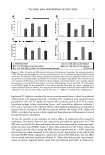
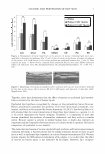
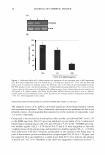
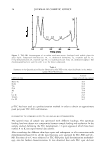
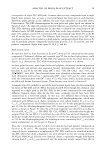
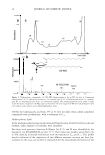
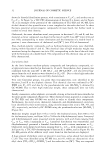
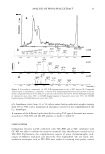
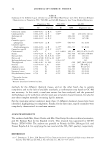
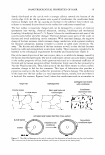
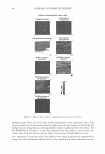
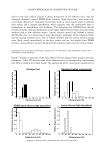
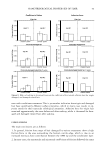
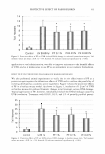
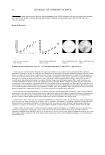
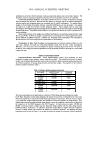
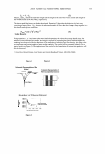
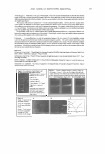
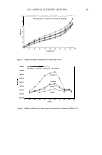
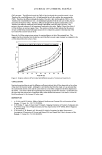
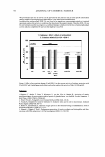
88 JOURNAL OF COSMETIC SCIENCE EFFECT OF OIL FILMS ON WATER VAPOR TRANSPORT INTO HUMAN HAIR ABSTRACT Yash K. Karnath, Ph.D., Karin Keis, Ph.D., and Craig L. Heummer TRI/Princeton, Princeton, NJ 08542 Sorption-desorption behavior of water vapor in human hair treated with various oils has been investigated using the Dynamic Vapor Sorption (DYS) Analyzer. Results show that the equilibrium water uptake is lowered significantly (-3-5%) on oil-treated hair. Diffusion coefficients calculated from the data go through a maximum in 40-60% RH range, Diffusion coefficients are also lowered significantly on oil- treated hair, suggesting that the oil films offer additional resistance to diffusion. Hair treated with larger amounts of oil ( with thicker oil films) absorbs lower amounts of water at equilibrium and has lower diffusion coefficients compared to hair treated with smaller amounts of oil. Removal of oil film reinstates the original sorption behavior, suggesting that the transport of water vapor is affected by the oil film on the surface of hair rather than the oil absorbed into the hair. INTRODUCTION Oils are extensively used as hair dressings in many parts of the world. Vegetable oils such as coconut oil has been shown to have a beneficial effect in protecting hair from grooming damage. Oils are known to be good plasticizers and lubricants which can reduce abrasive damage in combing [l]. They can also reduce penetration of damaging surfactants into the hair. Earlier studies have shown that vegetable oils with saturated or mono-olefinic fatty acids penetrate in hair to a greater extent compared to oils with polyunsaturated fatty acids [2]. Hydrocarbon oils such as mineral oils do not penetrate into hair [3]. We were interested in investigating how penetrability of an oil is related to moisturizing of hair. For this purpose we have chosen three different oils, e.g., coconut, sunflower and mineral oils for this study. EXPERIMENT AL All treatments were performed on dark brown European hair from DeMeo Brothers Inc. of New York, N. Y. The oils used in this study were commercially obtained low viscosity mineral oil and coconut and sunflower oils. The oil loadings on hair were typically 0.1 mL per gram of hair, massaged into the hair tress to attain a uniform distribution. The tresses were allowed to remin at roopm temperature for 24 h prior to starting the sorption-desorption experiment with the DYS. In some cases the tress was heated with a blow dryer at medium heat to promote the penetration of oil into the hair. In one specific experiment oil loading was increased to 1.2 mL per gram to deposit thick films of oil on the hair surface. Whenever necessary, oil films were removed from the hair by wiping with an acetone saturated wipe. Sorption-desorption experiments were conducted with the DYS instrument (Surface Measurement Sytems) at 25°C. The sample size was about 25 mg of hair cut in the form of snippets. Sorption-desorption cycle was confined to 0-95%RH in steps of 10% in the 0-90%range. The moisture regain was expressed as percent based on the dry weight of hair. RESULTS AND DISCUSSION Typical sorption --desorption isotherms are shown in Figure 1. It is clear that the equilibrium uptake of oil is significantly lowered by the application of oil. The differences between the oils were relatively small. This shows that deposition and penetration of oil into hair affects the accessibility of hair to water vapor. Although the differences between the oils are small, mineral oil seems to sorb the least amount of water compared to, for example, the coconut oil. The non-penetrating mineral oil is likely to have thicker films on the surface compared to coconut oil which is absorbed into the hair. The diffusion coefficients calculated from the sorption experiment are shown in Figure 2. Diffusion coefficients for all the samples go through a maximum, suggesting that the diffusion is likely to be proceeding through the cell membrane complexes between the cortical cells. Water molecules diffuse into the matrix of the cortical cells through the CMCs. The overall diffusion coefficient depends on whether the diffusion is controlled by the matrix or the CMCs. At low humidity, because the cells are not swollen, the

2005 ANNUAL SCIENTIFIC MEETING 30 -.------------------------------, 25 20 E 15 10 10 _._ Untreated -+- coconut _,.__ mineral ...... sunflower 20 30 40 so Target RH(%) 60 70 80 Figure 1. Sorption-desorption isothenns of oil-treated hair at 25°C 1.60E-09 1AbE-119 1.20E-09 1.00E-119 8.00E-1D 6.00E-10 4.00E-10 2.00E-10 O.OOE+-00 0 ---control -+-coconut ..,._mineral --sunflower 10 20 30 40 50 RH(%) 60 70 80 90 100 9D 100 Figure 2. Diffusion coefficients of water vapor in oil-treated hair as a function of RH at 25°C 89
Purchased for the exclusive use of nofirst nolast (unknown)
From: SCC Media Library & Resource Center (library.scconline.org)