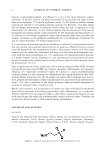
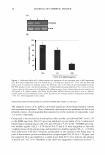
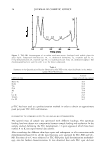
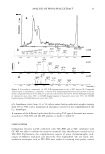
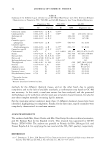
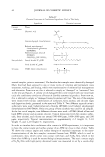
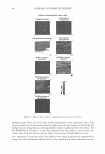
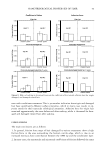
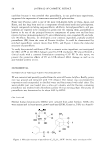
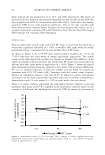
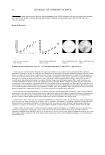
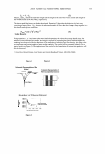
90 JOURNAL OF COSMETIC SCIENCE CMCs are open. The diffusion through the CMCs is fast, but through the unswollen matrix is slow. Therefore, the overall diffusion is slow. At high humidity the cells are swollen, thus narrowing the CMCs. Therefore, the diffusion through the matrix of the cells is fast, but through the CMCs is slow. Therefore, the overall diffusion is slow. At intermediate humidities both the cells are swollen, but not excessively to block the CMCs. Therefore, diffusion through both the matrix and the CMCs is fast. Therefore, the diffusion coefficient passes through a maximum in this RH range (40-60%). This pattern is observed in almost all the experiments conducted in this study. Figure 3 shows the effect of oil film thickness on moisture regain of hair. The sorption isothenns clearly indicate that the amount of water sorbed by hair treated with larger amount of oil is reduced to a greater extent than that of the hair treated with a smaller amount of oil. Removal of oil films using acetone restores the sorption behavior to that of the untreated hair. This suggests that the oil absorbed into the hair has very little effect on water vapor transport as compared to the oil films deposited on the surface of hair. 30 -,--------------------------, 1--contrnl ....-0.1 mVg coc --0.1 mVg min -+-1.2 ml/g coc �1.2 mVg mini 25 20 10 10 20 4D 50 60 70 80 so 100 Target RH (%) Figure 3. Sorption isotherms of hair treated with different amounts of coconut and mineral oils. CONCLUSIONS Sorption-desorption behavior and the diffusion coefficients indicate that oil films deposited on the surface of hair lower the moisture uptake. Although it is not entirely clear from this study, we can speculate that the oil penetrated into the cortex and the cuticle have less of an effect compared to the films deposited on the surface. They seem to block the oil molecules from entering into the fiber structure. Oil absorbed into the cortex does not seem to have a significant effect, either because the amount is too small or it does not block the pathways for the transport of water vapor. REFERENCES 1. A. S. Rele, and R. B. Mohile, Effect of Mineral, Sunflower and Coconut Oils on Prevention of Hair damage, J. Cosmet. Sci. 54, 175-192 (2003). 2. S. B. Hornby, Y. Appa, S. Ruetsch and Y. Karnath, Mapping Penetration of Cosmetic Compounds into Hair Fibers Using Time-of-Flight Secondary Ion Mass Spectrometry (TOF-SIMS), IFSCC Magazine, 8, 99-104 (2005). 3. S. B. Ruetsch, Y. K. Karnath, A.S. Rele and R. B. Mohile, Secondary Ion Mass Spectrometric Investigation of Penetration of Coconut and Mineral Oils into Human Hair Fibers: relevance to Hair Damage, J. Cosmet. Sci. 52, 169-184 (2001).

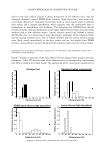
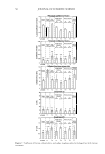
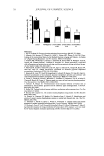
2005 ANNUAL SCIENTIFIC MEETING THE BIOLOGICAL CONSEQUENCE OF PEROXYNITRITE FORMATION IN INFLAMED SKIN Daniel Maes1, Ph.D., I. Sente2, D. Collins1, E. Pelle1 and Lieve Declercq2, Ph.D. 1 Estee Lauder Companies, Melville, NY 2 Estee Lauder Companies, Oevel, Belgium Introduction: Exposure to the environment (UV, smoke, pollution and Ozone), has been shown to initiate the release of inflammatory mediators in the skin, which ultimately will degrade the extra cellular matrix via the activation of metalloproteases. [ l] During this process of inflammation, specialized cells secrete reactive oxygen and nitrogen species that are intended to eliminate infectious agents from the skin. Activated macrophages and neutrophils concurrently generate high levels of superoxide (OZ-) and nitric oxide (NO ), which rapidly combine to form the highly reactive oxidant peroxynitrite (ONOO"). [2-3-4] Peroxynitrite can damage nucleic acids, lipids, and more importantly proteins with obvious consequences regarding the enzymatic activity in the skin leading to a significant reduction of some of the cells' most important defense mechanisms. [5] Interaction of peroxynitrite with proteins: Once formed, peroxynitrite interacts with proteins in many different fashions, from the non-specific fragmentation, reaction with suphydryl groups such as cysteine and methionine to reaction with aromatic amino acids such as tyrosine. Several in vitro assays were used to assess the effect of peroxynitrite. The Abel® antioxidant assay was used to measure peroxynitrite scavenging capacity of raw materials. A nitrotyrosine Elisa assay measures the nitrosylated end-products formed during the reaction between a protein's tyrosine moiety and peroxynitrite. An enzyme activity assay was used to assess the physiological impact of peroxynitrite damage to a protein. This allowed us to develop a model for measuring the extent of protein damage after reaction with peroxynitrite. In addition we were able to evaluate the effectiveness of known antioxidants in preventing protein damage as well as enzyme deactivation induced by peroxynitrite. Results: Peroxynitrite generated by SIN-I induced the nitrosylation of Bovine Serum Albumin (BSA) in a similar manner to a peroxynitrite salt, allowing us to use SIN-I as a peroxynitrite donor for the rest of our experiment. Similarly, ex vivo exposure of a Stratum Comeum extract to SIN-I induced the formation of nitrotyrosine residues indicating that the stratum comeum proteins are sensitive to this type of peroxynitrite damage. Antioxidant enzymes such as catalase and super oxide dismutase were exposed to SIN-I, but only the tyrosine containing enzyme catalase was found undergo nitrotyrosine formation, simultaneously a significant reduction of the antioxidant activity of this enzyme was detected. Another important enzyme transglutaminase, which plays an important role in the terminal differentiation process of the epidermis, was found to be equally susceptible to nitrosylation. Antioxidants such as Grape seed extract and N-Acetyl Cysteine were shown to protect BSA against nitrosylation by SIN-I. Similarly, these antioxidants protected catalase from being deactivated by SIN-I. Finally, the catalase mimic Euk-134, a manganese complex, was found to be insensitive to SIN-I damage as it kept its antioxidant activity regardless of the presence of peroxynitrite. Conclusions: The experiments described herein provide a clear evidence that peroxynitrite formation in the skin can cause nitrosylation of proteins and as a result can lead to a significant loss of enzyme activity ( catalase). 91
Purchased for the exclusive use of nofirst nolast (unknown)
From: SCC Media Library & Resource Center (library.scconline.org)