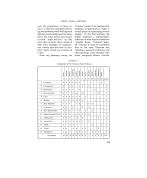
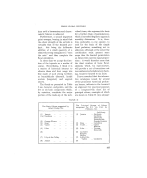
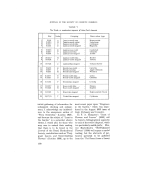
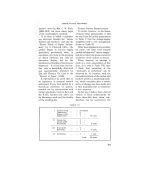
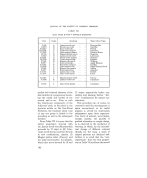
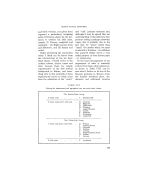
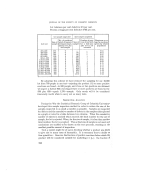
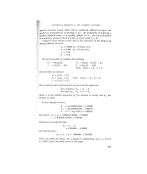
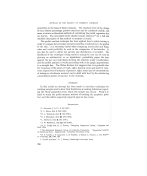
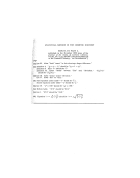
JOURNAL OF THE SOCIETY OF COSMETIC CHEMISTS methyl anthranilate, benzyl acetate and ionone, of which at least two items must be used for each named floral. With portions of these various substrata common to several basic odours, the colour analogy explains (at least to my satisfaction) certain aspects of the frequently encountered phenomena of odours "cancelling-out," the pro- duction of toneless nondescripts, and the devious approaches that may be made towards achieving a specific type of perfume. In fact, I think that the alternative routes to the tertiary colours provide a striking parallel with the matching ef a perfume, whereby two or more workers using different raw materials will arrive at an end-point, not necessarily exact, but fundamentally in agreement, between themselves and the original. SIMPLE FLORAL ELEMENTS We have seen from Table I that the members of this group of ancil- lary or secondary blossom odours are aggregates, built upon a substructure of primary fragrances and, in certain instances, usage is made of the judici- ous inclusion of strong osmophores. It is, therefore, at least instructive to attempt an investigation into the behaviour upon alignment of these perfumery "radicals" in order to learn what is evolved osmically, the extent of the permutations and, finally, whether or not there emerges from these combinations any regular aromatic grading or progression. For the purpose of the construction of Table IV, it is assumed that we have available the six "radical per- fumes," namely: (3) Jasmin (5) Neroli (9) Rose (warm) (13) Violet (17) Lilac (21) Lily (cold) of such a quality that these odours would be recognised without hesita- tion by any audience these per- fumes being approximately of the same odour strength and combined at first in equal proportions. The numerical indices are retained as a check against repetition therefore in the first column of Table IV we have observed the mechanism of the permutations. It is, however, of vital importance to pause here and first examine the outcome of the initial interblending which gives the diads, observing in passing that we have no descriptive nomenclature in perfumery to name the outcome of such simple odour combinations, although we know, from those who possess any measure of artistic feeling, that chords in music and colour-blending with only two components are for the most part •esthetically unsatisfactory. Exactly how far this analogy can be extended to perfumery depends, I believe, on what can be deduced from Table IV. From this it will be seen that from six components, fifteen combinations are possible, but it is probaNe that the only useful con- clusion which can be drawn is that some couplings (for instance, jasmin- violet, neroli-violet and rose-violet) are harsh and contrasting, and the violet element seems to be in more 188

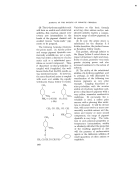
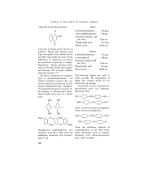
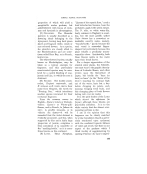
SIMPLE FLORAL PERFUMES TABLE IV The Diads, or combination sequence of two floral elements The Elements: (3) Jasmin, (5) Neroli, (9) Rose (warm) (13) Violet (17) Lilac (211 Lily (cold) 3/5 Jasmin-neroli (w) 3/9 Jasmin-rose (w) 3/13 Jasmin-violet 3/17 Jasmin-lilac 3/21 Jasmin-lily (s) 5/9 Neroli-rose 5/13 Netoil-violet 5/17 Neroli-lilac 5/21 Neroli-lily (w) (4) 9/13 Rose-violet 9/17 l•ose-lilac 9/21 l•ose-lily (3) 13/17 Violet-lilac (c) 13/21 Vio. letdily (c) (2) 17/21 Lilac-lily (c) (1) Total: ... (15) harmonious conjunction with lilac and lily. Furthermore, jasmin and neroli, in alignment with rose, give warm and quiet tonalities, while the lilac-lily grouping may be regarded as an agreeable presentation of cool, quies- cent odours. After due considera- tion, however, I think it more profit- able to consider the formulation of the triads, in accordance with Table V, which, it will be noted, com- mences with a combination of the "warm" (and postulated) radicals-- jasmin, neroli and rose. The change-ringing mechanism proceeding until the finality of the "cool" elements--violet, lilac and lily--is reached, is effected, it will be rioticed, in the comparatively short span of twenty movements. The final column of Table V is headed "Basic Odour Type," certain items in which are subsequently com- mented upon, but I would remark that this odour description should be regarded as tentative, in the same way in which, for instance, an aromatic chemical called "methyl linalyl ketone" might be described as "recalling the odour of Mitcham Lavender." A LITERARY DIGRESSION In parenthesis, I would state that, as a basis for inspiration and the 189
Purchased for the exclusive use of nofirst nolast (unknown)
From: SCC Media Library & Resource Center (library.scconline.org)