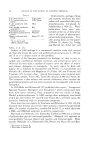
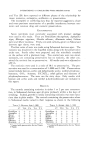
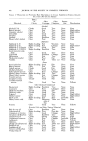
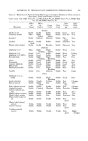
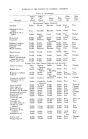
432 JOURNAL OF THE SOCIETY OF COSMETIC CHEMISTS DISCUSSION Wurster and Rath (21) showed that benzoic and salicylic acids formed complexes with Tween 20. Higuchi and Lach (22) studied complex forma- tion between benzoic, salicylic and p-hydroxybenzoic acids and Carbo- waxes. Wurzschmitt (23) states that condensation products of ethylene oxide with higher fatty alcohols form cation-active polyoxonium hy- droxides by dissociation in water which are capable of reacting with anions forming a stable cation-anion compound. Higuchi (24) has indi- cated that the hydrogen of the phenolic hydroxyl or of the acid carboxyl can react with the basic ether oxygen of the polyethylene glycol conden- sate, forming a complex. While complexing undoubtedly takes place, infrared transmission data do not support this contention when the ratio of preservative to nonionic is 1:10. However, when this ratio is changed to 1: 15 or more, other data not yet complete do indicate complexing. Even so, the complexing theory does not explain the failure of Carbowax 4000 to inactivate the preservative or the reason why oleic acid did in- activate it. There is also the possibility (25) that the higher solubility of an organic preservative in the fatty phase is aided by particular nonionics which in themselves may be more lipophilic than hydrophilic. If oils and non- ionics are colloidally dispersed, they can easily aid in transferring the preservative from the water to the fatty phase and leave the product un- protected. So, while complexing is an intriguing probability, and selective solu- bility of preservative in fats can reduce its concentration in water, one of us suggests another alternai:ive, namely, that the cation-anion complex of Wurzschmitt may dissolve in the fats preferentially and leave the media unprotected thus favoring microbial growth. SUMMARY In this report the common Spans and Tweens have been tested against seven microbials on Sabouraud dextrose agar at pH 5.6 using benzoic and sorbic acids and methyl p-hydroxybenzoate. Both benzoic and sorbic acids are useless in concentrations up to 0.2 per cent when incorporated into media containing all the common Tweens. Methyl p-hydroxybenzoate at the same concentration is somewhat in- activated but not to the extent of the two acids mentioned above. Some Spans when mixed with Tweens result in less interference with the preservative. The work of Bolle and Mirimanoff has been expanded. Complexing between the preservative and polyethylene glycol derira-

INTERFERENCE OF EMULSIFIERS WITH PRESERVATIVES 433 tives, is suspected, but does not account for the effect of Carbowaxes or oleic acid. Formation of an oil-soluble cation-anion complex of nonionic and preservative may render the preservative useless. REFERENCES (1) Griffin, W. C., and Rose, R. S., Proc. Sci. Sect. Toilet Goods Atssoc., No. 4, Dec. 6 (1945) Carter, P. J., and Griffin, W. C., •7. $oc. Cosmetic Chem., 1, 362 (1949) Griffin, W. C., y. Soe. Cosmetic Chem., 5, 249 (1954) Hadgraft, J. W., y. Pharm. & Pharmacol., 6, 816 (1954) Trinchieri, G., Arm. Dyestuff Rep., 41, 729 (1952) Harry, R. G., "Modern Cosmeticology," London, Leonard Hill, Limited (1955) Richards, R. M. E., and Whittet, T. D., Pharm. •7., 175, 141 (1955) "Cosme- tologie," Prod. Chim. Montagne Noir, Paris, France Texofors, "Nonionic Surface Active Agents," Glovers, Limited, Leeds, England "A Guide to Cosmetic Pharma- ceutical Formulations," Atlas Powder Company, Wilmington, Del. "Biological Bases for the Preparation of Cosmetics," Dehydag, G.m.b.H., Dusseldorf, Ger- many. Sabalitschka, Th., Pharm. Monatsh., 5, 235 (1924). Bohm, E., Pharm. Ztg., 74, 1670 (1929). Suess, A., Arm. Perfumer Essent. OilRev., 32, No. 6, 55 (1936). Neidig, C. P., and Burrell, H., Drug & Cosmetic Ind., 54, 408 (1944). Sokol, H., Drug Standards, 20, 89 (1952). Aalto, T. R., Firman, M. C., and Rigler, N. E., .7../lm. Pharm../lssoc., Sci. Ed., 42, 449 (1953). (6) Katz, K., and Lipsitz, A., ?. Bact., 33, 479 (1937). (7) Gershenfeld L., and Within, B., ,,/m. '7. Pharm., 113, 215 (1941). (8) Gershenfeld L., and Peristein, D., lb/d, 113, 89 (1941). (9) Allawala, N. A., and Riegelman, S., .7. Arm. Pharm. Atssoc., Sci. Ed., 42, 267 (1953). Fisher, C. V., ,4m. '7. Pub. Health, 32, 389 (1942). Youmans, A. S., ai•d Youmans, G. P., •7. Bact., 56, 245 (1948). Bolle, A., and Mirimanoff, A., ?. Pharm. & Pharmacol., 2, 685 (1950). Lawrence, C. A., and Erlandson, A. L., Jr., ?../lm. Pharm../lssoc., Sci. Ed., 42, 253 (1953). Erlandson, A. L., Jr., and Lawrence, C. A., Science, 118, 274 (1953). Sherwood, R. R., and Mattocks, A.M., ?. Arm. Pharm. Atssoc., Sci. Ed., 40, 90 (1951). Hadgraft, J. W., ?. Pharm. & Pharmacol., 6, 816 (1954). Shibasaki, I., and Terui, G., .7. Fermentation Technol. (Japan), 31, 28 (1953). Okabayashi, T., Ibid., 31,292 (1953). Plaxco, J. M., and Husa, W. J., A. Ph. A. Convention, Miami, Fla. (1955). Barr, M., and Tice, L. F., ./lm. •7. Pharm., 127, 260 (1955). Wurster, D. E., and Rath, D. W., A. Ph. A. Convention, Boston, Mass. (1954). Higuchi, T., and Lach, J. L., ?. Arm. Pharm. Atssoc., Sci. Ed., 43, 465 (1954). Wurzschmitt, B., Z. Atnal. Chem., 130, 2/3, 106 (1950). Oral communication. Atkins, F., Mfg. Chemist, 21, No. 2, 51 (1950). (2) (3) (3a) (4) (4a) (5) (10) (11) (12) (13) (14) (15) (16) (17) (18) (19) (20) (21) (22) (23) (24) (25)
Purchased for the exclusive use of nofirst nolast (unknown)
From: SCC Media Library & Resource Center (library.scconline.org)