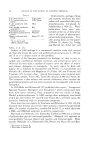
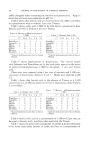
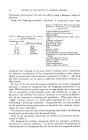
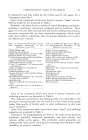
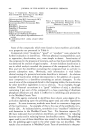
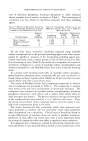
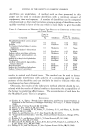
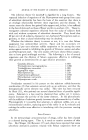
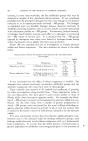
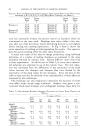
442 JOURNAL OF THE SOCIETY OF COSMETIC CHEMISTS dentifrices are undertaken. A method such as that presented in this paper can be used to evaluate dentifrices with a minimum amount of equipment, time and expense. A number of dentifrices can be compared simultaneously so that small variations among a group of dentifrices can be quickly resolved in favor of the one which is most likely to give favorable TABLE 9--COMPARISON OF MODIFIED CASEIN TEST RESULTS OF COMPOUNDS IN SOLUTIONs AND TOOTH PASTES Conc. in Solution, Conc. in Compound % Inhibition Pastes, % Inhibition Bis-05-hydroxyethyl) amino propyl tallow amide 0.1 Good 0.25 None Subtilin 0.1 Excellent 0.05 None N-(5mitro-2-furfurylidene)-l-amino hydantoin 0.1 Moderate 0.1 None 1,3-DiethyL2-dodecyl thiouronium bromide 0.1 Excellent 0.25 Slight Sodium tallow oxyethane sulfonate 0.1 Moderate 1.0 None Sodium phenyl polypropylene sul- fonate 0.1 Moderate 1.0 None Sodium di-n-hexyl-4-sulfophthalate 0.1 Moderate 1.0 Slight Tyrothricin 0.1 Excellent 0.05 Good 1,6-Di-4'-chlorophenyl diguanidino- hexane diacetate 0.1 Good 0.25 Slight Hexylresorcinol 0.1 Moderate 0.25 None Sodium di-(2-ethylhexyl) phosphate 0.1 Good 1.0 Good Sodium N-lauroyl sarcosinate 0.1 Good 2.0 None results in animal and clinical tests. The method can be used to detect unpredictable interference with activity of a promising agent by com- ponents of the dentifrice and can similarly be used to indicate when this interference has been eliminated. Obviously, the results of the laboratory method selected should be cor- related with the results of clinical studies to determine the acceptability of the former in predicting effectiveness. The accumulation of such data for the Modified Casein Test is in progress. REFERENCES (1) Easlick, K. A., Editor, "Dental Caries--Mechanism and Present Control Technics as Evaluated at the University of Michigan Workshop," St. Louis, C. V. Mosby Company (1948). (2) Gottlieb, B., •7- Dental Research 23, 169 (1944). (3) Pincus, P., Brit. Dental 7., 76, 231 (1944). (4) Martin, J. J., Isenberg, H. D., Schatz, V., Trelawny, G. S., and Schatz, A., Euclides (Madrid), 14, 311 (1954). (5) Schatz, A., and Martin, J. J., N.Y. State Dental 7., 21,367 (1955). (6) "Accepted Dental Remedies," 21st Ed., American Dental Association, Chicago (1956), p. 102. (7) Kitchin, P. C., and Robinson, H. B. G., 7. DentalResearch, 27, 501 (1948). (8) Manly, R. S., Ibid., 22, 479 (1943). (9) McCauley, H. B., Sheehy, M. J., Scott, D. B., Keyes, P. H., Fanale, S. J., and Dale, P. P., 7. Am. Dental Assoc., 33, 993 (1946). (10) Phillips, R. W., and Van Huysen, G., Am. Perfurner Essent. OilRev., 50, 33 (1948).

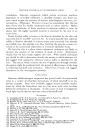
TREATMENT OF DANDRUFF AND SEBORRHEIC ERUPTIONS 443 (11) Fosdick, L. S., y./lm. Dental/lssoc., 40, 133 (1950). (12) McDonnell, C. H., and Domalakes, E. F., 5 e. Periodont., :23, 219 (1952). (13) Report of Evaluating Committee II, 5 e./lm. Dental/lssoc., 45, 16 (1952). Sulser, G. E., Lesney, T. A., and Fosdick, L. S., 5 e. DentalResearch, 19, 173 (1940). Ii1•I Barail, L. C., 5 e. Soc. Cosmetic Chem., 3,1 (1952). (16) Hill, T. J., 5 e./lm. Dental/lssoc. 48, 2 (1954). (17) "Clinical Testing of Dental Caries Preventives," American Dental Association, Chicago (1955). (18) Fosdick, L. S., y./lm. Dental/lssoc., 52, 9 (1956). (19) Fosdick, L. S., Calandra, J. C., Blackwell, R. Q., and Burrill, J. H., 5 e. DentalResearch, 32, 486 (1953). (20) Fosdick, L. S., Ludwick, W. E., and Schantz, C. W., 5 e./lm. Dental/lssoc., 43, 26 (1951). (21) King, W. J., U.S. Patent No. 2,689,170. (22) King, W. J., Manahan, R. D., and Russell, K. L., 5 e. Dental Research, 34, 703 (1955). (23) Forscher, B. K., and Hess, W. C., 5 e./lm. Dental/lssoc., 48, 134 (1954). (24) Brudevold, F., Little, M. F., and Rowley, J., Ibid., 50, 18 (1955). (25) Friedemann, T. E., and Graeser, J. B., 5 e. Biol. Chem., 100, 291 (1933). (26) Gershon, S. D., and Neiditch, O. W., U.S. Patent No. 2,723,217. (27) Zander, H. A., Lisanti, V. F., and Shiere, F. R., 5 e. DentalResearch, 30, 139 (1951). (28) Ludwick, W. E., Fosdick, L. S., and Schantz, C. W., 7./lm. Dental/lssoc., 43, 285 (1951). (29) Shiere, F. R., private communication. MODERN CONCEPT AND TREATMENT OF DANDRUFF AND SEBORRHEIC ERUPTIONS* By JOSEPH V. KLAUDER, M.D. Graduate School of Medicine, University of Pennsylvania, Philadelphia, Pa. PROBABLY NO common disorder of the skin has been subjected tO more controversy than dandruff. The controversy concerns the role several organisms, especially Pityrosporum ovale, play in its cause, the complexity of terms employed in its designation and the relation of dan- druff to seborrhea and baldness. Another aspect of dandruff of particular interest to members of this Society is the considerable time and money spent on the hair in its normal and abnormal state, and the number of prep- arations available in treatment of dandruff. DEFINITION OF TERMS Before reviewing investigations pertaining to dandruff, it is necessary to define terms since dandruff is intimately associated with seborrheic dis- orders. What is called dandruff by the laity and pityriasis simplex capitis in dermatologic nomenclature, refers to an incessant reproduction of variable degrees of dry, white or grayish scales on the scalp unaccompanied by inflammation. It should be noted that mild degree of scaling constitutes *Presented at the December 15, 1955, Meeting, New York City.
Purchased for the exclusive use of nofirst nolast (unknown)
From: SCC Media Library & Resource Center (library.scconline.org)