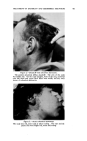
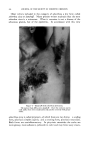
1ODOPHORE-IODINE SHAMPOOS 423 hair and scalp of both man and animals and are frequently transferrable from animal to human. Ringworm of the scalp occurs in humans most frequently in childhood. M. audouini is most often acquired from other infected children while infection with M. lanosum (canis) is acquired by contact with infected animals. Adults are relatively resistant to in- fection of the scalp, although in epidemics and in some areas, the number of adult cases may be fairly large. Diagnosis is best made by demonstrating the fungus in the hair or skin and by culture. The Wood's light (UV radiation) is valuable in locating and determining the extent of infection since some of the species of fungi causing infection fluoresce when this light is held close to the scalp in a semidark room. The two species of Microsporon differ considerably in their response to treatment. In both man and animals, M. lanosum (canis) infections usually respond more easily to topical application than the more resistant M. audouini infections. Treatments of scalp infections may be ex- radiations or manual epilation to remove the infected hairs, or local application of fungicides. Iodine as a germicide or fungicide on the hair and scalp has had a long and sporadic history. Time and again, as a tincture or as crystals in goose grease, oil or pretrolatum, iodine has been suggested for treatment of fungus infections. Its efficacy has been noted by a number of authors (23, 24), others have been less fortunate in its use (25). Unfortunately, iodine in most of these forms is quite irritating to the skin and damaging to the hair in addition it stains the hair and skin and is potentially harmful to the eyes. These limitations of iodine are minimized by the use of iodophor formula- tions. Kral (26) has employed an iodophor ointment* and lotion* in the treatment of ringworm infections of a large number of animals, including dogs, cats, horses, donkeys, monkeys and chinchillas. The ointment or lotion was rubbed into the affected area and its vicinity for a total of 3-5 applications, at one- to two-day intervals all of the cases were completely cured within twelve to twenty-six days. An iodophor-iodine shampoo formulation* was used as terminal treat- ment for ringworm infection (27) of dogs, cats and monkeys in the above cases. Prophylactic reapplication of the shampoo every two weeks for a period of three months eliminated reinfection of the animal from its living quarters, since spore survival is generally less than three months. Kra[ also suggests the use of iodophor-iodine shampoo in carriers (those in whom there are no clinically visible skin or hair lesions but on whom one can demonstrate fluorescence with the Wood's lamp), to eliminate sources * West Disinfecting Company, Long Island City, N.Y.

424 JOURNAL OF THE SOCIETY OF COSMETIC CHEMISTS of infection and of transmission from animal to animal or animal to human. Kral has reported (27) the characteristic fluorescence ceases one minute after applying the iodophor-iodine shampoo to isolated infected hairs. The fungus present in the hair is killed after an additional minute of con- tact according to his results. In addition to the veterinary use, both for terminal treatment and prophylaxis, the iodophor shampoo may have useful human applications, since prophylaxis is far easier than treatment. The iodophor shampoo is used in a double wash-up procedure, with the second shampooing following directly upon the first. The shampoo has been used over the whole body surface of a large number of animals, in- cluding dogs, cats and horses, and no toxic or irritant effects have been noted. Its action on the cat was especially studied because of the cat's habit of licking its fur, and thereby absorbing a relatively large amount of any substance which is applied to its skin and fur. No toxic effects of any type were seen, even with the cat. Formulations for cosmetic or shampoo purposes must be rigidly tested for their effects on the eyes and skin. The effects of the preparation on oral ingestion are generally included to round out the picture on toxicity, and to define the hazard of accidental oral ingestion. An iodophor-iodine shampoo formulation* (containing 1.5 per cent titratable iodine with nonionic surfactants) when tested for eye irritation by the Draize rabbit eye procedure (28) showed insignificant mild irritation of short duration. In the unwashed eyes this disappeared by the fifth day. Washing the eyes two and four seconds after instillation of the sham- poo decreased the irritancy, and all signs of mucosal irritation were gone by the second day. The iodophor-iodine shampoo formulation tested was therefore not an eye irritant, and it scored at least as well as other shampoos in common use. In contrast to this, a diluted Lugol's solution, of the same iodine content as the shampoo, was found to be a severe eye irritant, causing maximum damage to the cornea, iris and conjunctivae. The same iodophor-iodine shampoo when tested for skin irritancy on humans exerted a mild primary irritant action, ahd no signs of being a sensitizer. Decreasing the concentration of the product eliminated the primary irritancy entirely. The LD•0 value for rats for the iodophor-iodine shampoo was approxi- mately 10 cc./kg. according to current terminology (29) the shampoo may therefore be considered practically nontoxic. A toxicological study of the various carriers which may be used as a base for iodophor-iodine shampoos or other cosmetic formulations points to a number of interesting facts. There is considerable difference in the acute * West Disinfecting Company, Long Island City, N.Y.
Purchased for the exclusive use of nofirst nolast (unknown)
From: SCC Media Library & Resource Center (library.scconline.org)