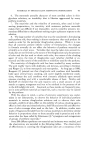
TREATMENT OF DANDRUFF AND SEBORRHEIC ERUPTIONS 45l ACIDITY OF THE SCALP AND DANDRUFF Explanation of itching of the scalp that may accompany dandruff is suggested by the studies of Bergeim and Cornbleet (21). They observed that the acidity of the scalp varied between pH 4.5 to $.$. There was some relation between acidity and itching the latter was often associated with low pH values and was alleviated when the scalp was washed with associ- ated rise in pH. No definite correlation of dandruff or other symptoms with acidity was noted. Of interest was their observation that growth of Micrococcus a/bus and aureus was inhibited at pH 5.4 by 0.025 normal volatile fatty acid. Few acid-susceptible organisms are included in the flora on the scalp. DANDRUFF AND BALDNESS It is interesting that Aristotle wrote that children, women and eunuchs do not become bald. Reference was, of course, made to the common bald- ness of men or calvities and not to loss of hair from other causes. Recession of hair on the temporo-frontal regions and vertex of the scalp, that characterizes the male pattern alopecia apparently is dependent upon' hormonal influences and inherited predisposition. Older beliefs that seborrhea and seborrheic disorders were causative agents are now less emphasized. Sabouraud expressed the opinion that increased sebaceous secretion led to hair loss. Seborrhea oleosa in the male has been attributed as a con- tributory cause of premature baldness in that sex. Apparently other factors are concerned since loss of hair does not result in all men who have oily seborrhea and this disorder in the female does not result in premature, baldness. Sabouraud's opinion is interesting in connection with the recent work of Flesch (22) who showed that squalene, a normal constituent of sebum, will cause reversible loss of hair when applied to the skin of rabbits. MODERN CONCEPT OF DANDRUFF AND SEBORRHEIC DISORDERS i do not believe it is the consensus that Pityrosporum ovale is a cause of dandruff. Dandruff is so intimately concerned with seborrheic eruptions that it is reasonable to ascribe it with seborrhea oleosa and seborrheic dermatitis to an abnormal state or functioning of the sebaceous glands. I think evidence suggests that Pityrosporum ovale and the ache bacillus regarded by Sabouraud as the microbacillus of seborrhea are saprophytic organisms that thrive on a greasy soil. It is difficult to separate dandruff in discussion of the seborrheic state and its disorders. As to their causes, dietary influence has long been emphasized more recently hormonal influence and vitamin deficiency have been stressed.

452 JOURNAL OF THE SOCIETY OF COSMETIC CHEMISTS HORMONAL INFLUENCES At puberty there is increased growth of the sebaceous glands with increase in the amount of sebum excreted to the skin surface. In the male this is attributed to the male hormones, testicular androgenic hormones, and in girls to increased androgens produced by the adrenals at puberty and at a later period to progesterone. The latter, like estrogen, is an ovarian hor- mone, but it possesses androgenic activity. Sebaceous gland hyperfunction, a characteristic of the seborrheic state, is apparently influenced by certain hormones. Ache vulgaris, a seborrheic disorder with its accompanying seborrhea oleosa and dandruff, is now regarded related to either excess of androgen or a disturbance of the nor- mal balance between androgens and estrogens. Pre-pubertal castrate and eunuchoid males do not develop seborrhea or acne spontaneously. How- ever, ache occurs following treatment with testosterone. Normal males and females may develop ache after treatment with large doses of testos- terone. I know of no data as to whether or not dandruff occurs in eunuchs or eunucholds. There is evidence, therefore, that androgen stimulates sebaceous gland activity and estrogen suppresses it hence, its favorable effect in treatment of acne vulgaris including the accompanying seborrhea and dandruff. According to Barber (23) local application of estrogen diminishes or abol- ishes dandruff. Disappearance of dandruff during pregnancy is attributed to the increase of circulating estrogen. Shapiro (23) reports favorable results from the use of topically applied estrogen lotion in treatment of six patients with premature baldness associated with dandruff and seborrhea. The lotion contained 1 mgm. of' sodium estrone sulfate per cubic centimeter in 70 per cent alcohol and was applied two to three times daily. The average dose was 4 to 5 mgm. per day. Therapy was continued from one to twelve months. No untoward reactions were observed. Regarding the use of estrogenic cream in treatment of dandruff, the study of Eller and Eller (24) of the effect of estrogenic cream was conducted on the smooth skin. In consideration of epidermal changes they observed it is not unreasonable that a far more reaching effect may result. In all probability the amount of estrogen required for local and con- tinuous use in treatment of dandruff would exceed "safe limits." Just what are these limits of dosage for a particular site, time interval and per- son, is not known. Moreover, estrogenic substances in adequate amount exert carcinogenic action in laboratory animals. DIETARY AND OTHER INFLUENCES Seborrheic disorders are apparently influenced by diet, hygienic care of the body, lack of exercise, fresh air, sunshine, infrequent bathing.
Purchased for the exclusive use of nofirst nolast (unknown)
From: SCC Media Library & Resource Center (library.scconline.org)