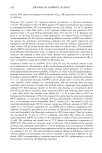
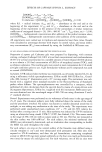
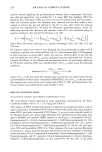
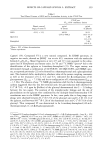
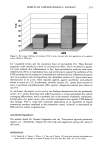
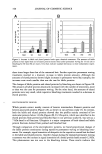
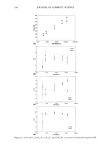
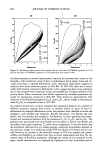
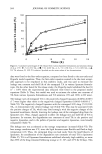
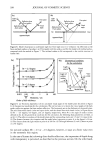
EFFECTS OF CAPPARIS SPINOSA L. EXTRACT 3 3 3 20 10 Figure 3. Percentage inhibition of erythema (P.I.E.) values obtained after skin application of tocopheryl acetate (TOC) or LECS gels. Ca2+-regulated events, and the respiratory burst of neutrophils) (41). These flavonol properties could contribute to their in vivo protective effect, which we observed, against UV-light induced skin inflammation in fact, lipid peroxidation products exert acute inflammatory effects in mammalian skin, and several papers support the usefulness of the UVB erythema test for evaluation of steroidal and nonsteroidal anti-inflammatory agents (42). In accordance with this hypothesis, the chloroform extracts of C. spinosa fruits were demonstrated to be active, when topically applied, against arachidonic acid-induced edema in mouse ear (43). Furthermore, alcoholic extracts of C. spinosa leaves proved to elicit a significant antiinflammatory effect against carrageenan-induced paw edema in rats (44). In conclusion, the present in vitro and in vivo findings demonstrate that the methanolic extract of C. spinosa flowering buds (LECS) possesses a strong antioxidant/free radical scavenging effectiveness, which is probably due to the presence of phenolic compounds. Furthermore, this polar extract gives excellent photoprotection against UVB-induced skin damage. Thus it could have important applications as an ingredient of topical cosmeceutic products employed in skin alterations caused, initiated, or exacerbated by ROS and free radical overproduction. ACKNOWLEDGMENTS The authors thank Dr. Rosario Cappadona and the "Cooperativa agricola produttori capperi a.r.l." (Pantelleria, Trapani) for their help and suggestions during the course of this work. REFERENCES (1) M. Podda, M. G. Traber, C. Weber, L. J. Yan, and L. Packer, UV-irradiation depletes antioxidants and causes oxidative damage in a model of human skin, Free Rad. BioL Med., 24, 55-65 (1998).

334 JOURNAL OF COSMETIC SCIENCE (9) (10) (2) Y. Shindo, E. Witt, D. Han, and L. Packer, Dose-response effects of acute ultraviolet irradiation on antioxidants and molecular markers of oxidation in murine epidermis and dermis,J. Invest. Dermato/., 102, 470--475 (1994). (3) J.J. Thiele, M. G. Traber, and L. Packer, Depletion of human stratum corneum vitamin E: An early and sensitive in vivo marker of UV induced photo-oxidation,J. Invest. DermatoL, 110, 756-761 (1998). (4) J.J. Thiele, C. Schroeter, S. N. Hsieh, M. Podda, and L. Packer, The antioxidant network of the stratum corneum, Curr. Prob/. Dermato/., 29, 26-42 (2001). (5) F. Bonina and L. Montenegro, In vivo evaluation of radical scavenger compounds in cosmetic formu- lations by means of skin reflectance spectrophotometry, SOFW-J., 122, 1-3 (1996). (6) A. Saija, A. Tomaino, D. Trombetta, M. Giacchi, A. De Pasquale, and F. Bonina, Influence of different penetration enhancers on in vitro skin permeation and in vivo photoprotective effect of flavonoids, Int. J. Pharm., 175, 185-199 (1998). (7) C. Saliou, M. Kitazawa, L. McLaughlin, J.P. Yang, J. K. Lodge, T. Tesuka, K. Iwasaki, J. Cillard, T. Okamoto, and L. Packer, Antioxidants modulate acute solar ultraviolet radiation NF-Kappa-B acti- vation in a human keratinocyte cell line, Free Rad. Bio/. Med., 26, 174-183 (1999). (8) C. Weber, M. Podda, M. Railis, J. J. Thiele, M.J. Trabber, and L. Packer, Efficacy of topical applied tocoferols and tocotrienols in protection of murine skin from oxidative damage induced by UV- irradiation, Free Rad. Bio/. Med., 22, 761-769 (1997). J. Lee and J. I. Youn, The photoprotective effect of 1,25-dihydroxyvitamin D3 on ultraviolet light B-induced damage in keratinocytes and its mechanism of action,J. Dermato/. SCI., 18, 11-18 (1998). C. Saliou, G. Rimbach, H. Moini, L. McLaughlin, S. Hosseini, J. Lee, R. R. Watson, and L. Packer, Solar ultraviolet-induced erythema in human skin and nuclear factor-kappa-B-dependent gene expres- sion in keratinocytes are modulated by a French maritime pine bark extract, Free Rad. BioL Med., 30, 154-160 (2001). (11) S.A.B.E. Van Acker, D. J. Van den Berg, M. N.J. L. Tromp, D. H. Griffoen, W. P. Van Bennekom, W.J.F. Van der Vijgh, and A. Bast, Structural aspects of antioxidant activity of flavonoids. Free Rad. Biol. Med., 20, 31•42 (1996). (12) T. Baytop, Therapy With Medicinal Plants (Past and Present) (Istanbul University Publications, Istanbul, 1984). (13) I. Calis., A. Kuruuzum, P. Ruedi, 1H-Indole-3 acetonitrile glycosides from Capparis spinosa fruits, Phytochemistry, 50, 1205-1208 (1999). (14) P. Yadav, S. Sarkar, and D. Bhatnagar, Action of Capparis decidua against alloxan-induced oxidative stress and diabetes in rat tissues, Pharmacol. Res., 36, 221-228 (1997). (15) P. Yadav, S. Sarkar, and D. Bhatnagar, Lipid peroxidation and antioxidant enzymes in erythrocytes and tissues in aged diabetic rats, Ind. J. Exp. Biol., 35, 389-392 (1997). (16) C. Gadgoli and S. H. Mishra, Antihepatotoxic activity p-methoxy benzoic acid from Capparis spinosa, J. Ethnopharmacol., 66, 197-202 (1999). (17) T. Lemmi Cena and P. Rovesti, Experimental studies on the cosmetological uses of Capparis. Riv. Ital. Essenze, Profumi, Plante, Off, Aromat., Syndets, Saponi, Cosmet. Aereosoh, 61, 2-9 (1979). (18) M. Rodrigo, M.J. Lazaro, A. Alvarruiz, and V. Giner, Composition of capers (Capparh spinosa): Influence of cultivar, size and harvest date,J. Food Sci., 57, 1152-1154 (1992). (19) M. Sharaf, M. A. E1-Ansari, and N. A.M. Saleh, Quercetin triglycoside from Capparis spinosa, Fitote- rapia, 71, 46-49 (2000). (20) A. Saija, A. Tomaino, R. Lo Cascio, D. Trombetta, A. Proteggente, A. De Pasquale, N. Uccella, and F.P. Bonina, Ferulic and caffeic acids as potential protective agents against photooxidative skin damage, J. Sci. Food Agric., 79, 476-480 (1999). (21) L. Montenegro, F. Bonina, and J. C. Dederen, In vivo protective effect of [3-bis(carboxyethyl) germa- nium sesquioxide,J. Soc. Cosmet. Chem., 47, 307-313 (1997). (22) P. Saturnino, A. Capasso, C. Saturnino, G. De Martino, N. Lozano Reyes, and R. Aquino, Flavonol glycosides from Aristeguetia discolor and their inhibitory activity on electrically-stimulated guinea pig ileum, Int. J. Pharm., 35,305-312 (1997). (23) P. Rapisarda, A. Tomaino, R. Lo Cascio, F. Bonina, A. De Pasquale, and A. Saija, Antioxidant effectiveness as influenced by phenolic content of fresh orange juices, J. Agric. Food Chem., 47, 4718-4723 (1999). (24) A. Saija, D. Trombetta, A. Tomaino, R. Lo Cascio, P. Princi, N. Uccella, F. Bonina, and F. Castelli, In vitro evaluation of the antioxidant activity and biomembrane interaction of the plant phenols oleuropein and hydroxytyrosol, Int. J. Pharm., 166, 123-133 (1998).
Purchased for the exclusive use of nofirst nolast (unknown)
From: SCC Media Library & Resource Center (library.scconline.org)