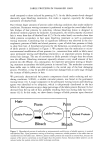
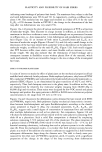
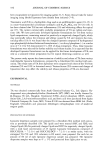
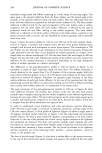
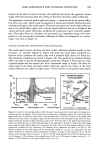
HAIR APPEARANCE AND INTERNAL STRUCTURE 401 APPENDIX CALCULATION OF VISUAL ANGLE BETWEEN FRONT AND BACK SURFACE REFLECTIONS The visual angle between the front and back surface reflections was obtained by the following numerical calculation. The geometrical conditions and parameters used for the calculation are defined in Figure 11. Figure 1 la shows the fixed parameters in the calculation. The angle of surface incline: Os -- 2.5 degrees. The distance between viewpoint (V) and model plate (the point V to A in the figure): dvA -- 30 cm. The distance from light source (L) to the point A: dLA = 100 cm. The angle between the imaginary lines L-A and A-V at the point A: OVAL = 45 degrees. The refractive indexes of the model plate (nl) and the surrounding media (nO) are fixed as 1.5 and 1.0, respectively. The thickness of the model plate (Dh) and the diameter of the spherical light source (DL) are fixed as follows: Dh = 0.01 cm (100 pm) and DL = 10 cm. The curl radius of the model plate (Rc) is varied in the calculation in Figure 10. The notations of the points on the geometry of the front and back surface reflections are shown in Figure 1 lb and 1 lc, and the distance between the points L and F and the angle between two lines L-F and V-F at the point F are described, for example, as dLF and OWL, respectively. Based on the geometrical conditions shown in Figure 11, the geo- metric equations are derived. In Figure 11, the following four equations are derived from Snell's law and the condition of specular reflection. These equations were solved using a personal computer utilizing the Newton approximation method. Specular reflection at the front surface: (Ovc• + O•vc) + Os = (O•c• + OcL?) - Os Refraction at the front surface (the incident light from the light source): nO sin (OcLx + OxcL - Os) = nl sin (OcxB - Os) 1 a) Fixed parameters Light source (L) D '\ ',,,,,, ......... View , '"',, &A ........ point ß '"'",, ,? '""' ........... ' ""= \ '"'"// A Center of the hair curl (C) lb) Front surface reflection L c 1 c) Back surface reflection Figure 11. Geometrical definitions and conditions for the calculation of the visual angle between the front and back surface reflections. (a) Fixed parameters in the geometry of the model plate, light source, and viewpoint. (b) Geometry of the front surface reflection. (c) Geometry of the back surface reflection.

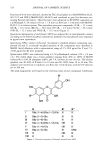
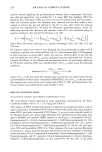
402 JOURNAL OF COSMETIC SCIENCE Specular reflection at the back surface: (0YcB + 0BYc) - Os = (0•cx + 0cx•) + Os Refraction at the front surface (the reflected light from the back surface to the view- point): nO sin (OYvc +Ovcv + Os) = nl sin (O•vc + Os) Finally, the visual angle between the front and back surface reflections (0v) was obtained as a function of the curl radius (Rc): OV = OFVC - OYVC ACKNOWLEDGMENTS The authors express their gratitude to Mr. Itomi Homma, Director of the Hair Care Laboratories of the Kao Corporation, for helpful discussions and guidance. Thanks are also due to Professor Keiji Uchikawa of the Tokyo Institute of Technology for helpful discussions on visual perception. REFERENCES (1) S. Nagase, S. Shibuichi, K. Ando, E. Kariya, and N. Satoh, Influence of internal structures of hair fiber on hair appearance I. Light scattering from porous structure of the medulla of human hair, J. Cosmet. Sci., 53, 89-100 (2002). (2) S. Nagase, S. Shibuichi, K. Ando, E Kariya, M. Okamoto, R. Yakawa, A. Mamada, and N. Satoh, Light-scattering control at the medulla enhances human hair shine: Internal structures of hair fiber and its shine (I), Proceedings of 21st IFSCC Congress, 153-159 (2000). (3) I. J. Kaplin, A. Schwan, and H. Zahn, Effects of cosmetic treatments on the ultrastructure of hair, Cosmet. Toiletrs, 97, 22-26 (1982). (4) S. Nagase, S. Shibuichi, M. Ohshika, M. Okamoto, Y. Masukawa, H. Shimogaki, H. Satoh, A. Mamada, and N. Satoh, Structure factors of hair fiber influencing beautiful appearance of hair: Internal structures of hair fiber and its shine (II), Proceedings of21st IFSCC Congress, P-36 in CD-ROM (2000). (5) M. Okamoto, A. Mamada, R. Yakawa, S. Inoue, S. Nagase, S. Shibuichi, and N. Satoh, Hole generation mechanisms in hair medulla and its repairing technique: Internal structures of hair fiber and its shine (III), Proceedings of21st IFSCC Congress, P-37 in CD-ROM (2000). (6) R. F. Stamm, M. L. Crarcia, and J. J. Fuchs, The optical properties of human hair. I. Fundamental consideration and goniophotometer curves, J. Soc. Cosmet. Chem., 28, 571-599 (1977). (7) R. F. Stamm, M. L. Crarcia, and J. J. Fuchs, The optical properties of human hair. II. The luster of hair fiber, J. Soc Cosmet. Chem., 28, 601-609 (1977). (8) H. K. Bustard and R. W. Smith, Investigation into the scattering of light by human hair, Appl. Optics, 30, 3485-3491 (1991). (9) W. Czepluch, G. Hohm, and K. Tolkiehn, Gloss of hair surfaces: Problems of visual evaluation and possibilities for goniophotometric measurements of treated strands,J. Soc Cosmet. Chem., 44, 299-318 (1993). (10) L.J. Wolfram and L. Albrecht, Chemical- and photo-bleaching of brown and red hair, J. Soc. Cosmet. Chem., 82, 179-191 (1987). (11) E. B. Goldstein, Sensation and Perception, 5 th ed. (Brooks/Cole, Pacific Grove, CA, 1999) pp. 215-241.
Purchased for the exclusive use of nofirst nolast (unknown)
From: SCC Media Library & Resource Center (library.scconline.org)