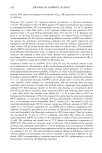
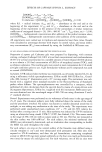
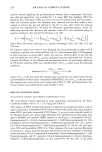
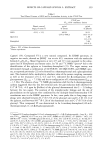
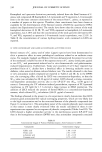
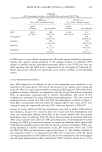
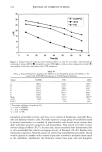
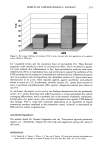
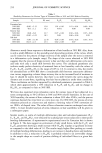
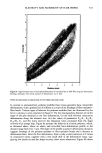
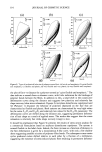
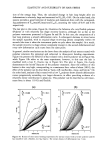
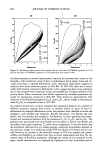
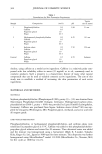
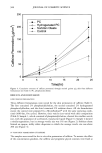
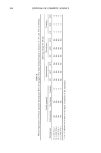
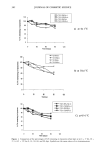
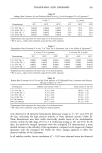
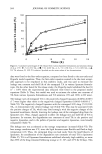
TRANEXAMIC ACID LIPOSOMES 385 indicated the stability of TA when entrapped in liposomes. Similar to the leakage rate constants, the degradation rate constants of total TA in liposomes and in the pellets of liposomes were accelerated as the storage temperature increased (Table V). In the in vitro release study, the release rate constants of TA from the 7:2:1(5% TA,+) and 7:2:1 (5% TA,-) liposomes (6.1-6.3 %/h •/2) were lower than the 7:2:1(10% TA,+) and 7:2:1 (10% TA,-) liposomes (8.1-8.6 %/h •/2, Table VI). Thus, the release rates of TA from liposome formulations were dependent on the initial TA concentrations and the hydrophilicity ofTA. TA is a hydrophilic drug with weak positive charge properties that can be incorporated in an aqueous layer of the multilamellar liposomes. In the negatively charged lip4somes {7:2:1 (5% TA,-) and 7:2:1 (10% TA,-)}, TA may interact with the surface charge of liposomal bilayers, resulting in the difficulty of TA to be released from liposomes (23,24). However, there were no significant differences in the release rates of TA from the positively and negatively charged liposomes (6.1-8.1%/h •/2 vs 6.3-8.6 %/h •/2, Table VI). Thus, the release rates of TA from liposomes were apparently inde- pendent of charges. The release rates of TA from the 7:2:1 (5% TA,+), 7:2:1 (10% TA,+), 7:2:1 (5% TA,-), and 7:2: ! (10% TA,-)varied between 6.1 and 8.6%/h •/2. In comparison, the respective release rates of TA from 5% and 10% solutions in DI water were 18.9% and 19.8%/h •/2. Thus, the release rates of TA from all liposome formulations were - 3 times slower than that from the solution. This suggests that all liposome formulations prolong and sustain the release of TA. CONCLUSION TA in all liposome formulations demonstrated relatively high chemical stability. The best formulation, evaluated from liposomal size, physical stability, leakage rate constant, shelf life, release rate, and the total amount of TA released, was found to be the negatively charged liposome with the 10% entrapped TA {7:2:1 (10% TA,-)}. In addition, TA entrapped in liposome formulations showed sustained and prolonged release, as their release rates were slower than that in the solution. We have previously found that the 7:2:1 (10% TA,-) liposome exhibited a relatively high percentage of entrapment of the drug (13%). The charges of liposomes appeared to affect the physical stability, leakage rate, and shelf life of TA in liposomes, whereas TA concentrations apparently affect the release rate of TA and the total amount of TA released from liposomes. It is a challenge for the future development of TA entrapped in liposomes, for parenteral and topical applications. The developed topical product of TA can function not only as a depot system but as a product with low irritation as well. ACKNOWLEDGMENTS The authors acknowledge Dr. Kuncoro Foe for his assistance in the preparation of the manuscript. We also acknowledge JJ-Degussa (T) Ltd., Thailand, for the gift of Emul- metik 950 ©, and Thistle Corp., Ltd. (Thailand) for the gift oftranexamic acid. We thank the Research and Development of Natural Products for Thai Traditional Medicines Research Unit, Pharmaceutical-Cosmetic Raw Materials and Natural Products Research

386 JOURNAL OF COSMETIC SCIENCE and Development Center, Institute for Science and Technology Research and Develop- ment at Chiang Mai University, for financial support. REFERENCES (1) A.D. Bangham, M. W. Hill, and G. A. Miller, "French Pressure Cell Liposome: Preparation, Prop- erties, and Potential," in Liposome Technology, G. Gregoriadis, Ed. (CRC Press, Boca Raton, FL, 1974), Vol. 1, pp. 37-49. (2) D. Lasic, Liposomes, Am. Sci., 80, 20-31 (1992). (3) M. Mezei, Delivering the good, Can. Pharm. J., 124, 132-155 (1991). (4) M. A. Soltan, M. A. Fadel, and W. I. Medhat, Prolonged effect of liposomes encapsula•ing pilocarpine HC1 in normal and glaucomatous rabbits, Int. J. Pharm., 198, 29-38 (2000). (5) N. Oku, Y. Namba, A. Takeda, and S. Okada, Tumor imaging with technetium-99m-DTPA encap- sulated in RES-avoiding liposomes, Nucl. Med. Biol., 20, 407-412 (1993). (6) I. Ogihara-Umeda, T. Sasaki, S. Kojima, and H. Nishigori, Optimal radiolabeled liposomes for tumor imaging, J. Nucl. Med., 37, 326-332 (1996). (7) C. A. Presant, R. T. Proflirt, and A. F. Turner, Successful imaging of human cancer with Indium-111 labeled phospholipid vesicles, Cancer, 62, 905-911 (1988). (8) C. A. Presant, D. Blayney, R. T. Proffitt, A. F. Turner, L. E. Williams, H. I. Nadel, P. Kennedy, C. Wiseman, K. Gala, and R. J. Crossley, Preliminary report: Imaging of Kaposi sarcoma and lymphoma in AIDS with indium-lll-labeled liposomes, Lancet, 335, 1307-1309 (1990). (9) A. Kubo, K. Nakamura, and T. Sammiya, Indium-lll-labeled liposomes: Dosimetry and tumor detection in patients with cancer, Eur. J. Nucl. Med., 20, 107-113 (1993). (10) G. Borea, L. Montebugnoli, P. Capuzzi, and C. Magelli, Tranexamic acid as a mouthwash in antico- agulant-treated patients undergoing oral surgery: An alternative method to discontinuing anticoagu- lant therapy, Oral Surg. Oral Med. Oral Pathol., 75, 29-31 (1993). (11) A. Tibbelin, R. Aust, M. Bende, M. Holgersson, B. Petruson, H. Rundcrantz, and U. Alander, Effect of local tranexamic acid gel in the treatment of epistaxis,J. Otorhinolaryngol. Relat. Spec., 57, 207-209 (1995). (12) N. G. Waly, Local anti-fibrinolytic treatment with tranexamic acid in hemophilic children undergoing dental extractions, Egypt Dent. J., 41, 961-968 (1995). (13) D. Mitsuhiro, K. Kenji, M. E. Peter, and R. Kenneth, Trans-4-aminomethylcyclohexane carboxylic acid (T-AMCHA), an anti-fibrinolytic agent, accelerates barrier recovery and prevents the epidermal hyperplasia induced by epidermal injury in hairless mice and humans,J. Invest. Dermatol., 109, 84-90 (1997). (14) MIMS Annual (Mealimedia International Group, Singapore, 1998), pp. 958-960. (15) Drug Facts and Comparison (Kluwer, St. Louis, 1999), pp. 394-395. (16) Martindale XXXI (Royal Pharmaceutical Society of Great Britain, London, 1996), pp. 771-772. (17) K. Maeda and M. Naganuma, Topical trans-4-aminomethylcyclohexane carboxylic acid prevents ul- traviolet radiation-induced pigmentation, J. Photochem. Photobiol. B, 47, 136-141 (1998). (18) British Pharmacopoeia (Her Majesty's Stationery Office, Norwich, 1998), pp. 1316-1317. (19) A. Manosroi, K. Podjanasoonthon, and J. Manosroi, Development of novel topical tranexamic acid liposome formulations, Int. J. Pharmaceut, 235, 69-70 (2002). (20) S. Atmaca, Spectrophotometric determination of tranexamic acid with 2,4,6-trinitrobenzosulfonic acid, Acta Pharm. Turcica, 31, 115-118 (1989). (21) S. Benira, J. D. Plenecassagne, G. Caves, D. Drouin, P. L. H. Dong, and D. Sincholle, Pilocarpine hydrochloride liposomes: Characterization in vitro and preliminary evaluation in vivo in rabbit eye, J. Microencapsul., 1,203-216 (1984). (22) M. N. Sarbolouki and T. Toliat, Storage stabilized MLV and REV liposomes containing sodium methotrexate (aqueous & lyophilized),J. Pharm. Sci. Tech., 52, 23-27 (1998). (23) N. E.-G. Omaina and H. H. Ahmed, Preparation and evaluation of acetazolamide liposomes as an ocular delivery system, Int. J. Pharm., 15, 121-127 (1997). (24) K. M. G. Taylor, G. Taylor, I. J. Kellaway, and J. Stevens, Drug entrapment and release from multilamellar and reverse-phase evaporation liposomes, Int. J. Pharm., 58, 49-55 (1990).
Purchased for the exclusive use of nofirst nolast (unknown)
From: SCC Media Library & Resource Center (library.scconline.org)