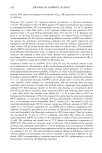
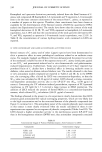
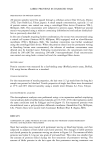
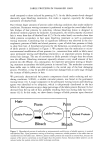
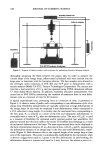
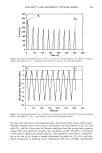
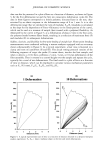
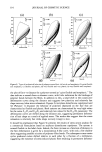
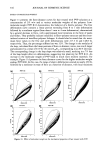
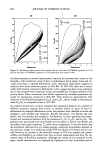
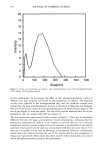
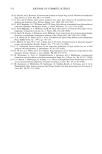
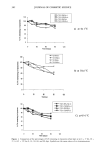
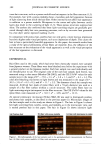
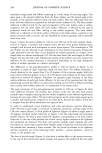
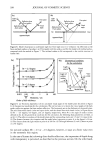
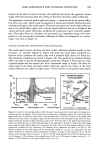
356 JOURNAL OF COSMETIC SCIENCE EFFECT OF MOLECULAR WEIGHT Figure 11 presents the force-distance curves for hair treated with PVP solutions at a concentration of 2% w/w and at various molecular weights of the polymer. Low- molecular-weight PVP K12 demonstrates the behavior of a brittle polymer. The first deformation curve contains a linear portion extending from 0 to 1 mm deformation followed by a nonlinear region (from about 1 mm to 4 mm deformation), characterized by a general decrease in force, with superimposed local variations in the form of peaks and valleys. They probably indicate instability in fiber-polymer structure and the stress- induced scission of interfiber polymer linkages. It should also be noted that the maxi- mum force values in the first and tenth deformations were 217.5 G and 148.8 G, respectively. Thus, the percentage stiffness loss was 32%. The change in the modulus of the loop, calculated from the linear portions of force-rs-distance curves, was much larger and amounted to a value of 0.19 for the ratio E•o/E •, corresponding to an 81% decrease. The corresponding change in the loop shape was relatively small, resulting in a 7% loss of the loop height after ten deformations, suggesting low plasticity for PVP K12. An increase in the molecular weight of PVP leads to much more resilient materials. For example, Figure 1 ld presents the force-distance curves for the higher-molecular-weight analog, PVP K60. In this case, the range of elastic deformation extends to nearly 450 G, followed by a nonlinear increase of force as a function of distance, with local variations (a) .v..-•= (•) .v..-• (c) .v..-=o 250 450 400 --/•-•" •"•'/ •0 2O0 / :• 300 150 • i • '•' •Z •ø ,oo t / 5o o o o 1 2 3 D•nce (mm} ) 0 1 2 3 4 1 2 3 Ol,•.ce {ram} D•t•ce Figure 11. Effect of molecular weight on the mechanical properties of hair treated with PVP.

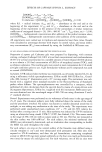
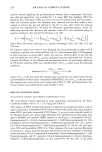
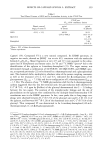
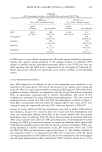
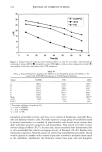
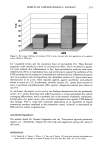
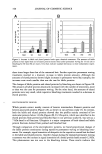
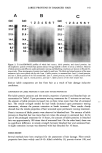
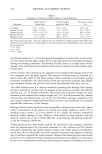
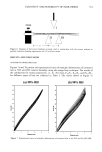
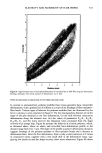
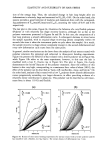
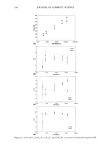
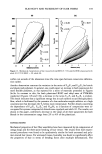
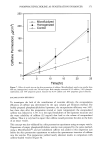
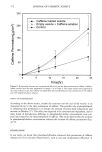
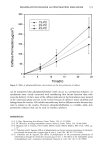
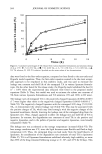
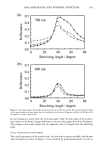
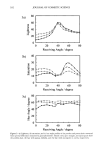
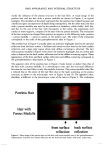
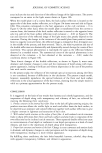
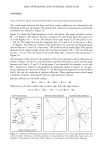
ELASTICITY AND FLEXIBILITY OF HAIR FIBERS 357 indicating some breakage of polymer-hair bonds. The maximum force values in the first and tenth deformations were 596 G and 521 G, respectively, yielding a stiffness loss of about 13%. The modulus loss was larger and resulted in a value of 0.33 for the ratio E•o/E•, a 67% decrease. Similar to PVP K12, the change in the dimensions of the hair loop after ten deformations was very small (7%). Figures 12a-12d present the plots of various mechanical parameters of PVP as a function of molecular weight. They illustrate (i) a large increase in stiffness, as indicated by the maximum in the force-vs-distance curves (a similar although not as pronounced increase in stiffness ratio, i.e., force measured at 1 mm deformation and standardized to untreated hair) (Figure 12a), (ii) an increase of both ratios F•o(max)/F•(max) and E•o/E • as a function of molecular weight (Figures 12b and 12c), and (iii) only a small change in the dimensions of the hair loop treated with a polymer with no dependence on the polymer's molecular weight, as reflected by the ratio H•o/H•, (Figure 12d). Such results suggest that PVP becomes stiffer, more elastic, and more flexible with an increase in its mo- lecular weight. The data also indicate that the elimination of bond breakage and a consequent increase in flexibility occurs without plastic flow of the material, which could inadvertently lead to an irreversible change in the size or shape of the investigated hair loops. EFFECT OF POLYMER PLASTICIZERS It is also of interest to study the effect of plasticizers on the mechanical properties of hair modified with relatively brittle polymers. Both employed polymers, ethyl ester of PVM/ MA copolymer (PVM/MA) and isobutylene/ethylmaleimide/hydroxyethylmaleimide co- polymer (IEHC) (Figure 1), are characterized by glass transitions of 102øC and 100øC, respectively. Thus, both hairspray resins are in the glassy state. In addition to this, they are characterized by relatively low molecular weights (ranging from 60,000 dl/g to 80,000 dl/g) and viscosities. These resins were designed for low-VOC aerosol and pump hairsprays and produce fine spray patterns in EtOH or EtOH-water solutions at polymer concentrations in the range from 3% w/w to 6% w/w. Figures 13a and 14a present the deformation curves obtained for hair treated with IEHC and PVM/MA, respectively. Both polymers display mechanical characteristics interme- diate between brittle/nonplastic and quite flexible/nonplastic according to the classifi- cation presented in Figure 9. Also, the calculated parameters, F•o/F•, E•o/E•, and H•o/H•, suggest only a small degree of conservation of maximum force and modulus after multiple deformations as well as low plasticity. For comparison, Figures 13b and 14b show the deformation curves of hair treated with the same polymers containing 41% oleth-lO as a plasticizer. Such a solid film composition is obtained by employing solutions containing 5.71% polymer and 4% of the plasticizer. The glass transition of a polymer blend of PVM/MA (59%)-oleth-10 (41%) was found to be -17øC by dif- ferential scanning calorimetry, indicating that such a polymer system is in the rubbery state (8). From the mechanical results, it is evident that both polymer systems become plastic as a result of the addition of a nonionic surfactant as suggested by a shift between subsequent deformation loops along the distance axis. The shift is clearly more pro- nounced for the ethyl ester of PVM/MA copolymer-oleth-10 system, with a significant proportion of the change in the shape of the loop recovering from deformation
Purchased for the exclusive use of nofirst nolast (unknown)
From: SCC Media Library & Resource Center (library.scconline.org)