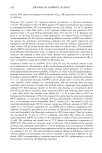
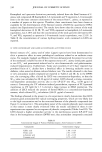
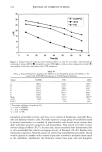
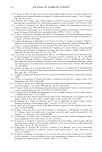
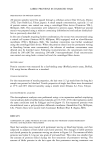
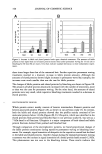
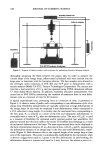
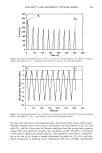
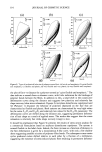
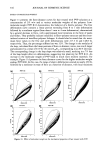
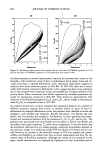
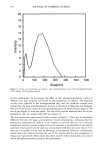
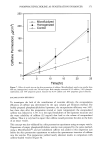
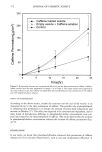
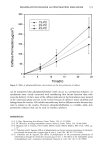
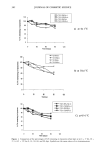
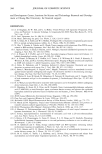
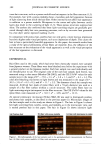
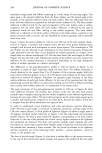
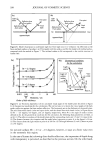
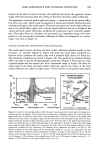
354 JOURNAL OF COSMETIC SCIENCE 400 300 250 - 200 ß t$O - tO0 , 50. 0 (a) F•--•-ø = 0.66 •" H•ø = 0.92 Hi t 2 3 4 Distance (ram) 600 5OO 400 2OO IO0 0 (b) .•o= 0.80 i 2 3 4 Distance (rn rn) (c) El0 4so -- = 0.85 H•o =0.81 H, 0 I 2 3 4 Distance (ram) F•ø = 0.99 HIø: 0.68 (d) .......... (e) Figure 9. Types of mechanical behavior of polymer-treated hair: (a) brittle and nonplastic (b) quite flexible and nonplastic (c) flexible and plastic (d) very flexible and very plastic (e) very flexible and nonplastic. the plot of force-vs-distance for a polymer termed as "quite flexible and nonplastic." The data indicate a smooth force-rs-distance curve, with little indication for the breakage of polymer bonds between the fibers. In addition to this, a small shift in the consecutive deformation curves along the distance axis suggests low plasticity and relatively fast shape recovery (slow stress relaxation). Figures 9c (acrylates dimethicone copolymer) and 9d (Polymer 1) illustrate the behavior of polymers deposited on the hair that are characterized as flexible and plastic. Both systems are characterized by very high values for the ratios F•o/F 1 and Eto/E • and relatively low values for the Hto/H • parameter. The deformation curves are shifted along the distance axis, suggesting permanent deforma- tion of hair shape as a result of applied stress. The results also suggest that the stress relaxation is relatively fast while shape recovery (creep) is slow. It should be emphasized that Figure 9c presents the results of stress-strain analysis for a commercial formulation based on acrylates dimethicone copolymer. The system is termed flexible in the label claim. Indeed, the force increase as a function of distance in the first deformation is given by a monotoneous S-like curve, with only a few shallow dents suggesting possible scissions of polymer fiber bonds. The subsequent stress-strain cycles produced curves shifted relative to each other by a fraction of a millimeter, suggesting the existence of stress-induced plastic flow resulting in permanent deforma-

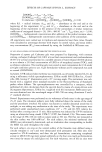
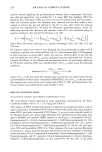
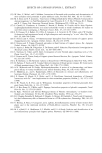
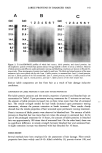
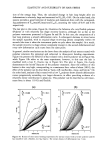
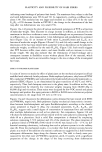
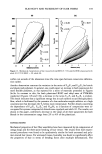
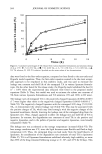
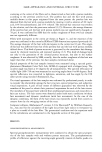
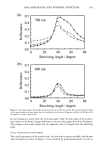
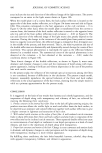
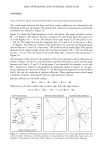
ELASTICITY AND FLEXIBILITY OF HAIR FIBERS 355 tion of the omega loop. Thus, the calculated change in hair loop height after ten deformations is relatively large and amounted to H1o/H • =0.81. On the other hand, this system provides a good retention of modulus and maximum force with the correspond- ing parameters of Flo(max)/Fl(max) and Elo/E • assuming the values of 0.85 and 0.39, respectively. The last plot in this series, Figure 9e, illustrates the behavior of a very flexible polymer (Polymer 2) with relatively fast shape recovery kinetics, although not as fast as the polymer treatments presented in Figures 9a and 9b. In this case, the compression of a hair loop produces a smooth deformation curve. A subsequent decrease in stress leaves the sample squashed, with its original shape recovering almost completely within l0 seconds (the time it takes the instrument probe to cycle above the sample). As a result, the sample recovers its shape almost completely (except in the second deformation) and every new deformation cycle starts from the same point. In general, similar conclusions can be drawn from the analysis of hair tresses treated with polymer solutions (by spraying) and subjected to three-point bending experiments. Figure 10a presents the behavior of hair treated with a brittle polymer (as in Figure 9a), while Figure 10b refers to the same experiment however, in this case the hair is modified with a low Tg fixative {as in Figure 9c). The plot in Figure 10a clearly demonstrates the brittle character of the polymer treatment. Since the stiffness of this hairset is also very high, corresponding to a maximum force value of about 300 G, the effect of the polymer can be described as "hard, stiff, nonflexible, crispy, and brittle." On the other hand, analysis of hair treated with a low Tg polymer shows smooth deformation curves progressively extending over larger distances, in effect providing evidence of a relatively minor contribution to plasticity. This polymer can be described as soft (maxi- mum force is about 110 G) and flexible. 300' 250' 150' (a) F•ø = 0.66 E•ø = 0.11 100' 5o[ .80 0. lOO 80 50 40 20 0 (b) F•ø -- 0.72 • E•o = 0.26 =o.7 0 1 2 3 4 5 6 2 4 6 8 10 Distance (ram) Distance (ram) Figure 10. Results of three-point bending experiments for (a) hair treated with a brittle polymer and (b) hair modified with a flexible, low Tg, fixative. The initial distance of deformation was 5 mm
Purchased for the exclusive use of nofirst nolast (unknown)
From: SCC Media Library & Resource Center (library.scconline.org)