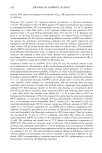
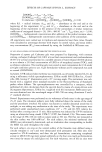
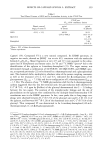
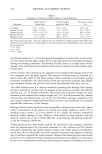
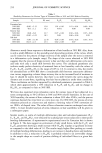
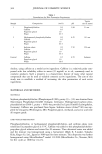
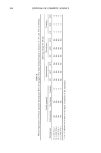
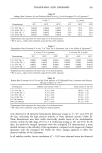
EFFECTS OF CAPPARIS SPINOSA L. EXTRACT 329 Table I Total Phenol Content of LECS and Its Antioxidant Activity in the UV-IP Test UV-IP test IC5o (95% confidence limits) Phenol content a pg/ml pg/ml (mg/g of extract b) of extract of phenols LECS 65.13 + 5.53 366.91 26.21 (270.2-498.2) (19.3-35.5) Quercetin 1.88 (1.3-1.9) Kaempferol 5.86 (4.9-6.3) Mean _+ S.D. of three determinations. Rutin equivalents. Capparis (34). Compound VI is a new natural compound. Its ESIMS spectrum, in negative ion mode, showed an [M-H]- ion at m/z 623, consistent with the molecular formula C28H32016. Major fragments at m/z 477 and 315 were assigned to the subse- quent loss of deoxyhexose and hexose units. Its 1H and •3C NMR • spectra* led to the identification of the aglycon as 6-methoxy-kaempferol (35). The sugar moiety was determined through a combination of 1D TOCSY, 2D DQF-COSY, and HMQC spec- tra, as reported previously (22) to be formed by a rhamnopyranosyl and a glucopyranosyl unit. The chemical shifts, multiplicity, absolute value of the proton coupling constants, as well as the resonance of C-2, C-3 and C-5, indicated the [3-configuration of D- glucopyranose (JH•-H2 = 7.5 Hz) and the or-configuration of L-rhamnopyranose (JH•-H2 = 1.5 Hz). The absence of any •3C NMR glycosidation shift for the L-rhamnopyranosyl carbons suggested that this was the terminal unit the glycosidation shift observed for C-2" (8 79.9, +4.9 ppm by [3-effect) of the glucosyl demonstrated the (1 2) linkage between the two sugars. The position of the interglycosidic linkage and the site of glycosidation on the aglycon were confirmed by the multiple bond heteronuclear C-H correlations seen in the HMBC spectrum. In fact, cross peaks due to long-range cou- plings were observed between H-i" (8 5.79) of the glucosyl unit and C-3 (8 132.1) of the aglycon, and between H-l"' (8 5.26) of the rhamnosyl unit and C-2" (8 79.9) of the glucosyl. Thus compound VI was determined to be 6-methoxy-kaempferol-3-O-c•-L- rhamnopyranosyl-( 1 - 2 )- [3-D-glucopyranoside. * Compound VI (6-methoxy-kaempJ•rol-3-O-t•-L-rhamnopyranosyl-(I-2)-13-D-glucopyranoside): 4 mg, R t = 10.8 min, UV )kma x (MeOH) 345.272 nm m.p. 240-242øC ESIMS m/z 623 [M-HI-, 477 [(M-H) - 146]-, 315 [(M-H)-(146 + 162)] •H NMR aglycon 8:8.10 (d, J = 9 Hz, H-2' and H-6'), 6.94 (d, J = 8.0 Hz, H-3' and H-5'), 6.24 (s, H-8), 3.91 (s-OMe), glucopyranosyl 8:5.79 (d, J = 7.5 Hz, H-i"), 3.66 (dd, J = 8.5 and 7.5 Hz, H-2"), 3.56 (t,J = 8.5, H-3"), 3.30 (t,J = 8.5, H-4", 3.24 (m, H-5"), 3.55 (dd, J = 12.0 and 4.5, H-6"a), 3.77 (dd, J = 12.0 and 3.0, H-6"b) rhamnopyranosyl 8:5.26 (d, J = 1.5 Hz, H-l"), 4.03 (dd, J = 2.5 and 1.5 Hz, H-2'"), 3.80 (dd, J = 2.5 and 8.5 Hz, H-3'"), 3.36 (t, J = 8.5 Hz, H-4'"), 4.08 (dd, J = 8.5 and 6.5 Hz, H-5'"), 1.00 (d,J = 6.5 Hz, Me-6'") •3C NMR aglycon 8:178.8 (C-4), 159.1 (C-2), 158.0 (C-7), 161.4 (C-4'), 150.0 (C-5), 158.8 (C-9), 132.1 (C-3), 123.1 (C-I'), 132.3 (C-2' and C-6'), 116.1 (C-3' and C-5'), 104.7 (C-10), 129.3 (C-6), 100.1 (C-8), 61.7 (-OMe) glucopyranosyl 8:99.9 (C-i'"), 79.9 (C-2"), 78.4 (C-3"), 71.7 (C-4"), 78.9 (C-5"), 62.3 (C-6") rhamnopyranosyl 8:102.3 (C-1'"), 72.3 (C-2'"), 72.0 (C-3"'), 74.1 (C-4'"), 69.7 (C-5'"), 17.1 (C-6'").

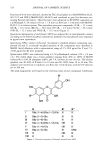
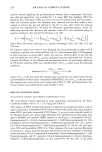
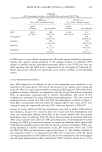
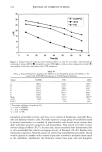
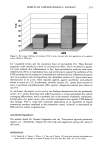
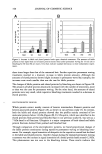
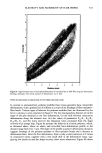
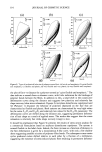
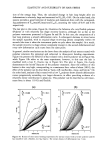
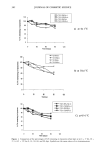
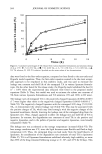
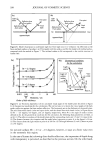
330 JOURNAL OF COSMETIC SCIENCE Kaempferol and quercetin derivatives previously isolated from the floral buttons of C. spi,osa and compounds III (kaempferol-3-O-rutinoside) and V (quercetin-3-O-rutinoside) seem to be the more constant constituents of the extracts from C. spinosa, as reported in a number of papers on this species. Therefore, these constituents have been chosen as standards for the determination of the flavonol content of LECS by quantitative HPLC analysis (see Experimental section). The results have shown that the content of the total kaempferol derivatives (I, II, III, VI, and VIII), expressed as kaempferol-3-O-rutinoside equivalents, was 3.28% and that the concentration of the total quercetin derivatives (IV, V, and VII), expressed as quercetin-3-O-rutinoside (rutin) equivalents, was 2.52%. In Table II the concentrations of various hydroxycinnamic acids contained in LECS are reported. IN VITRO ANTIOXIDANT AND RADICAL SCAVENGING ACTIVITIES OF LECS Several extracts of C. spinosa and of other Capparis species have been demonstrated to elicit a protective effect in some pathological conditions related to an oxidative stress status. For example, Gadgoli and Mishra (16) have demonstrated the protective activity of the methanolic soluble fraction of the aqueous extract of C. spinosa aerial parts against in vivo CCI 4- and paracetamol-induced and in vitro thioacetamide- and galactosamine- induced hepatotoxicity. Furthermore, Yadav and coworkers (14,15) have reported that powdered fruits of C. decidua have a beneficial effect in lowering oxidative stress in diabetes, when tested in alloxan-induced diabetic rats. The results obtained in the three in vitro antioxidant models employed are reported in Tables I and III. As to the DPPH test, the scavenging effect elicited by LECS was concentration-dependent, so that the SC5o value was calculated as 68.36 lng/ml of extract. LECS showed a strong, concentra- tion-dependent antioxidant activity also in the LP-LUV test (IC5o 32.98 lng/ml of extract). Concerning the UV radiation-induced peroxidation, exposure of PC liposomal membranes to UV light for 1.5 h elicited a large increase in MDA production. The addition of LECS reduced the amount of formed MDA in a concentration-dependent manner, which allowed IC5o calculation (366.91 lng/ml of extract). The findings obtained in the present in vitro experiments clearly demonstrate that LECS possesses good antioxidant/free radical scavenging properties, which are very likely due to the high concentration and to the structural features of the phenolic compounds (see Figure 1) contained in it. The antioxidant power of the complex phenolic pool contained in this extract is more clearly evidenced when the results calculated in these in vitro experiments are expressed as micrograms of phenolic compounds (Tables I and III). The LECS showed a higher antioxidant activity in the membranous system (LP-LUV test) than in the homogeneous solution (DPPH test) thus antioxidant compounds contained Table II Concentration (mg/g) of Various Hydroxycinnamic Acids Contained in LECS Compounds Concentration (mg/g) Caffeic acid 1.98 + 0.29 Ferulic acid 2.42 + 0.07 p-Cumaric acid 1.63 + 0.10 Cinnamic acid 0.75 + 0.01
Purchased for the exclusive use of nofirst nolast (unknown)
From: SCC Media Library & Resource Center (library.scconline.org)