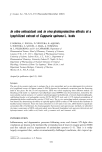
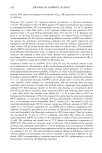
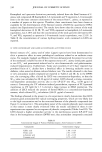
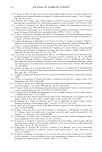
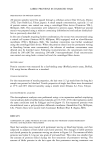
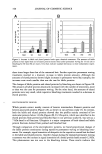
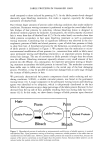
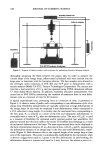
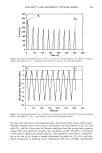
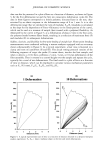
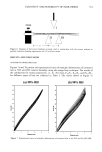
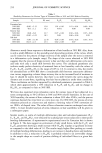
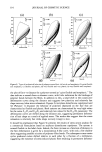
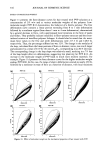
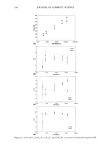
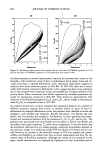
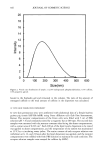
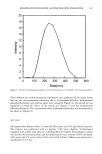
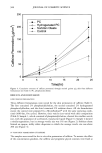
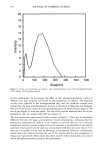
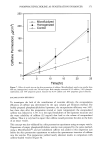
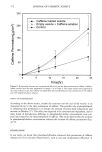
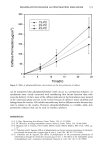
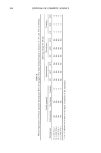
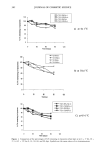
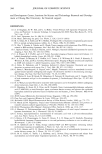
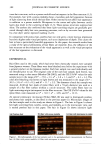
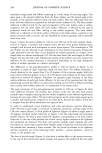
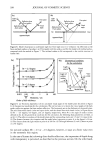
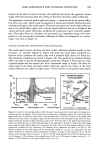
358 JOURNAL OF COSMETIC SCIENCE 800 700 600 500 o•400 3O0 2OO 100 0 1000 (a) 1. o8 (b) O45 04 035 O3 025 02 015 01 (c) .... 1 o9 3: o 85 10000 100000 1000000 MW (Daltons) 10000000 2.00% [35.71% 10000 100000 100o000 MW (Daltons) ß 2,00% E] 5.71% 100oo 1 ooooo 10000o0 MW (Daltons) o 8 ß 2.00% E]5.71% 075 lOOO 10000 100oo0 10o0000 10000o00 (d) MW (Daltons) Figure 12. (a) F• and F•o, (b) F•o/F •, (c) E•o/E•, and (d) H•o/H • as a function of molecular weight for PVP.

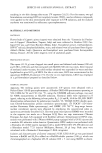
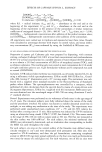
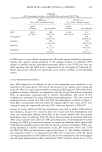
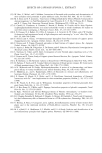
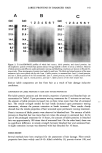
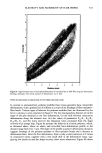
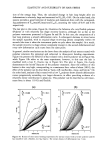
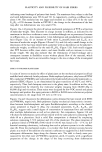
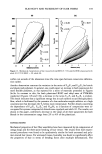
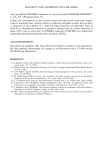
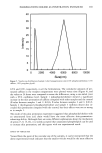
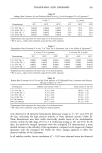
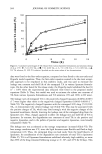
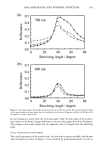
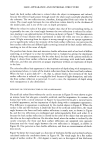
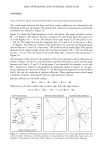
ELASTICITY AND FLEXIBILITY OF HAIR FIBERS 359 (a) (b) 600 600 1 F•ø = 0.49 H'ø = 0.87 S00 J • • il =0. 400 m = 0.73 200 100 0.95 0 , 0 I 2 3 4 5 o • 2 3 4 s Dis•n ce (m m) o•=ne (mm) Figure 13. Mechanical characteristics of hair treated with (a) IEHC (5.71%) and (b) IEHC plasticized with oleth-10 (5.71% IEHC + 4% oleth-10). within ten seconds of the relaxation time (the time span between consecutive deforma- tion cycles). Another observation concerns the variation in the ratios of Flo/F • and Elo/E • for brittle and plasticized polymers. In general, one could expect an increase in both parameters for more flexible polymers, as was reported for a series of materials presented in Figures 9a-9e. In contrast to this, for both plasticized IEHC and ethyl ester of PVM/MA copolymer (Figures 12b and 13b), a decrease in the ratios Flo/F 1 and Elo/E • is evident. This result indicates that a significant energy loss in such systems occurs through plastic flow, which is facilitated by the presence of a low-molecular-weight additive at a high concentration that decreases the Tg below room temperature. Further details concerning the dependence of F•o/F•, Elo/E l, and Hlo/H 1 as a function of composition were in- vestigated for systems comprised of dimethicone copolyols and oleth-10. The results, not shown in this paper, confirmed a decrease in the values of all three parameters for both blends in the concentration range from 2% to 4% of the plasticizer. CONCLUSIONS Mechanical properties of hair fiber assemblies have been measured by (a) compression of omega loops and (b) three-point bending of hair tresses. The results from both experi- mental procedures were found to be qualitatively similar for both untreated and poly- mer-treated hair tresses. For untreated tresses, humidity was found to significantly affect the properties of hair in terms of bending forces after multiple deformations. The
Purchased for the exclusive use of nofirst nolast (unknown)
From: SCC Media Library & Resource Center (library.scconline.org)