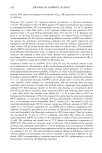
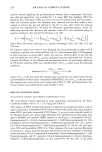
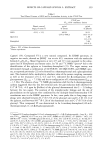
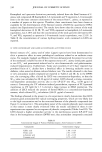
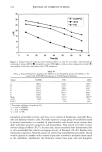
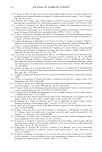
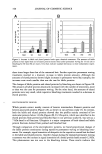
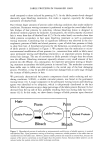
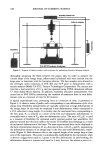
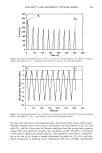
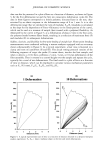
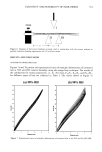
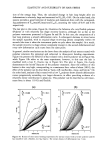
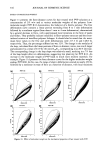
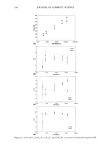
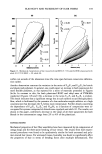
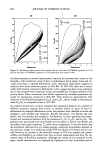
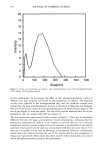
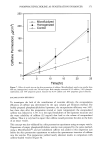
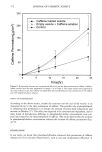
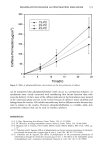
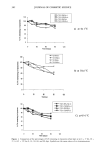
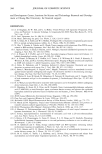
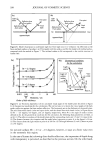
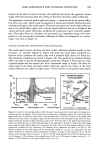
360 JOURNAL OF COSMETIC SCIENCE 260 20O (a) (b) •øø I Fi ø = •ø =0.19 • 0.58 | / I ,o = 0.79 400 0 I 2 3 4 5 6 Distance (ram) Distance (ram) Figure 14. Mechanical characteristics of hair treated with (a) ethyl ester of PVM/MA copolymer (5.71%) and (b) ethyl ester of PVM/MA copolymer (5.71%) plasticized with oleth-10 (4%). calculated parameters showed nearly perfect elasticity for untreated hair tresses at low humidity, with mechanical curves of force-rs-deformation being almost linear and vir- tually coinciding in repeated deformation cycles. Additional experiments suggested a relatively slow stress relaxation process at 50% RH. At 90% RH, there was a consid- erable shift between consecutive deformation curves, suggesting faster stress relaxation due to the increased level of moisture in hair, presumably due to higher mobility of the protein chains. These conclusions were further supported by calculated parameters ob- tained for experiments conducted at 90% RH. They showed an approximately 10% reduction in the flexibility parameters F•o/F • and E•o/E•, and no change in the plasticity index H•o/H • as compared to hair at 50% RH. For polymer-treated hair, we have compared the mechanical behavior of a number of different polymers ranging from brittle to flexible. Based on plots of force-rs- deformation for multiple deformation cycles, the polymers were classified as brittle and nonplastic, quite flexible and nonplastic, flexible and plastic, very flexible and very plastic, and very flexible and nonplastic. Furthermore, we have quantitatively charac- terized each mechanical behavior with the parameters F•o/F•, E•o/E•, and H•o/H •. The polymers that were found to be very flexible and very plastic as well as very flexible and non-plastic had a glass transition, Tg, below room temperature. It was also shown that the mechanical characteristics of a model polymer, poly(vinyl pyrrolidone), depends on the molecular weight. Low-molecular-weight PVP was shown to be brittle and not very stiff. However, an increase in the molecular weight of PVP was coupled with greater stiffness and flexibility, as evident from force-rs-strain relationships and from the cal- culated values of flexibility parameters. Although the results are not presented in this paper, similar characteristics are displayed by copolymers of vinyl pyrrolidone such as

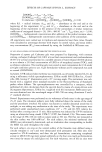
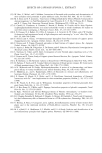
ELASTICITY AND FLEXIBILITY OF HAIR FIBERS 361 vinyl pyrrolidone/DMAPMA copolymer or vinyl pyrrolidone/DMAPMA/DMAPMA ©- C12H25 Cl © (Polyquaternium-55). Finally, the measurements of hair tresses treated with plasticized resins have demon- strated a transition from a brittle polymer to a flexible and plastic system. Such an effect is produced by the addition of a relatively high proportion of surfactants (such as oleth-10 or dimethicone copolyol) to polymers characterized by a glass transition of about 100øC such as ethyl ester of PVM/MA copolymer (PVM/MA) and isobutylene/ ethylmaleimide/hydroxyethylmaleimide copolymer (IEHC). ACKNOWLEDGMENTS The authors are thankful to Ms. Susan Chen for her help in carrying out the experiments. We also gratefully acknowledge the support of, and discussions with, L. Foltis and the ISP Marketing Department. REFERENCES (1) J. Jachowicz and K. Yao, Dynamic hairspray analysis. I. Instrumentation and preliminary results,J. Soc Cosmet. Chem., 47, 73 (1996). (2) Webster's Third New International Dictionary of the English Language (unabridged) (Encyclopedia Britan- nica, Inc, 1981). (3) C. R. Robbins and R. Crawford, Cuticle damage and tensile properties of human hair, J. Soc. Cosmet. Chem., 42, 59 (1991). (4) M. Gamez-Garcia, Effects of some oils, emulsions, and other aqueous systems on the mechanical properties of hair at small deformations, J. Sot'. Cosmet. Chem., 44, 69 (1993). (5) L.J. Wolfram and L. Albrecht, Torsional behavior of human hair,J. Soc. Cosmet. Chem., 36, 87 (1985). (6) J. Jachowicz and R. McMullen, Thermal degradation of hair. III. Effect of hydrolized methyl vinyl ether/maleic acid copolymers, Proceedings of Cosmetics 2000, Barcelona, April 2000, p. 146. (7) J. Jachowicz and R. McMullen, The mechanical analysis of elasticity of polymers used as hair fixatives, Proceedings of the IFSCC Conj•rence, Santiago de Chile, May, 1999. (8) DSC studies of polymer blends and polyesters have been carried out by D. Hood in the Analytical Department of International Specialty Products.
Purchased for the exclusive use of nofirst nolast (unknown)
From: SCC Media Library & Resource Center (library.scconline.org)