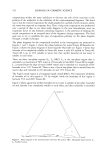
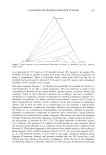
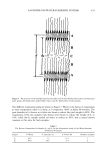
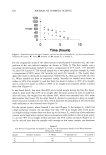
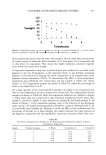
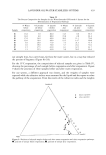
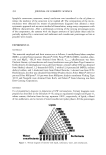
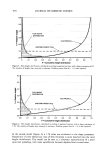
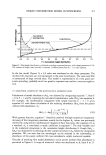
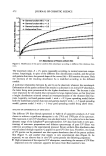
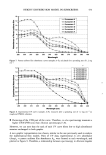
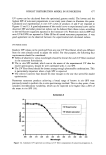
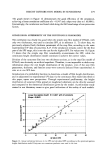
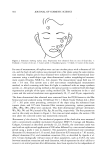
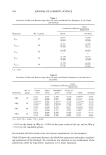
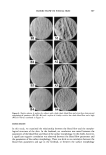
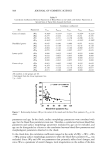
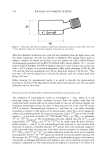
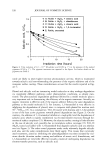
440 JOURNAL OF COSMETIC SCIENCE of samples before and after evaporation for the liquid samples (Table IV), the positions of the samples before and after evaporation are pointed out in Figure 9, which clarifies that the pathways are not straight lines but curves. At room temperature the water is the first to evaporate, but once the temperature is raised to 35øC, the lavender oil or some of its compounds evaporate first. This was expected, since water supports the evaporation of fragrance material, and at this tem- perature it helps to drive off the volatile compounds. CONCLUSION The structural changes observed during evaporation of the fragrance emulsions can be related to the different amphiphilic association structures in the phase diagram. Fra- grance solublization studies have shown how fragrance ingredients are solubilized in surfactant solution (L2) and how such a system serves as a fragrance reservoir. The different intermolecular interactions between the fragrance compounds and the surfac- tant results in different patterns during evaporation of the fragrance emulsion as well as of the microemulsion. Although at room temperature water is the first to evaporate, the higher surfactant solutions evaporate more slowly and retain their weight for slow and fast evaporations. Once the temperature is raised to 35øC, lavender oil or some of its compounds evaporate first, since water supports the evaporation of fragrance material and at this temperature helps to drive off the volatile compounds. ACKNOWLEDGMENTS The author thanks the Deanship of Academic Research of the University of Jordan for funding this research project, and also Ayat Bozeya and Tamador A1-Ahmad for their valuable help. REFERENCES (1) Kirk-Othmer, Encyclopedia of Chemical Technology, 3rd ed. (John Wiley & Sons, New York, Chichester, Brisbane, Toronto, Singapore, 1981), vol. 16, p. 324. (2) O. Secondini, Handbook of Perfumes & Flavors (Chemical Publishing Co., New York, 1990), p. 48. (3) A. Dale and S. Cornwell, The role of lavender oil in relieving perineal discomfort following childbirth: A blind randomized clinical trial, J. Adv. Nursing, 19, 89-96 (1994). (4) C. Dunn, J. Sleep, and D. Colerr, Sensing an improvement: An experimental study to evaluate the use of aromatherapy, massage and periods of rest in an intensive care unit, J. Adv. Nursing, 21, 34•40 (1995). (5) K. Hm and C. Sh, Lavender oil inhibits immediate-type allergic reaction in mice and rats,J. Pharm. Pharmacol., 51,221-226 (1999). (6) M. Billany, S. Denman, S. Jameel, and J. K. Sugden, Topical antirheumatic agents as hydroxyl radical scavengers, Int, J. Pharmacol., 124, 279-283 (1995). (7) S. Nyiredy, B. Renata, and T. Heinz, Gas chromatographic retention behavior of substances of plant origin, Acta Pharm. Hung., 55, 49-58 (1985). (8) E. Revenchon, G. Dellaporte, and F. Senatore, Supercritical CO 2 extraction and fractionation of lavender essential oil and waxes, J. Agr. Food Chem., 43, 1654-1658 (1995). (9) V. D. Zheljazkov and N. E. Nielsen, Studies on the effect of heavy metals (Cd, Pb, Cu, Mn, Zn and Fe) upon the growth, productivity and quality of lavender, J. Essential Oil Res., 8, 259-274 (1996).

LAVENDER OIL/WATER/STABILIZER SYSTEMS 441 (lO) (11) (12) (13) (14) (15) (16) (17) (18) (19) (20) (21) S. E. Friberg, Q. Yin, and P. A. Aikens, Vapor pressure of phenethyl alcohol and limonene in systems with water and Laureth 4, Int. J. Cosmet. Sci., 20, 355-367 (1998). S.E. Friberg, M. Szymula, L. Fei, P. A Aikens, J. Barber, and A. A1-Bawab, Vapor pressure of a fragrance during evaporation in simple emulsion, Int. J. Cosmet. Sci., 19, 259-265 (1997). Y. Tokuoka, H. Uchiyama, and M. Abe, Phase diagrams of surfactant/water/synthetic perfume ternary systems, Colloid. Po/ym. Sci., 272, 317-323 (1993). Y. Tokuoka, H. Uchiyama, M. Abe, and S. D. Christian, Solubilization of some synthetic perfumes by anionic-nonionic mixes surfactant systems, Langmuir, 11, 725-729 (1995). Y. Satio, K. Miura, Y. Tokuoka, Y. Kondo, M. Abe, and T. Sato, Volatility and solubilization of synthetic perfumes by pluronic, J. Dispers. Sci. Techno/., 17, 567-576 (1995). J. Yang, G. Rong, S. E. Friberg, and P. Aikens, The phase behaviour of polyoxyethylene 10 stearyl ether/geraniol/olive oil/H20 system and preliminary evaluation of fragrance evaporation, Int. J. Cosmet. Sci., 18, 43-56 (1996). Z. Zhang, S. E. Friberg, and P. Aikens, Change of amphiphilic association structures during evapo- ration from emulsions in surfactant-fragrance-water systems, Int. J. Cosmet. Sci., 22, 181-194 (2000). D. Thracharod and K. P. Rao, Transdermal absorption of nifedipine from miceoemulsions of lipophilic skin penetration enhancers, Int. J. Pharm., 11,235-240 (1994). S.J. Vona, Jr., s. E. Friberg, and A.J. Brin, Location of fragrance molecules within lameliar liquid crystals, Col/olds Surf A, 137, 79-89 (1998). S. E. Friberg, Fragrance compounds and amphiphilic association structures, Adv. Colloid Interface Sci., 75, 181-214 (1998). S. E. Friberg, L. Fei, and P. A. Aikens, Vapor pressures of organic solvents in amphiphilic association systems, Recent Res. Develop. Phys. Chem., 1, 193-208 (1997). S. E. Friberg, Vapor pressure of some fragrance ingredients in emulsion and microemulsion formula- tions, Int. J. Cosmetic Sci., 19, 75-86 (1997).
Purchased for the exclusive use of nofirst nolast (unknown)
From: SCC Media Library & Resource Center (library.scconline.org)