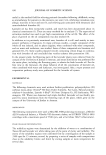
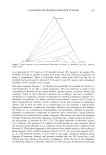
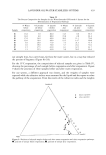
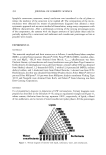
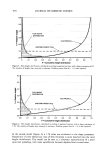
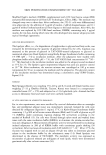
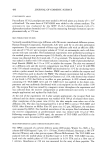
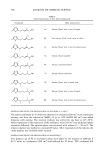
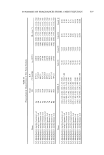
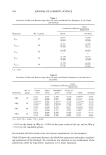
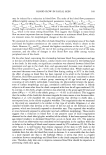
456 JOURNAL OF COSMETIC SCIENCE Table I W/W Percentages of Components of O/W Microemulsions Obtained With Cx2_•5 Alkylbenzoate (CAB), Cetearyl Sulfate (CS)/Decylpolyglucose (DPG), Water, and 1,2-Hexanediol (HD) Surfactant/lipid Total blend Dilution HD water CAB DPG CS 85/15 10/90 3.33 39.37 13.5 37.97 3.83 90/10 10/90 3.33 41.30 9.0 42.32 4.05 90/10 50/50 3.33 52.57 5.0 23.51 2.25 90/10 90/10 30.00 63.85 1.0 4.70 0.45 C= -C•= a I ky I benzoate 1,2 hexanediol•l 211 e, • $oya Lecithin 33 % Decylpolyglucose 67% Figure 4. Ternary diagram of systems with C•2 •5 alkylbenzoate, soya lecithin, decylpolyglucose, water, and 1,2 hexanediol. Table II W/W Percentages of Components of Microemulsions With C•2_•5 Alkylbenzoate (CAB), Soya Lecithin (SL)/Decylpolyglucose (DPG)/water, and 1,2-hexanediol (HD) Surfactants/lipid Total phase Dilution HD water CAB DPG SL 70/30 30/70 10.00 34.77 21.00 18.06 16.17 70/30 60/40 20.00 48.44 12.00 10.32 9.24 70/30 70/30 23.33 53.00 9.00 7.74 6.93 80/20 40/60 13.33 41.14 12.00 17.69 15.84 80/20 70/30 23.33 53.91 6.00 8.84 7.92 80/20 90/10 30.00 62.41 2.00 2.95 2.64 alkylbenzoate/soya lecithin/decylpolyglucose/water, 1,2-hexanediol system. Table II shows the percentages of components of some microemulsions with C•2_•5 alkylbenzo- ate/soya lecithin/decylpolyglucose/water and 1,2-hexanediol. The 33/67 soya lecithin/decylpolyglucose mixture produced transparent formulations when the 70% of the 30/70 oil/surfactant mixture was diluted with 30% polar phase this mixture thus allowed microemulsions with the lowest surfactant/lipid percentage to

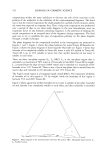
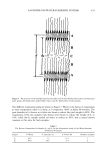
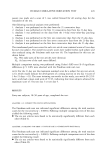
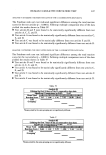
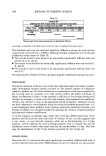
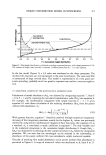
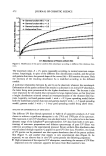
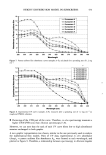
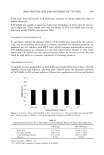
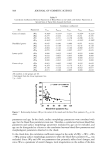
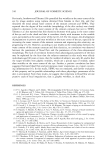
OW MICROEMULSION IN SUNSCREENS 457 be obtained. This ternary system gave the most efficient microemulsion, with a 9.0% disperse phase and a 14.67% surfactant mixture. Among the systems prepared with cetearyl sulfate and soya lecithin, the best was probably that with C•2_•5 alkylbenzoate/soya lecithin/decylpolyglucose, water, and 1,2 hexanediol, since it had the lowest percentage of surfactants and a good amount of disperse phase, which could be partially replaced with a sunscreen agent to give solar products a suitable protective effect. Since the primary aim of this study was to obtain transparent, nonsticky, and waterproof sunscreen products, sprayable and with a fresh feeling on the skin, in a second step of the study, the lipid phase of these systems was partially replaced with 4-methylbenzilidene camphor, a crystalline powder, and octylmethoxycinnamate, an apolar oil, both of which are sunscreen agents frequently used in cosmetic products. For this purpose, it was necessary to use a lipid phase that could easily solubilize both sunscreens, to avoid areas of crystals or of oil separation, which can originate from non-uniform products with poor diffusion on the skin, or areas of excessive concentration of sunscreen. To avoid these unwanted effects, ethanol was mixed to the lipid phase. Two ternary diagrams were then constructed for each sunscreen agent, in which a 2/1 or 4/1 mixture of C•2_•5 alkylbenzoate/ethanol was at one corner, cyclomethicone was at the second corner, and octylmethoxycinnamate or 4-methylbenzilidene camphor was at the third. Cyclomethicone was used to provide a fresh feeling and nonsticky products, and ethanol was used to increase the compatibility of C•2_•5 alkylbenzoate and cyclo- methicone and sunscreen miscibility in the systems. Figures 5 and 6 give some examples of ternary diagrams of the lipid systems constructed, respectively, with octylmethoxycinnamate, C•2_• 5 alkylbenzoate/ethanol (4/1), and cy- clomethicone (Figure 5) and with 4-methylbenzylidene camphor, C•_• 5 alkylbenzoate/ ethanol (2/1), and cyclomethicone (Figure 6). The absence of crystals or phase separation was checked with a light polarized microscope. C12-C16 alkylbenzoate/ethanol 4tl Octy Im etho xy c innam ate Figure 5. Ternary diagram of systems with C•2_•5 alkylbenzoate, ethanol, cyclomethicone, and octylme- thoxycinnamate.
Purchased for the exclusive use of nofirst nolast (unknown)
From: SCC Media Library & Resource Center (library.scconline.org)