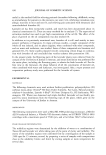
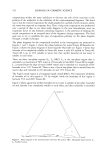
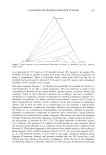
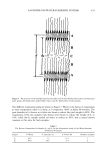
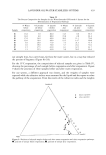
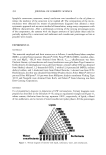
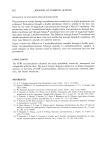
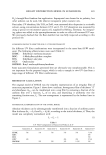
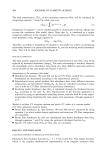
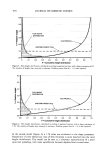
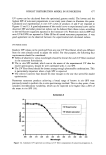
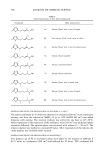
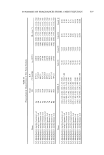
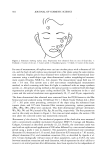
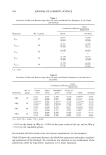
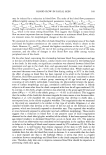
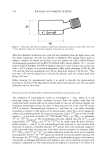
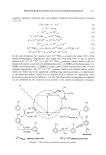
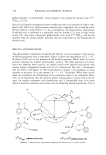
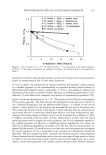
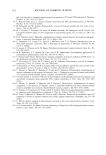
460 JOURNAL OF COSMETIC SCIENCE C•2-C•= alkylbenzoate 33.6% ethanol 8.4% cyclomethicone 18% Octylm etho xycinnamate 4O% 1,2heWxaat•er/dlol ,. ,ecithin 33% 2/1 •i •i • • Decylpolyglucose 67% Figure 8. Ternary diagram of the complex mixtures with C•2_•5 alkylbenzoate, ethanol, cyclomethicone, octylmethoxycinnamate, soya lecithin, decylpolyglucose, water, and 1,2 hexanediol. Table IV W/W Percentages of Components of Microemulsions With Octylmethoxycinnamate (OMC), C•2_•5 Alkylbenzoate (CAB)/Cyclomethicone (CMC)/Soya Lecithin (SL)/Decylpolyglucose (DPG), and Ethanol/1,2-Hexanediol (HD)/Water or Ethanol/2-Methyl-2,4-Pentanediol (MPD)/Water Total Surfactant/lipid Dilution HD water DPG SL CAB Ethanol CMC OMC 60/40 40/60 13.33 37.52 13.27 11.88 8.06 2.02 4.32 9.60 70/30 50/50 16.67 43.88 12.90 11.55 5.04 1.26 2.70 6.00 70/30* 90/10' 30.00* 62.11' 2.58* 2.31' 1.01' 0.25* 0.54* 1.20' 80/20 60/40 20.00 49.66 11.79 10.56 2.69 0.67 1.44 3.20 80/20 90/10 30.00 62.41 2.95 2.64 0.67 0.17 0.36 0.80 MPD 70/30 50/50 14.29 46.26 12.90 11.55 5.04 1.26 2.70 6.00 70/30 90/10 25.71 64.40 25.80 2.31 1.01 0.25 0.54 1.20 80/20 50/50 14.29 47.77 14.74 13.20 3.36 0.84 1.80 4.00 80/20 90/10 25.71 66.70 2.95 2.64 0.67 0.17 0.36 0.80 * Best microemulsion. 23.45%, soya lecithin 11.55%, 1,2-hexanediol 14.00%, allantoin 0.17%, ethanol 2.50%, water 33.30%. The addition of stearyl methicone and menthol to the lipid phase of the microemulsion with 4-methylbenzilidene camphor produced a system in which the amount of sunscreen agent was reduced from 4.5% to 3.0%, to compensate for a proportional increase in cyclomethicone, ethanol, and C•2_•5 alkylbenzoate. System D was modified by adding stearyl methicone, allantoin, and menthol to give: F: octylmethoxycinnamate 5.44%, cyclomethicone 2.45%, ethanol 1.14%, C•2_•5 al- kylbenzoate 4.57%, menthol 0.40%, stearyl methicone 1.00%, decylpolyglucose 23.45%, soya lecithin 11.55%, 1,2-hexanediol 16.50%, allantoin 0.17%, water 33.30%. This system did not show phase separation under optical microscope. Dilution with water was possible, producing a sunscreen percentage (2.72%) comparable to that

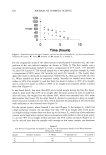
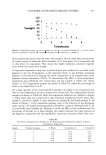
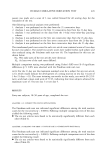
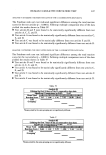
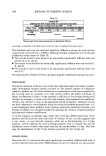
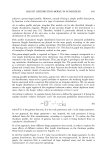
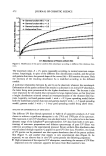
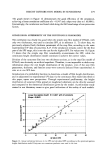
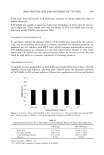
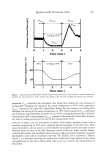
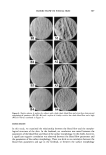
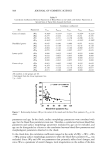
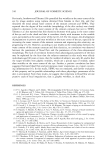
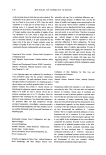
OW MICROEMULSION IN SUNSCREENS 461 of the microemulsions prepared with 3.0% of 4-methylbenzylidene camphor: G: octylmethoxycinnamate 2.72%, cyclomethicone 1.22%, ethanol 0.57%, C•2_•5 al- kylbenzoate 2.29%, decylpolyglucose 11.73%, 1,2-hexanediol 8.25%, allantoin 0.09%, water 66.66%. CHARACTERIZATION OF MICROEMULSIONS Microscopy and laser light scattering. Optical microscopy, either simple or equipped with polarized light, did not show crystals or droplets in microemulsions immediately after preparation or over time at 37% relative humidity. With laser light scattering, micro- emulsions with 4-methylbenzylidene camphor and octylmethoxycinnamate showed mean diameters, respectively, of 15 nm (polydispersity index of 0.171) and 17 nm (polydispersity index of 0.183 nm). The diameters of the microemulsion containing 4-methylbenzilidene camphor, diluted 1:3, and of the microemulsion with octylmethoxy- cinnamate, diluted 1:1.66, increased slightly. These dilutions gave transparent systems, which were still microemulsions or swollen micelies and produced systems containing less diol and emulsifier than the concentrated ones, and they can be expected to be better tolerated by the skin. Rheology studies. The rheograms of the microemulsions containing 4-methylbenzilidene camphor (E) and octylmethoxycinnamate (F), immediately after preparation and equili- brated at 37% relative humidity for 30, 60, and 90 minutes, denoted a Newtonian flux, as also shown by the trend of viscosity over time at increasing shear rates. The viscosity of the systems was independent of evaporation and denoted the absence of crystal formation or flocculation. After 90 minutes equilibration at 37% relative humidity, the microemulsions had a weight loss of 5%, and no crystals or phase separation or droplets could be seen under microscopic observation. Water resistance. Collagen felts coated with the microemulsions containing sunscreen agents did not release oil or particles of product over twelve to twenty-four hours. Such felts are usually employed to reconstitute the skin, and were therefore used as a substrate comparable to the skin. Diffusion of 4-methyl benzylidene camphor through double membrane 0.12 = 0.1 .• o 0.08 ß = '•' 0.06 • 0 o.o4 .•. 0.02 0 50 1 O0 150 200 minutes Figure 9. Diffusion of methylbenzylidene camphor from microemulsion through hydrophilic/lipophilic membrane.
Purchased for the exclusive use of nofirst nolast (unknown)
From: SCC Media Library & Resource Center (library.scconline.org)