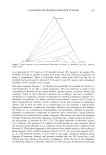
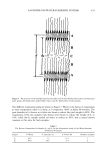
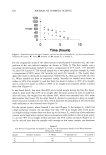
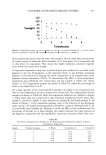
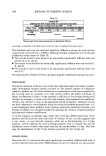
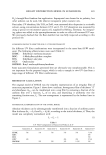
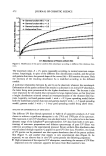
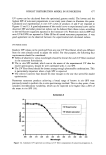
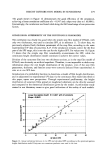
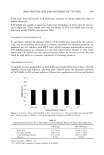
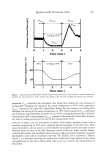
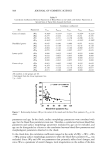
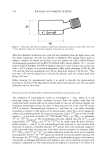
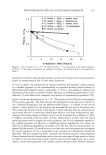
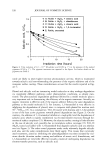
462 JOURNAL OF COSMETIC SCIENCE PERMEATION OF SUNSCREENS FROM MICROEMULSIONS The permeation studies through membranes were satisfactory, as slight permeation was evidenced. Permeation through a double membrane, which is similar to the skin, was lower by one order of magnitude than permeation through a Silastic © membrane. The permeation rates of 4-methylbenzilidene camphor from microemulsions through lipo- philic membrane and through Silastic © membrane were one order of magnitude higher than those through a double membrane. The diffusion through Silastic © membrane and double membrane did not have a lag time, unlike that through lipophilic membrane. All these runs followed a pseudo zero-ordered kinetics. Figure 9 shows the diffusion of 4-methylbenzilidene camphor through a double mem- brane. Octylmethoxycinnamate behaved similarly to methylbenzilidene camphor. A good tolerance of these systems could be deduced, since the sunscreens had very low permeation. CONCLUSIONS The O/W microemulsions obtained are easily spreadable, nonsticky, waterproof, and compatible with the skin. The use of ternary diagrams allowed us to obtain transparent systems, in the form of O/W microemulsions, vehicles for sunscreens, menthol, allan- toin, and stearyl methicone. REFERENCES (1) A.V. Calogero, Sunscreen final monograph, Cosmet. Toiletr., 114, 5-72 (1999). (2) Quires UNIPRO n ø 29: Coordinated test of the low (articles and annexes), n ø 713, 11 October 1986 (April 1999). (3) W. Jhonlock, Sunscreen interaction in formulations, Cosmet. Toiletr., 114, 75-82 (1999). (4) F. Comelies, J. Caelles, J. L. Parres, and J. Sanches, Transparent gels: Study of their formation and assimilation of active ingredients through phase diagrams, Int. J. Cosmet. Sci., 14, 183-195 (1992). (5) F. Comelies, V. Magias, J. Sanches, J. L. Parra, F. Balanguer, and C. Pelejero, Application of ternary systems in specific cosmetic formulations, Int. J. Cosmet. Sci., 11, 5-19 (1989). (6) F. Puisieux and M. Sillar, Galenica 5: Agent de surface et Emulsions (les systemes dispers6s), Technique et Documentation (Lavoisier), 1983. (7) G. Marti Mestres, J.P. Lagit, H. Mallois, and G. Fernendez, Solubilizations des tiltres UV dans des melanges ternaires de phase apolaires: Optimization par utilization de reseaux centrEes, Int. J. Cosmet. Sci., 20, 19-30 (1998). (8) T. Moaddel, T. Huang, and S. E. Friberg, Sunscreen microemulsions, J. Dispers. Sci. Technol., 17, 459-475 (1998). (9) F. Comelies, J. L. Parra, C. Ferrando, J. Caelles, and J. Sanches, Transparent formulations of a lipo- soluble sunscreen agent in aqueous medium, Int. J. Cosmet. Sci., 12, 185-196 (1990).

j. Cosmet. Sci., 54, 463-481 (September/October 2003) Efficiency of a continuous heioht distribution model of sunscreen film oeometry to predict a realistic sun protection factor L. FERRERO, M. PISSAVINI, S. MARGUERIE, and L. ZASTROW, Coty Beauty-Lancaster Group, International Research & Development Center, Athos Palace, 2, rue de la Lujernetta, MC 98000, Monaco. Accepted for publication June 16, 2003. Synopsis Irregularities in the geometry of sunscreen films spread on rough areas, like skin, is often presented as being the main cause of the degree of UV absorption achieved by the UV filters that are inside. Until now, only the step film, a model invented by O'Neill, was simple enough to calculate UV data close to in vitro experimental data, after determination of a limited number of fraction areas with their corresponding thickness. However, such models are obviously too simple to represent a real situation. In the present work, more complex distributions of film thickness were calculated, with an infinite number of individual heights. Realistic models were achieved via a probability function. The consequences for UV absorption were deduced, and the calculated UV data were compared to experimental in vitro data on sunscreen products measured after being spread on a roughened PMMA substrate. The latter substrate was previously selected for its ability to achieve a good correlation with in vivo SPF. An optimized version of the continuous mathematical model was finally determined in order to achieve UV curves, similar in shape and intensity to the experimental ones. The latter model can be used to predict realistic SPF values. INTRODUCTION Numerous attempts have been made to understand how sunscreen preparations protect against UV radiation (1-6). Normally, the final UV protection achieved by a sunscreen product should be the result of each filter UV absorption present in the preparation. However, it is now trivial to note the poor correlation between UV absorption of sunscreens diluted in alcohol solutions and the in vivo SPF. O'Neill (6) demonstrated in 1983 that a simple model of irregular film, a one-step film geometry, could satisfactorily account for the discrepancy between clinical results and simple spectrographic data. However, only a single wavelength calculation was possible in 1983. In previous pub- lications (7,8), we used the simple step film geometry proposed by O'Neill to success- fully calculate UV curves similar in shape and intensity to in vitro experimental ones. Our experimental data was collected by spreading different sunscreen formulations onto the well-known irregular transparent substrate Transpore © tape (3M Corporation) (9). Later, D. F. Tunstall (10) developed a similar mathematical analysis to demonstrate 463
Purchased for the exclusive use of nofirst nolast (unknown)
From: SCC Media Library & Resource Center (library.scconline.org)