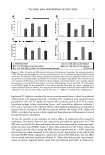
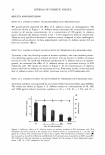
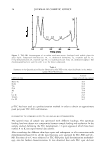
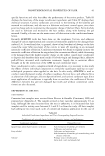
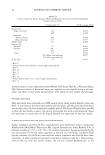
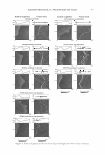
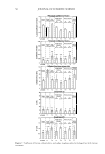
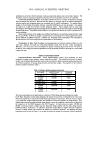
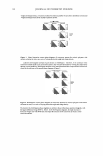
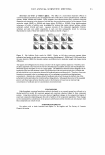
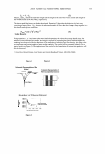
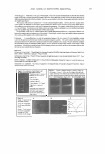
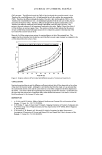
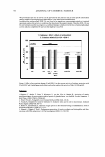
52 JOURNAL OF COSMETIC SCIENCE lubrication and thus give the conditioner more mobility on the hair surface compared to just surfactants and fatty alcohols. The inverse trend was seen only for the amino silicone group. The amino silicones have a strong electrostatic attraction to the negatively charged hair surface, which in turn creates higher binding forces and less mobility. The dampened mobility of the amino silicone at high deposition levels, with respect to hair surface and tip, may account for this wide variation in coefficient of friction and large adhesive force values. In terms of adhesive force, it was previously observed in Figure 6 that the amino silicone treatments showed much more distinct regions of higher and lower adhesion compared to PDMS-blend silicones. This nonuniform amino silicone thickness distri- bution on hair is also believed to be caused by the inhibited mobility, as the molecules immediately attach to the hair at contact and do not redistribute as a uniform coating. The increased polarity of the amino silicones compared to the PDMS blend can also be a major contributor to the higher friction and adhesion at high deposition levels. If we look at the hair only with the BTMAC surfactant and fatty alcohols, and then add low deposition levels of PDMS blend (blend of low and high MW) or amino silicone, we see that the coefficient of friction decreases, while adhesion remains approximately the same. If we increase the deposition level, it is observed that the PDMS blend is still lower, but now the coefficient of friction for the amino silicone is about the same as for the BTMAC-only samples. The mobility of the conditioner layer is again a major issue, as this easier mobility accounts for the lower coefficient of friction. However, as is seen when there is a large amount of the amino silicones on the hair surface, the mobility ceases and the coefficient of friction becomes high again. The BAPDMA surfactant typically showed a higher adhesive force than the BTMAC surfactant. However, there may be an increased accumulation of the BAPDMA surfac- tant such that the conditioner layer is more easily sheared by the tip, as is the case for damaged treated hair. The inherent differences in surfactant composition and how they interact with the damaged hair surface most likely account for the coefficient of friction differences. In respect to roughness, the vertical standard deviation decreased slightly with most treatments, although the standard deviations were similar. The spatial parameter in- creased slightly with the treatments, but the variation also became extremely high. EFFECT OF SOAKING ON COEFFICIENT OF FRICTION FOR VIRGIN, DAMAGED, AND DAMAGED TREATED HAIR Virgin, damaged, and treated hair samples were soaked in de-ionized water for five minutes. Their corresponding coefficient of friction was measured and compared to coefficient of friction values for dry samples that were adjacent to the wet samples on the respective hair fiber. Figure 8 shows the results for two hair samples of each hair type. Virgin hair exhibits a decrease in the coefficient of friction after soaking. Virgin hair is more hydrophobic, and so more of the water is present on the surface and results in a lubrication effect after soaking. Damaged hair tends to be less hydrophobic due to the chemical degradation of the cuticle surface, and absorbs water after soaking. This softens the hair and increases the real area of contact with the tip, which leads to higher friction,

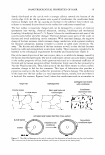
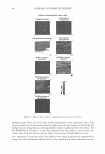
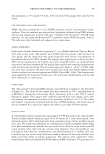
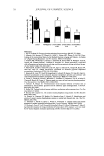
NANOTRIBOLOGICAL PROPERTIES OF HAIR 53 Coefficient of friction Virgin hair 0.100 .-- ---------------- 5 0.075 � O 0.050 c GI ·o � 0.025 (.) Hair# 1 Hair#2 0 ------�-�---�---� Unsoaked Soaked Unsoaked Soaked Chemically damaged hair 0.100.------------------- 0 0.075 � - 0 c 0.050 GI ·o GI o 0.025 0 Hair# 1 Hair#2 0 ..____, __ ...,_ _ ____._ _____ ........_ _ ____._ __ ...____. Unsoaked Soaked Unsoaked Soaked Chemically damaged treated hair (1 cycle) 0.100 .------------------ C 'fl 0.075 ;s 'o c 0.050 GI ·o � 0.025 (.) Hair# 1 Hair#2 Unsoaked Soaked Unsoaked Soaked Adhesive force Virgin hair 50 ----------------- Z 40 .s GI � 30 ,E GI "iii 20 GI � 10 Hair# 1 Hair#2 Unsoaked Soaked Unsoaked Soaked 50 r------------r----------,hairdamagedChemically Z 40 .s � 30 ,E GI -� l3 20 Hair# 1 Hair# 2 0 ..____, __ ...,_ _ ____,_ _ ___.__....._ _ __. __ ....____, Unsoaked Soaked Unsoaked Soaked Chemically damaged treated hair (1 cycle) 50 .------------------- Z 40 .s � 30 ,E GI -� Ill 20 GI ( 10 Hair# 1 Hair#2 Unsoaked Soaked Unsoaked Soaked Figure 8. Effect of soaking in de-ionized water on the coefficient of friction and adhesive force for virgin, damaged, and damaged treated hair. even with conditioner treatment. This is yet another indication that virgin and damaged hair have significantly different surface properties, which in many cases results in op- posite trends for their nanoscale tribological properties. Adhesive force for virgin hair remained approximately the same before and after soaking, while it decreased for dam- aged and damaged treated hair after soaking. CONCLUSIONS The main conclusions are as follows: 1. In general, friction force maps of hair damaged by various treatments show a high friction force in the area surrounding the bottom cuticle edge, which is due to an increased meniscus force contribution between the AFM tip and the conditioner layer. 2. In most cases, the macroscale and microscale coefficients of friction followed the same
Purchased for the exclusive use of nofirst nolast (unknown)
From: SCC Media Library & Resource Center (library.scconline.org)