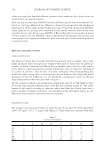
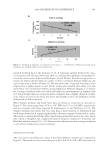
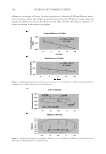
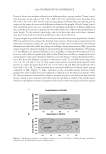
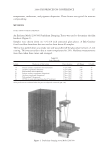
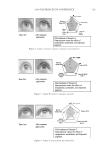
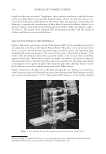
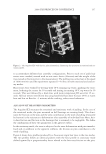
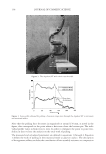
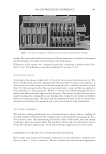
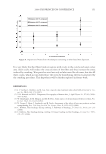
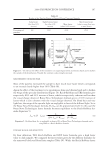
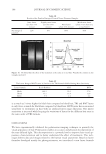
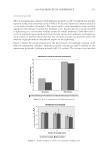
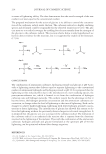
2008 TRI/PRINCETON CONFERENCE 271 CONCLUDING REMARKS This study shows that the incline plane fi ber loop method may detect adhesion forces in the range of 1 μN and elegantly separate the tangential and normal components of the fi ber–fi ber interactions. By collecting the data from a large number of sliding events and by controlling fi ber tension, we were able to detect hair surface damage and differentiate silicone treatments. At concentrations of 1000 ppm and above, silicone treatments in- creased the fi ber–fi ber adhesive forces signifi cantly. In addition, we demonstrated that the collective effect of these interactions infl uenced the behavior of curly hair assembly at high humidity. In particular, the study suggests that block copolymer silicone chemistry allows tuning the level of attractive fi ber–fi ber interactions and controlling the quality of the curly hair assembly appearance. Further measurements of the fi ber–fi ber interactions at lower silicone concentrations and different delivery vehicles will be evaluated in the future. REFERENCES (1) B. Bhushan, Nanoscale chacterization of human hair and hair conditioners, Prog. Mater. Sci., 53, 585– 710 (2008). (2) C. R. Robbins, in Chemical and Physical Behavior of Human Hair, 4th ed. (Springer-Verlag, New York, 2002). (3) H. G. Howell and J. Mazur, Amontons’ law and fi bre friction, J. Textile Inst., 44, T59–T69 (1953). (4) M. Kropfgans, S. Musiol, and S. Nienstedt, Silicone quats—Color retention benefi ts and infl uence of structure modifi cations and blending on conditioning, J. Cosmet. Sci., 55, S133–S141 (2004). (5) D. Dowson, History of Tribology (Longman, London and New York, 1979). (6) H. Yoshizawa, Y.-L. Cheng, and J. Israelachvili, Fundamental mechanism of interfacial friction. 1. Rela- tion between adhesion and friction, J. Phys. Chem., 97, 4128–4140 (1993).

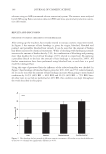
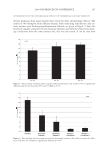
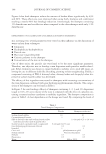
J. Cosmet. Sci., 60, 273–280 (March/April 2009) 273 Brazilian oils and butters: The effect of different fatty acid chain composition on human hair physiochemical properties ADRIANA FREGONESI, CARLA SCANAVEZ, LEANDRA SANTOS, AMANDA de OLIVEIRA, ROBERTA ROESLER, CASSIANO ESCUDEIRO, PRISCILA MONCAYO, DAISY de SANCTIS, and JEAN LUC GESZTESI, Natura Inovação e Tecnologia de Produtos– Brazil, Rodovia Anhanguera s/n° km 30.5, Polviho CEP: 07750-000, Cajamar, SP, Brazil. Synopsis This study evaluated the performance of fi ve oils and three butters extracted from Brazilian plants with dif- ferent fatty chain composition on hair mechanical properties, split end formation, combing analysis and gloss measurements. Oil treatment reduced the combing force percentage for wet conditions. However, the hair treated with butters showed poor combing. Except for ucuúba butter, oils and butters used in this work had generally no infl uence on hair tensile properties. In general, hair treated with oils showed a signifi cant gloss increase and a decrease for split end formation. The fatty acid composition of the oils and butters tested showed an effect on the physicochemical properties of hair. INTRODUCTION Vegetal oils have been extensively used by hairdressers around the world as cosmetic treatments for human hair of different ethnic origin. As an example, the prolonged use of coconut oil is claimed to lead to healthy looking long hair, suggesting that oil may pre- vent cuticle cell damage. This behavior is expected due to the lubricating effects of oils on hair fi ber that reduces abrasive damage (1). Another interesting aspect is that the dif- fusion of oils into hair fi ber depends on oil triglyceride composition. Coconut oil is basi- cally composed of lauric chains (C12), therefore, able to penetrate the fi ber. Once inside the hair fi ber, the oil seems to increase protein hydrophobicity and consequently reduces the cuticle swelling effect by water, providing a reduction of the fatigue imposed to the fi ber by successive swelling cycles (2). The layers of cuticle cells form the outer barrier of the hair fi ber and are mainly responsible for the cosmetic properties such as easy combing, gloss and smooth touch. Cuticle cells are susceptible to damage by grooming, weathering and daily care procedures. The loss of cuticle cells is the fi rst step for the formation of split ends and the use of oil and butter may prevent this cuticle damage (3). Hair strength, on the other hand, is attributed to the cortex, which forms the bulk of the fi ber and is re- sponsible for mechanical properties (4).
Purchased for the exclusive use of nofirst nolast (unknown)
From: SCC Media Library & Resource Center (library.scconline.org)