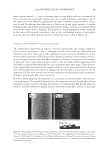
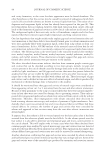
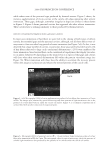
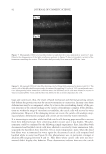
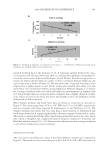
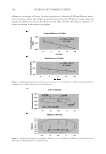
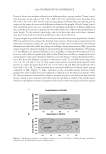
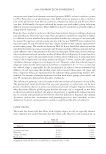
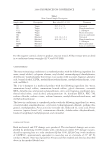
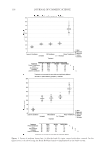
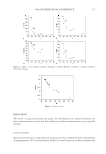
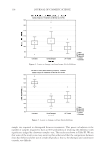
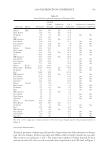
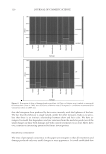
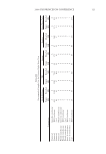
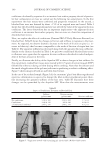
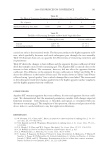
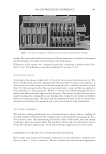
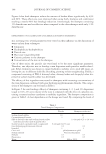
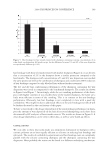
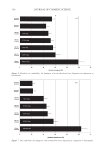
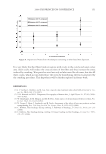
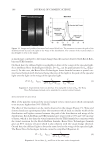
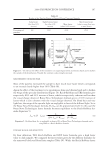
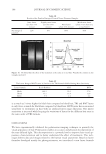
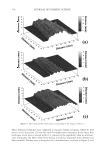
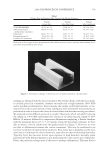
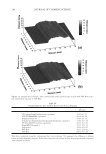
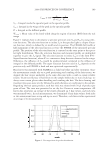
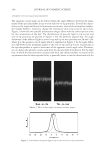
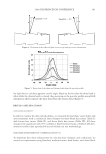
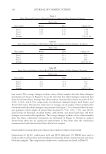
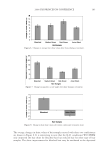
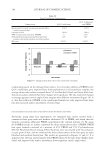
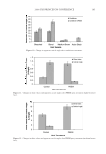
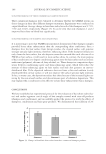
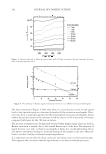
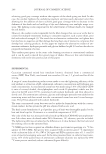
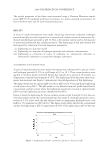
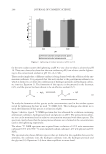
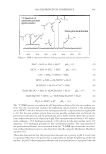
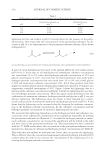
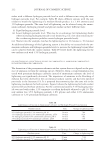
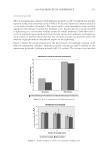
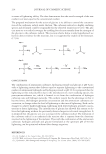
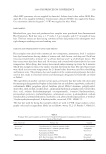
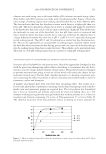
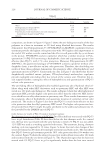
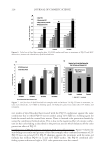
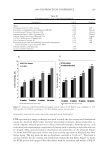
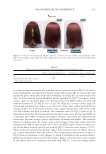
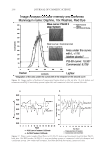
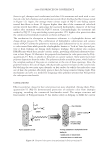
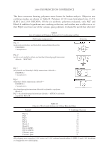
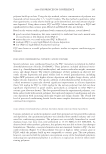
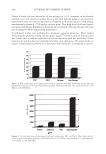
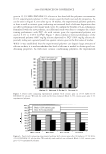
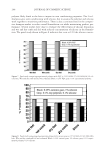
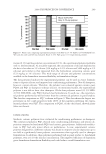
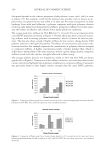
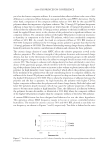
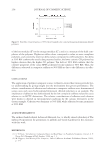
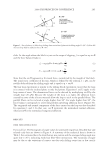
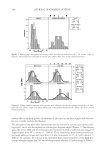
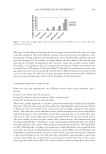
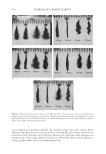
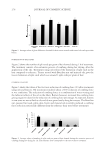
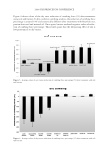
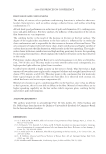
2008 TRI/PRINCETON CONFERENCE 107 Table II Two-Way ANOVA p-Values Property Ethnicity Curl class Cross-sectional area 0.038∗ 0.162 Ellipticity 0.212 0.082 Young’s modulus 0.001∗ 0.165 Break stress 0.001∗ 0.001∗ *Signifi cant when one-and two-way ANOVA are consistent and p 0.05. variations were found with keratin associated proteins (KAPs) at basic isoelectric points pH 9. Particular to our observations, more KAPs spots are present in the circled por- tion of the gel for hair from African countries compared to Jamaican and African-Amer- ican hair. Additionally, the spots indicated by arrows vary with ethnic group indicating different protein concentrations. These differences may be attributed to possible ethnic or origin-related variations. From the above studies it can be seen that hair characteristics change according to degree in curl and ethnicity. However, since some ethnic groups have curlier hair compared to others, it is diffi cult to assess whether the results are related to ethnicity or to type of curl or to both. So, answer this question, statistics using one-way and two-way ANOVA were conducted on hair from types VI and VII where there was a larger number of hair samples representative of each ethnic group. The results are shown in Table II. It was found that ethnicity was the sole driver for values in cross-sectional area and Young’s modulus, whereas curl class did not solely infl uence any of the parameters discussed in this paper. Both ethnicity and curl type affected variations in break stress but neither of them affected ellipticity. It seems that these statistics do not agree with our earlier results of them affected ellipticity. It seems that these statistics do not agree with our earlier results since Figure 3 shows a statistically signifi cant correlation between ellipticity and degree of curl. However, when the reduced range in ellipticity values for the latter statistical method is considered (1.67–1.71), it is clear that the reduced range is responsible for the inconsistency. In order to better understand the infl uence of curl type using this method, more data is needed where more curl types, and hence, ellipticity values, are represented for the different ethnic groups being studied. Nev- ertheless, the amount of samples represented within both ethnic groups, particularly curl type VI, statistically demonstrates the effect of ethnicity. The infl uence of geometry can easily explain why the mechanical properties in hair differ. The geometrical twists and kinks that are more prevalent in curlier hair can be local points of weakness that act as stress concentrators and result in higher fragility. However, when hair from different global regions that has the same curl is compared, as was done in the latter statistical method, the impact of geometry is signifi cantly reduced and one has to consider other possible factors for the observed differences. Regional and cultural diversities, such as diet, environment and grooming practices, may contribute to these differences however, more research is needed to understand the effect of ethnicity. CONCLUSIONS This study has shown that hair fi bers with a higher degree in curl are typically thinner, more elliptical and weaker than hair that has looser curls. Based on curl classifi cation, in

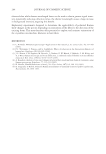
JOURNAL OF COSMETIC SCIENCE 108 general, African-American hair is looser in curl and curl degree increases in the order of Jamaican Ghanaian Liberian Kenyan. The cross-sectional area and Young’s modu- lus values are infl uenced by ethnicity, while break stress is infl uenced by both ethnicity and the degree of curl in hair. DSC and 2-D gel experiments suggest that structural and chemical composition of curly hair from different ethnic groups may also vary. Collec- tively, these results show that both curl type and ethnicity are important factors to con- sider when evaluating the behavior of hair, which may potentially impact the hair’s response to treatments and processes. ACKNOWLEDGMENTS The authors express their genuine thanks to Hui (Stacey) Tang for her knowledge and help with statistical methods and analyses and Charles Flemming for his contributions involving amino acid analysis. We would also like to acknowledge all of our colleagues from all over the world for special operations in obtaining hair, comments, discussions and support of our work. REFERENCES (1) K. Keis, K. R. Ramaprasad, and Y. K. Kamath, Studies of light scattering from ethnic hair fi bers, J. Cosmet. Sci., 55, 49–63 (2004). (2) C. R. Robbins, C. Reich, and J. Clarke, Hair manageability, J. Soc. Cosmet. Chem., 37, 489–499 (1986). (3) M. L. Garcia and J. Diaz, Combability measurements of human hair, J. Soc. Cosmet. Chem., 27, 379–398 (1976). (4) T. A. Evans, T. N. Ventura, and A. B. Wayne, The kinetics of hair reduction: Repairing effects of diglu- cosyl gallic acid on coloring-damaged hair, J. Soc. Cosmet. Chem., 45, 279–298 (1994). (5) R. de la Mettrie, D. Saint-Léger, G. Loussouarn, et al., Shape variability and classifi cation of human hair. A worldwide approach, Hum. Biol. 79, 265–281 (2007). (6) G. Loussourarn, A. L. Garcel, I. Lozano, et al., World diversity of hair curliness: A new method of assess- ment, J. Dermatol., 46, 2–6 (2007). (7) A. Syed, A. Kuhajda, H. Ayoub, and K. Ahmed, African-American hair: Its physical properties and differences relative to Caucasian hair, Cosmet. Toil., 110, 39–48 (1995). (8) A. Franbourg, P. Hallegot, F. Baltenneck, et al., Current reseach on ethnic hair, J. Am. Acad. Dermatol., 48, S115–S119 (2003). (9) L. J. Wolfram, Human hair: A unique physicochemical composite, J. Am. Acad. Dermatol., 48, S106– S114 (2003). (10) C. R. Robbins, Chemical and Physical Behavior of Human Hair (Spinger-Verlag, New York, 1988), Vol. 4. (11) C. Porter, S. Diridollou, and V. H. Barbosa, The infl uence of African-American hair’s curl pattern on its mechanical properties, Int. J. Dermatol., 44 (Suppl. 1) 4–5 (2005). (12) S. Nagase, M. Tsuchiya, T. Matsui, et al., Characterization of curved hair of Japanese women with refer- ence to internal structures and amino acid composition, J. Cosmet. Sci., 59, 317–332 (2008). (13) J. Menkart, L. J. Wolfram, and I. Mao, Caucasian hair, Negro hair, and wool: Similarities and differ- ences, J. Soc. Cosmet. Chem., 17, 769–787 (1966). (14) D. Hrdy, Quantitative hair form variation in seven populations, J. Phys. Anthrop., 39, 7–17 (1973). (15) Y. K. Kamath, S. Hornby, and H. D. Weigmann, Mechanical and fractographic behavior of Negroid hair, J. Soc. Cosmet. Chem., 35, 21–43 (1984). (16) Y. K. Kamath, S. Hornby, and H. D. Weigmann, Effect of chemical and humectant treatments on the mechanical and fractographic behavior of Negroid hair, J. Soc. Cosmet. Chem., 36, 39–52 (1985). (17) M. Feughelman, Mechanical Properties & Structure of Alpha-Keratin Fibers (UNSW Sydney Press, 1997). (18) N. I. Khumalo, P. T. Doe, R. F. Dawber, et al., What is normal hair like? A light and scanning electron microscopic study, J. Am. Acad. Dermatol., 43, 814–820 (2000). (19) B. Bernard, Hair shape of curly hair, J. Am. Acad. Dermatol., 48, S120–S126 (2003).
Purchased for the exclusive use of nofirst nolast (unknown)
From: SCC Media Library & Resource Center (library.scconline.org)