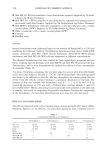
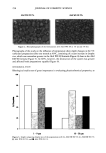
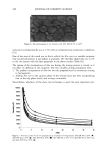
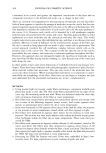
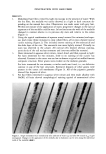
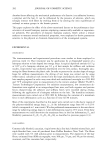
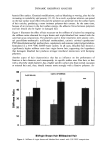
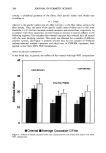
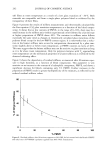
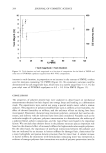
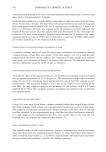
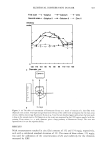
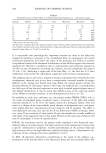
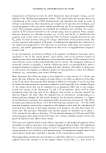
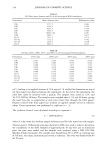
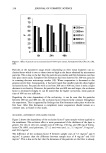
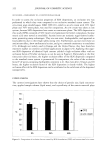
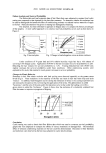
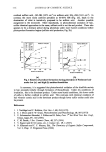
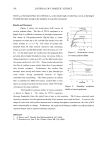
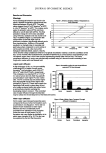
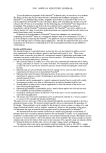
288 JOURNAL OF COSMETIC SCIENCE suming a cylindrical geometry of the fibers, their specific surface area should vary according to •r = 2/(rp) where •r is the specific surface area of a fiber (cm2/g), r is the fiber radius, and p is the fiber density. Thus, the ratios of the specific surface areas of fibers used in this work should be 2:1.4:1 for fine caucasian, normal caucasian, and oriental hair, respectively. In accordance with these arguments, we have found an increase in hairset stiffness in the following sequence: fine caucasian hairnormal caucasian hairoriental hair, all treated with the same hairspray solution. This result was obtained for a number of different polymer systems, and Figure 5 presents selected data for two samples of VA/butyl maleate/isobornyl acrylate copolymer and ethyl ester of PVM/MA copolymer, both applied to hair from 100% VOC formulations. EFFECT OF SOLVENT COMPOSITION It was found that, in general, the stiffness of hair treated with high-VOC compositions 4O 3O 2O 10 Co(VA-BM-IA)(1) I Ethyl Ester PVMIMA _ I ! Co(VA-BM-IA)(2) L B Oriental B Average Caucasian E! Fine Figure 5. Stiffness of normal caucasian brown, fine caucasian brown, and oriental hair treated with 100% VOC compositions.

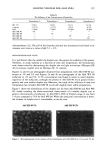
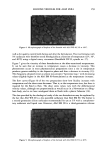
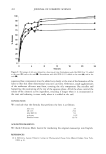
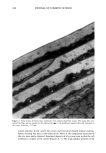
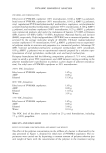
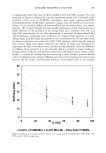
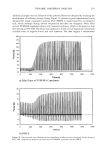
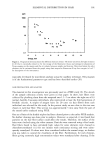
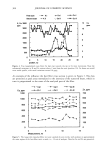
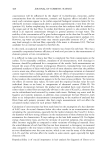
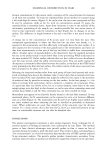
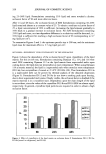
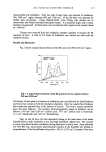
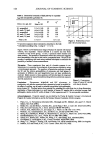
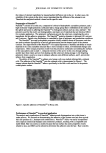
DYNAMIC HAIRSPRAY ANALYSIS 289 is significantly lower than that of fibers modified with low-VOC systems. The data presented in Figure 6, obtained for co(vinyl pyrrolidone-methacrylic acid-lauryl meth- acrylate), ethyl ester of PVM/MA copolymer, and vinyl caprolactam/PVP/ dimethylaminoethyl methacrylate copolymer, suggest that the presence of water con- tributes to an increased stiffness of resin-modified hair for both cationic and anionic polymers. We initially thought that one possible explanation of this observation was a small difference in the geometry of the omega loops after treatment with low- and high-VOC formulations. In our early experiments, a treatment of omega-shaped hair with formulations containing water resulted in the change of hair geometry to a more oblong shape, with the longer axis parallel to the vertical direction. On the other hand, no change in geometry was evident for 100% VOC products, which typically retained their circular shape after drying. However, the change of shape was eliminated by supporting the loops with teflon-coated cylinders during treatment. Since the difference in stiffness values persisted, it is now thought that it is related to water's ability to strongly interact with hair and facilitate interactions with fixative resins. Water, unlike alcohol, is capable of swelling hair and producing a more intimate polymer-keratin contact by allowing some polymer diffusion into hair or by activating ionic interactions between the hair surface and hairspray polymers. This should result in the stronger 6O 5O o 40 10 0 20 40 60 80 100 % voc * Co(VCL-VP-DMEMA) ß Co(VP-MA-LM) • Ethyl Ester PVM/MA Figure 6. Stiffness as a function of water content in a solvent system for 100% VOC, 80% VOC, 55% VOC, and 0% VOC compositions.
Purchased for the exclusive use of nofirst nolast (unknown)
From: SCC Media Library & Resource Center (library.scconline.org)