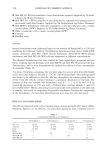
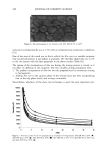
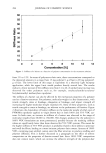
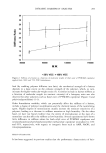
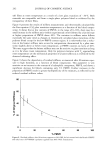
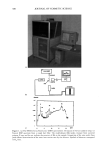
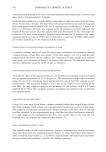
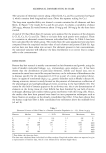
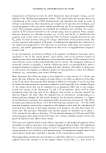
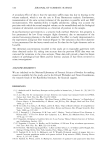
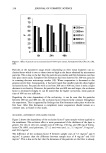
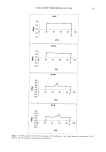
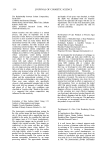
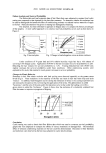
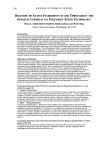
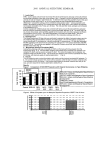
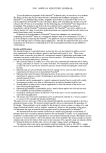
ELEMENTAL DISTRIBUTION IN HAIR 303 First scan --) -Sulphur = Calcium -- •-- Zinc Second scoa : -Sulphur II --m -Calcium II .... •, --Zinc II Arbitrary scale 0 I I 120 116 101 a Diameter, IJm 80 b X-rays I I I I I 70 85 96 110 115 105 Figure 3. (a) The effect of attenuation of fluorescent X-rays as a result of rotation of a hair fiber with elliptical cross section. The high-energy fluorescent X-rays of Zn suffer little attenuation by the mass cross section, whereas low-energy fluorescent X-rays (e.g., S and Ca) are absorbed appreciably when the beam path is long in the sample matrix. (b) Diameters on the x-axis are measured by the CCD camera parallel with the primary X-ray source, i.e., a wide diameter gives a long pathway to fluorescent X-rays. The scan was repeated once to test the reproducibility. RESULTS NAA measurements resulted in zinc (Zn) contents of 152 and 154 rag/g, respectively, each with a calculated standard deviation of 1%. The mean of these values, 153 rag/g, was used for calibration of the concentrations of Zn and indirectly for the elements measured by XRF.

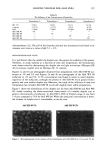
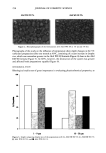
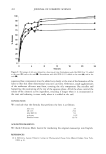
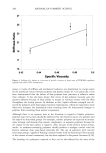
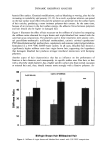
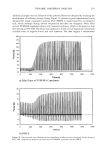
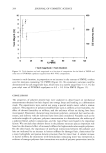
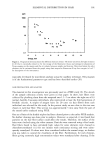
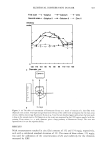
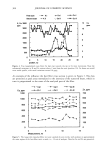
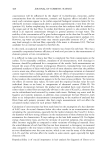
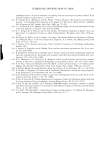
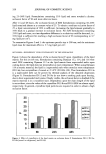
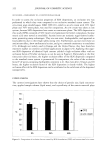
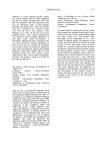
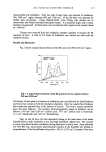
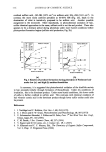
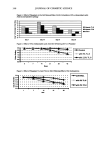
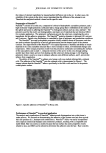
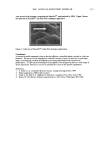
304 JOURNAL OF COSMETIC SCIENCE First scan - - •' - K I -o- Ca I Cu I Second scan -+- K II -,- Ca II = Cu II K, Ca 3500 t 12 Cu ppm ppm 3000 - 10 2500 - 1500 ' I - " 0 ..... I ! i J 0 0 5 10 15 20 25 30 position, no Figure 4. Two longitudinal scans from the hair root towards the tip in 0.2-ram increments. Note the substantial variations in K and Ca content above 2 mm from the root (position 10). Cu shows an overall more stable profile, with small variations around l0 pg/g. An example of the influence the hair fiber cross section is given in Figure 3. The data are presented as peak areas normalized to the intensity of the scattered beam, which in turn is proportional to the mass of the analyzed part of the fiber. Ca, ppm 1200 1000 800 600 400 200 -Ca I - - •- - Ca II ---m -Ca III Znl , -Znll - * -Znlll o Measurement, no 5 10 Zn, ppm 700 600 500 400 300 200 100 0 15 Figure 5. The long-term reproducibility test over a period of seven weeks, with analyses in approximately the same region of the hair fiber twice a week, i.e., 14 sets of analyses. Data for Ca and Zn are presented.
Purchased for the exclusive use of nofirst nolast (unknown)
From: SCC Media Library & Resource Center (library.scconline.org)