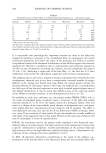
2001 ANNUAL SCIENTIFIC SEMINAR 341 VEIlNIX AND INFANT SKIN: INTERFACING BIOLOGY AND AESTHETICS Wael YousseP •, Steven B. Hoath 2, M.D., and R. Randall Wickett TM, Ph.D. 1Cosmetic Science Program, University of Cincinnati College of Pharmacy, Cincinnati, OH 2Skin Science Institute, Children's Hospital Research Foundation, Cincinnati, OH Introduction The skin of the newborn baby combines a functionally superb barrier with a highly aesthetic presentation. This study focuses on vernix caseosa, the proteolipid biofilm which progressively covers the fetal skin surface during the last trimester of pregnancy. Vernix is a complex formulation, which includes hydrated fetal corneocytes embedded in a mixture of physiological lipids derived from stratum corneum and sebaceous sources (1 2). In earlier work, we demonstrated that vernix has very low surface free energy and is highly unwettable. The limited interaction between vernix and hydrophilic liquids supports the hypothesis that vernix acts as a natural protectant cream to "waterproof" the fetus in utero while submerged in the amniotic fluid (3). The present study is aimed at further physical characterization of vernix in order to facilitate understanding its putative physiological roles and its possible applications in cosmetic and other sciences. Vernix is a very thick semi-solid and is relatively intractable. Its thick consistency comes as a surprise given the fact that vernix is 80% water (1). Investigating its rheology may provide an explanation of that fact and, consequently, may shed light on the biology behind it. The water transport properties of vernix under aqueous and gaseous conditions were also investigated. These states compared to vernix environments before and after birth. Materials and Methods Rheology Vernix rheology was analyzed using a Dynamic Stress Rheometer. Rheological behavior of vernix over the physiologically relevant temperature range from 25øC to 40øC was investigated. The Arrhenius model was used to characterize the effect of temperature on vernix flow behavior. The effect of addition of Survanta to vernix (2:1 w/w) was investigated (vernix+saline was used as control). Survanta © is a clinically used pulmonary surfactant suspension isolated from bovine lung lavage. Pulmonary surfactants are one of the components of the amniotic fluid. Vernix creep compliance behavior was also investigated by applying a constant shear stress of 1000 dyne/cm 2 a vernix sample for a period of 480 seconds. Liquid water diffusion Franz cells were used to study the flux of I•uid water through vernix compared to protective barrier creams such as petrolatum and Aquaphor . This model simulated the in utero situation where liquid water (amniotic fluid) is in touch with vernix at the skin surface. Vernix was spread on supporting hydrophilic membranes at different thicknesses using a special spreader. Both receptor and donor compartments were filled with phosphate buffered saline. The donor compartment contained radio-labeled ((ritiated) water. Water diffusion was estimated using Liquid Scintillation Counting. The water flux was calculated using Fick's first law of diffusion. The permeability coefficient (PC) at 20 •t m (thickness of stratum corneum) was estimated. Water vapor diffusion A new method for measuring the occlusivity and water vapor transport properties was used. Polystyrene disposable weighing dishes were half filled with distilled water. Cyanoa_crylate glue was carefully applied to the rim of the boat. Then, a piece of water breathable fabric (Gortex•), cut to the same size of the boat, was glued onto it and left until the glue dried. Vernix was applied to the Gortex and spread uniformly. The boats were weighed at different time intervals. The rate of weight loss was calculated in terms of mass per unit time per unit surface area. This model simulated the post-partum situation where water vapor instead of liquid water is in contact with vernix surface. The method was used to measure water vapor transport through different thickness of vernix and at different temperatures (controlled using an incubator). Vernix was compared to petrolatum and Aquaphor. This method was developed and utilized instead of clinical testing for the sake of simplicity, convenience, and cost.

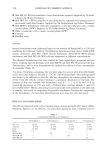
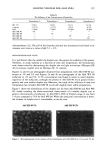
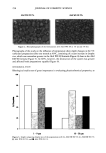
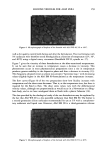
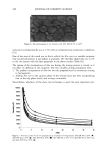
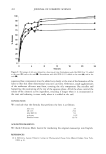
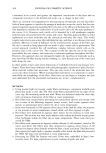
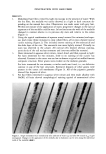
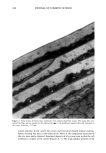
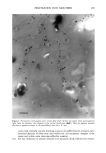
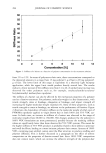
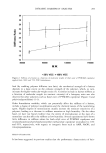
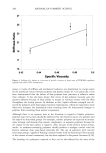
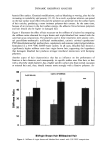
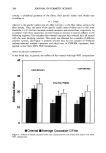
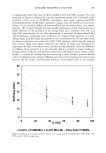
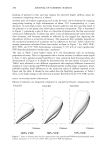
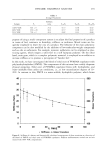
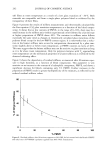
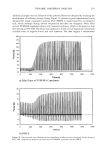
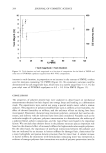
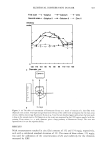
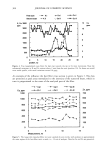
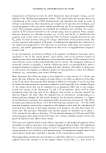
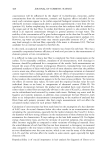
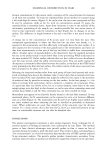
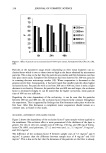
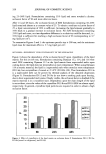
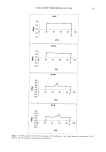
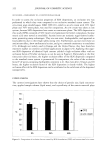
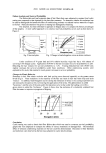
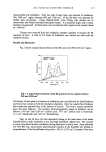
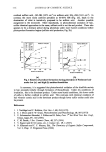
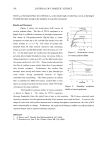
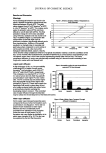
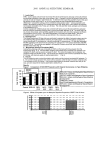
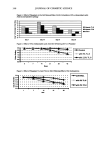
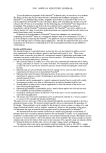
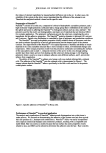
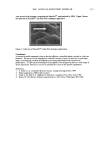
342 JOURNAL OF COSMETIC SCIENCE Results and Discussion Rheology Vernix rheological behavior was found to be plastic. Marked temperature dependence was observed between 25 and 40øC. The yield value dropped from 6.7x10³ dyne/cm• at 25øC to 4.0x10³dyne/cm 2 at 40øC. This makes vernix easier to spread in utere (37øC) and more difficult to rub off after birth (25øC). The flow activation energy for vernix was calculated using Arrhenius analysis and was found to be 102.7 Kcal/Mole (Figure 1). Interaction with components of amniotic fluid such as pulmonary surfactant significantly altered vernix flow characteristics. Addition of Survanta© resulted in a dramatic drop in viscosity and yield value when compared to vernix alone or vernix+saline (control). Like many other biological materials (blood, sputum, etc) (4), Figure 1. Arrhenius Analysis of Effect of Temperature on Vernix Rheology 3.S 3.0 u •.0 $.1•E-O• , vernix showed creep compliance behavior of a typical viscoelastic material. Under the conditions of the test, vernix showed initial instantaneous compliance followed by a curved portion corresponding to the viscoelastic region then a third linear portion representing steady state viscous flow. The creep compliance behavior of vernix was mechanically modeled using a 4-element model consisting of one Voigt unit in series with one Maxwell unit. Liquid water diffusion At film thickness of 20 • m, the permeability coefficients(PC) of water through vernix, Aquaphor © and petrolatum were 203x10 -3, 96.1 x10 '3 and 8.3x10⁻³cm/hr, respectively. This compares to a reported PC of 1.7x10 -3 for native human skin (5). Both Aquaphor• and petrolatum have higher PC than native skin. The PC of vernix was two times higher than Aquaphor• and 25 times higher than petrolatum (Figure 2). These data support the hypothesis that vernix in utero does not act as a totally occlusive biofilm but rather forms a semiocclusive barrier overlying the developing stratum corneum. This controlled rate of water diffusion through the fetal skin Figure 2. Permeability coeffient of water through different materials (37"C/20urn thickness) Vernix Aquaphor Petrolatum Skin may be critical for the development of the fetal skin barrier. Water vapor diffusion Vernix water vapor transpert properties were compared to those of other formulations such as petrolatum and Aquaphor. Vernix did not •- 8o present much resistance to water vaper •- diffusion and was considerably more • •' 60 permeable than petrolatum and Aquaphor. •' • Unlike the case of liquid water (Fig. 2), 4o Aquaphor was very similar to petrolatum in its • 2o -- water vaper transpert (Fig. 3). This fact can • be explained by the fact that ^quaphor 0 Figure 3. Rate of Water Vapor Transport Through different Formulations 100 Gortex Vernix Petrolatum Aquaphor
Purchased for the exclusive use of nofirst nolast (unknown)
From: SCC Media Library & Resource Center (library.scconline.org)