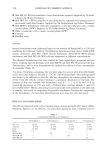
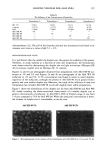
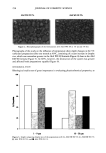
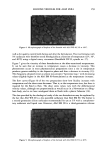
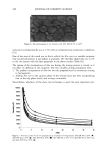
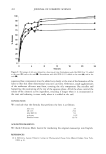
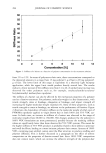
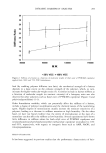
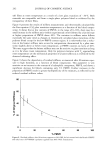
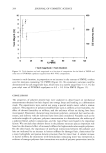
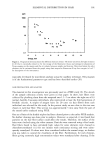
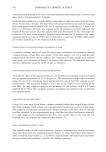
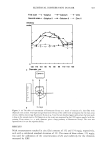
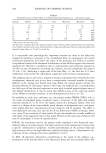
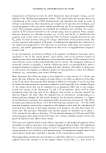
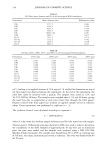
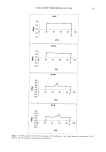
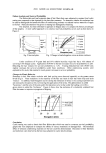
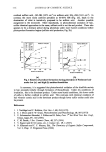
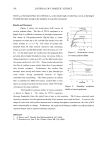
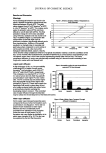
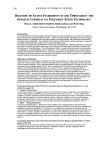
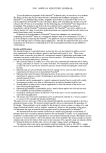
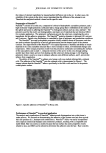
2001 ANNUAL SCIENTIFIC SEMINAR 333 respectively. The RHC of the bleached hair decreased 72.8% compared with that of the virgin hair. Such a decrease indicates the severity of damage sustained by the bleached hair. SEM inspection found many visible holes and severe cuticle abrasion on the surface of bleached hair. Ta increases with an increase in bleaching time. Since Ta depends on the cross-link density of the matrix, the higher the cross-link density is, the higher their viscosity will be, and the more hindered the helix/coil transition will be in the IFs. It is known that the content of cysteic acid (the product of oxidation of cystinc during bleaching) increases with bleaching time. The increase in Ta with the bleaching time may reflect the increased amount of cysteic acid being produced in bleached hair and the stronger ionic interactions that result. It is also observed that the AHa decreases and Ta increases with an increase in relaxation time for Afro-American hair. ß Helix Peak Recovery - Hair Restructuring Data on AHa and Ta of bleached hair before and after treatemnts with a selection of protein derivatives are presented in Table II. Table II Effects of Protein Treatments on Helix Peak of Bleached Hair Hair None Hydrolyzed Cystinc Hydrolyzed Wheat Protein and Treatment Wheat Protein Polysiloxane Hydroxypr0pyl Polysiloxane AHa (J/g) 1.07 (100%) 1.90 (177.5%) 1.84 (172.0%) 2.02 (188.8%) Ta (øC) 247.0 242.2 241.5 242.2 The RHC increased 77.5%, 72.0%, and 88.8%, respectively, for hair samples treated with Hydrolyzed Wheat Protein, Cystinc Polysiloxane, and Hydrolyzed Wheat Protein and Hydroxypropyi Polysiloxane. The Ta decreases dramatically after treatment with the proteins. Previous studies (6) have shown that hydrolyzed wheat protein and cystinc polysiloxane are both able to penetrate the hair where they undergo disulphide bond interchange reactions with cystinc residues in the hair. These reactions change the amount and structure of helix in the hair, as reflected by an increase in AHa and decrease in Ta. It is found that the leave-on products showed better peak recovery effects than the rinse-off products. Generally speaking, high molecular weight protein derivatives like hydrolyzed wheat protein and hydroxypropyi polysiloxane cannot penetrate into the hair because of their large size. As mentioned before, the bleached hair sample was severely damaged and very porous. The porosity of the hair may have made it possible for the polymer to penetrate into hair and react with the hair. The partial penetration may account for the significant increase in the AHa of hair sample treated with the polymer. An increase in AHa and decrease in Ta are also observed for the relaxed hair samples treated with the protein derivatives. 2.5 o • 1.5 0.5 210 230 250 T Figure I DSC curve of human hair References i. 2. 3. 4. 5. 6. 105 100 95 90 85 80 242 "'' ' ø ' 240 238 234 2•2 0 15 30 45 60 Bleaching Time (min.) Figure 2 Changes in RHC and Ta with bleaching time M. Spei and R. Holzem, Thermoanalytical investigation of extended and annealed keratins, Colloid & Polymer Sci., 265,965- 970 (1987). M. Spei and R. Holzem, Thermoanalytical determination of the relative helix content of keratins, Colloid & Polymer Sci., 267, 549-551 (1989). P. Milczarek, M. Zielinski and M.L. Garcia, The mechanism and stability of thermal transition in hair keratin, Colloid & PolymerSci., 270, i 106-1 i 15 (1992). J. Cao, Melting study of the a-form crystallites in human hair keratin by DSC, Therm. Acta, 335, 5-9 (1999). F.J. Wortmann, C. Springob and G. Sendeibach, Investigation of cosmetically treated hair by DSC in water, Proceedings of XXl IFSCC, 293-298, 2000. • J.A. Swift, S.P. Chahal, N.A. Chalioner, and J.E. Paefrey, Investigations on the penetration of hydrolyzed wheat proteins into human hair by confocal laser-scanning fluorescence microscopy, J Cosmet_ Sci., 5 i (3), 193-203 (2000).

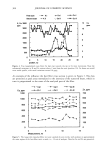
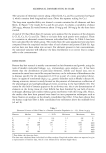
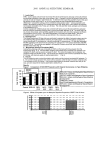
334 JOURNAL OF COSMETIC SCIENCE FTIR INVESTIGATION OF THE AMBIENT DEPENDENT PHOTODAMAGE IN HAIR K.R. Ramaprasad, Ph.D., N. Vasanthan, Ph.D. and Yash Kameth, Ph.D. TRl/Princeton, Princeton, NJ 08542 Introduction The literature on the oxidation of the disulfide bond, be it in model compounds or keratin fibers, spans many years. Both chemical and photochemical studies have established the general course of oxidation (see, for example, 1-5). The products of oxidation, mostly sulfoxides and sulfonic acid, are dependent on the chemical agents used and other reaction conditions. Photolysis of cystinc itself in aqueous acid solutions [2] yields various products including cysteine, ammonia, cysteic acid and alaninc. Using the model compound N,N'-bisacetyl-L-cystine bismethylamide (ACM), Schumacher- Hamedat, et al [3] have shown the formation of monoxide (K-SO-S-R) and dioxide (K- SO2-S-R) when treated with performic acid or a commercial bleaching solution. Such oxides were also identified in similarly treated hair. With particular reference to the weathering, that is, photodegradation, of hair, in an FTn• investigation, Signori and Lewis [5] report mainly cysteic acid from peroxide bleaching and photodegradation [5]. Using FT Raman spectroscopy, Pande [4] has contrasted results from chemical oxidation with those from photodamage, pointing out the formation of intermediate sulfur oxides in the latter compared to the highly oxidized sulfur (cysteic acid) from the chemical route. The present work is a reinvestigation of the FTn• spectra of hair that has been photodamaged under two different ambient humidities. The goal was to examine the existence, if any, of different pathways for the photodamage, depending on the ambient. Earlier literature on disulfides [6] suggests that, during the oxidation of the disulfide bond, anhydrous conditions favor formation of oxides whereas hydrolyric conditions are conducive to formation of the acids with sulfur oxidized to higher states. The final stable product will in all cases be sulfonic acid, where sulfur is in its highest state of oxidation. Both brown European and Piedmont hair fibers were investigated in this work. Experimental Hair tresses were supplied by De Meo Bros., New York. Irradiation work was carried out at two relative humidities (10 - 14% and 60-65% ranges). Low humidity work was performed using Q-UV Weatherometer (Model QUV/SE). Atlas Fade-O- Meter (Model 25-FR) was used in the higher humidity photolysis. Though the two instruments have different radiation intensities, for FTIR work, as explained below, use of Amide I internal standard circumvents different radiation levels at the substrates. Infrared spectra were collected on a Nicolet 560 FTn• Spectrometer. All the spectra were gathered using an attenuated total reflectance accessory (ATR) and a ZnSe crystal. At least 128 scans were obtained to achieve an adequate signal to noise ratio. Hair tresses were suitably mounted to have a constant tress configuration during n•
Purchased for the exclusive use of nofirst nolast (unknown)
From: SCC Media Library & Resource Center (library.scconline.org)