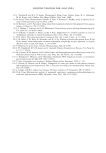
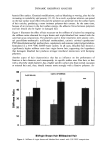
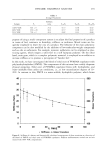
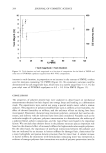
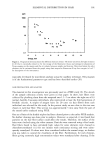
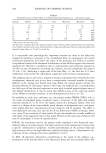
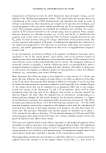
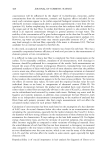
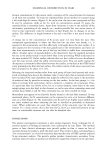
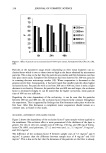
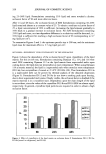
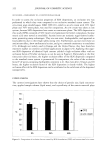
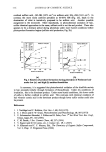
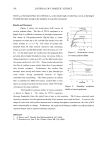
294 JOURNAL OF COSMETIC SCIENCE 10 45O 8 7 6 4 3 2 0 0 I I I 20 40 60 % PMVE I I 0 80 100 120 300 o 15o ß Tack magnitude ß Tack Duration Figure 11. Tack duration and tack magnitude as a function of composition for the blend of PMVE and ethyl ester of PVM/MA copolymer applied from 80% VOC compositions. increase in tack duration, in proportion to an increase in the content of PMVE, evident even for mixtures containing 5% PMVE (Figure 11). No systematic variation could be demonstrated by tack magnitude data, which vary in a narrow range from 5.3+ 1.3 G for pure ethyl ester of PVM/MA copolymer to 6.9 + 0.2 G for PMVE (Figure 11). CONCLUSIONS The properties of polymer-treated hair were analyzed in detail based on mechanical measurements obtained on hair shaped into omega loops and bending as a deformation mode. The experiments were carried out using a special tensile meter called a texture analyzer. The properties of polymer-modified hair such as stiffness at low humidity, the effect of elevated humidity on stiffness, and the tackiness of hair on drying have been investigated. Parameters characterizing treatment polymers, untreated hair used as sub- strates, and delivery vehicles (solvents) have been also considered. Variables such as the molecular weight of a polymer, polymer concentration in a formulation, the make-up of a polymer blend, solvent composition, and the type of hair were found to be important factors. We conclude that cohesive forces in the polymer structure play an important role based on the observed effect of increased stiffness for higher-molecular-weight polymers. On the other hand, the importance of interfacial interactions between the polymer and hair are indicated by an increase in hairset stiffness for damaged hair, characterized by a more hydrophilic and porous keratin structure than for intact hair. A similar increase in hairset stiffness for treatments with formulations containing water was interpreted as evidence of stronger polymer-hair interactions as a result of polymer penetration into the

DYNAMIC HAIRSPRAY ANALYSIS 295 surface layers of the water-swollen hair structure. In addition to this, an investigation of several properties of hair treated with a polymer blend of ethyl ester of PVM/MA copolymer and poly(methylvinylether) has shown: (a) high sensitivity of stiffness reten- tion and tackiness duration to the presence of a hydrophilic component (PMVE), and (b) relatively low sensitivity of stiffness to polymer blend composition for systems charac- terized by a glass transition above room temperature. ACKNOWLEDGMENTS The authors wish to thank R. McMullen for numerous discussions of the results and for help in the preparation of the manuscript. REFERENCES (1) J. Jachowicz and K. Yao, Dynamic hairspray analysis. I. Instrumentation and preliminary results,•/. Soc. Cosmet, Chem., 47, 73 (1996). (2) J. Jachowicz and R. McMullen, The mechanical analysis of elasticity and flexibility of polymers used as hair fixatives, Proceedings of the IFSCC Conference, Santiago de Chile, May 1999. (3) J. Jachowicz and R. McMullen, Mechanical analysis of hair fiber assemblies by static and relaxation measurements, XXI IFSCC International Congress, Berlin, September 11-14, 2000, pp. 287-292. (4) J. Martin, J. F. Johnson, and A.R. Cooper, Mechanical properties of polymers: The influence of molecular weight and molecular weight distribution,J, Macrotool. Sci, Revs. Macrotool. Chem., C8(1), 57 (1972). (5) The question of interactions between the fibers and polymeric matrix was addressed in the literature in the context of composite materials such as polymer fiber systems. M. Nardin and J. Schultz, Langmuir, 12, 4238 (1996), discuss it in terms of interfacial shear strength described by the following equation: where x is the interfacial shear strength, E,, and Ej are el•tic toodull of the matrix and the fiber, W is the work of adhesion, and 8 is the distance. Thus, the strength of the polymer-fiber interactions are dependent upon cohesive strength of the polymer (proportional to E•,5) and adhesive strength pro- portional to W. (6) R. W. Rance, Studies of factors controlling the action of hairsprays. II. The adhesion of hairspray resins to hair fibers,J, Soc. Cosmet, Chem., 25, 297 (1974). (7) R. R. Wickerr, J. A. Sramek, and C. M. Trobaugh, Measurement of the adhesive strength of hair- hairspray junctions,J. Soc. Cosmet, Chem., 43, 169 (1992). (8) J. Jachowicz and C. Ramireddy, Cationic polymers, US Patent 5,149,752 J. Jachowicz and C. Ramireddy, Conditioners based on cationic polymers, US Patent 5,147,635. (9) For example, "Shrinkproofing wool by treating with water soluble hardenable polymer (polycarbam- oylsulphonates, Bunte salt polymers, amphoteric polymers) in aqueous medium," FR 2,434,888, assigned to IWS Nominee Ltd. (10) L.J. Wolfram, Wool modification by deposition of reactive polymers, AppL PoOm, Syrup,, 18, 523, (1971). (11) Y.K. Kamath, C.J. Dansizer, and H. D. Weigmann, Wettability of keratin fiber surfaces, J, Soc. Cosmet. Chem., 28, 273 (1977). (12) Y. K. Kamath, C. J. Dansizer and H. D. Weigmann, Wetting behavior of human hair fibers,J. AppL PoOm. SN,, 22, 2295 (1978). (13) Enoc/opedia ofPoOmer Sciene and Engineering, H. Mark, N. Bikales, Ch. Overberger, G. Menges, and J. Kroschwitz, Eds. 0ohn Wiley & Sons, New York, 1987), Vol. 7, p. 534.
Purchased for the exclusive use of nofirst nolast (unknown)
From: SCC Media Library & Resource Center (library.scconline.org)