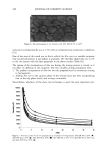
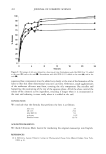
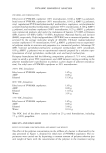
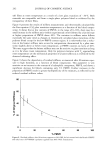
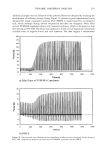
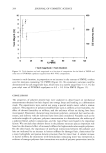
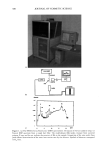
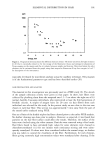
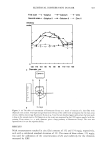
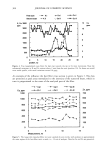
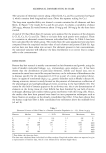
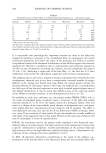
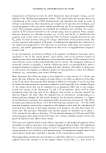
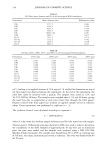
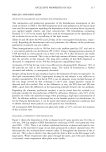
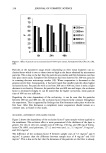
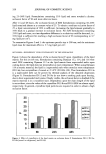
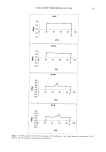
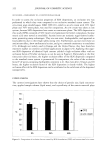
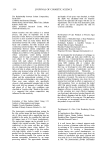
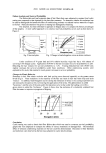
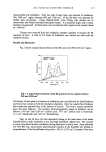
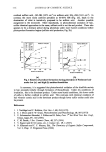
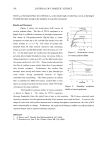
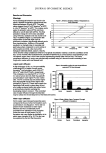
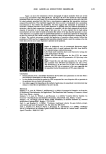
ELEMENTAL DISTRIBUTION IN HAIR 305 The variation of elemental content along a fiber for K, Ca, and Cu is presented in Figure 4, which contains both longitudinal scans. (Note the separate scaling for Cu.) The long-term reproducibility test showed a certain variation for all elements and hair fibers. In Figure 5 the results for Ca and Zn are given. Ca shows a variability of about 200 mg/g, whereas Zn varied between about 30 mg/g and 100 mg/g for the three hairs studied. A total of 250 hair fibers from 63 persons were analyzed for the presence of the elements S, Cl, K, Ca, Fe, Cu and Zn. Three or six hairs from each person were analyzed. There is a variation in elemental content between individual hair fibers. In Table I data have been calculated for the whole group. The results from the same population have also been computed from the empirical median value of each element and person (Table II). Age and sex have not been taken into account. For elements present in low concentrations, the statistical variation will influence the data distribution to an extent that is compa- rable to the concentration. DISCUSSION Present-day hair research is mainly concentrated on hair formation and growth, using the tools of modern molecular biology, e.g., immunology, gene analysis, etc. It has been shown that the distribution of particular elements, mobile and bound ions, not to mention the metal ions crucial for enzyme function, can be indicators of disturbances due to diseases specific for the integument (12,19) or as part of a more generalized distur- bance in organs of ectodermal origin, e.g., genetic disorders such as Menke's disease (4). Among scientists, interest is rarely focused on the presence of elements as a reflection of the physiological and pathophysiological events occurring in the hair follicle (10). The reason for this lack of interest appears to be an obvious one: the •, sit• determination of elements in the living tissue of a hair follicle has been hindered by our lack of micro- techniques allowing such studies without gross interference with the living cells. Hence, the studies that have been pursued were based on inert preparation techniques such as freeze fixation or analyses on the already consolidated hair fiber. It has been shown that the human scalp hair fiber is fully consolidated one millimeter above the midbulb level (cf. ref. 8). Table I Elemental Content of Hair Fibers in a Normal Caucasian Population (n = 63), Given in •g/g Element Median Mean +/- 1S.D. Minimum Maximum Unit S 3.6 3.6 0.6 1.2 4.8 % C1 * * 0.2 * 3.6 % K * 108 276 * 2182 I•g/g Ca 196 208 117 * 629 l•g/g Fe 4 6 7 * 41 t•g/g Cu 5 5 4 * 32 •g/g Zn 182 184 23 96 259 •g/g * Data below the detection limit. The data were calculated from individual hair fiber analyses. Empirical median values are expected to give a representation of baseline data, which is less influenced by extreme (high) values.

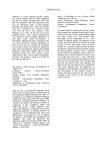
306 JOURNAL OF COSMETIC SCIENCE Table II Elemental Content of Hair Fibers in a Normal Caucasian Population (n = 20), Given in pg/g Element Median Mean +/- 1S.D. Minimum Maximum Unit S 3.6 3.6 0.5 2.0 4.6 % CI 0.5 0.5 0.1 0.2 1.0 % K * 78 195 * 1261 pg/g Ca 186 194 92 53 507 pg/g Fe 2 3 3 * 18 ktg/g Cu 4 5 2 1 18 pg/g Zn 183 182 17 148 232 pg/g * Data below the detection limit. The data were calculated from the emprical median values of the hair fibers obtained from each individual. As in Table I, elements with a skew distribution have conspicuous differences between empirical median and empirical mean values, cf. K and Ca versus Zn. It is conceivable that physiologically important elements are more or less effectively trapped by bonding to proteins in the consolidated fiber. In consequence, the overall elemental composition will reflect the status of the particular hair follicle at growth. Longitudinal studies of the elemental distributions in hair follicles support this tentative argument (2). Moreover, interference due to contamination and extraction imposed on the fiber by the environment (including any cosmetic activity) complicates the analysis (cf. refs. 5,14). Analyzing a virgin part of the hair fiber, i.e., the first few (2-5 mm) millimeters will provide the information sought for with minimal contamination. The sampling area on the scalp is important because individuals with a heredity for AnA (androgenetic alopecia) may in fact have a conspicuously increased number of telogen follicles in the coronal and frontal areas long before the typical pattern of hair loss becomes obvious (3). The region chosen in this study, the temporal one, is excluded from the AnA type of hair loss and represents an area with a normal anagen/telogen ratio of hair follicle distribution. It may be noted that different areas of the scalp may indeed reveal different elemental contents, as was demonstrated by Seta et M. (24). No methods are truly inert, and some, e.g., the particle probes (XRMA, PIXE), will, in the course of prolonged times of analysis, cause a "burn-out" of the light and volatile elements (mainly H, C, N, O) in the organic matrix of a biological sample. This will result in a change of the (non-volatile) metal element to background ratio, and appar- ently higher-than-live concentrations of such elements will be recorded. The effect is time-dependent and may exist also for the X-ray fluorescence (XRF) technique. How- ever, using X-ray excitation of characteristic X-rays, the samples are virtually unaffected with doses of the magnitude used in this study. Revisits to the same area of analysis will thus be meaningful in terms of reproducibility. ITRAX, the instrument used in the present study, represents a new design for trace- element analysis in small samples. The high sensitivity of the instrument is achieved by a specific combination of properties, namely monochromacy of the primary beam and high intensity due to the high-efficiency capillary focusing device. Comprehensive de- scriptions of the technique have been published (7,16,21). In XRF, all-important phenomena contributing to the result of the analysis, e.g., attenuation of the primary beam or the fluorescent beam and any secondary effects like
Purchased for the exclusive use of nofirst nolast (unknown)
From: SCC Media Library & Resource Center (library.scconline.org)