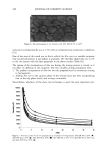
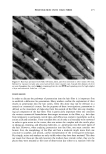
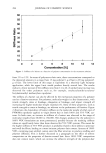
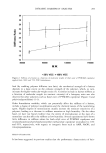
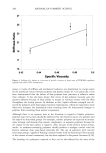
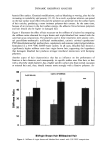
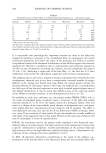
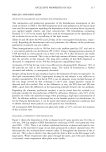
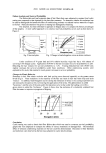
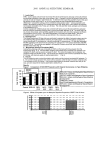
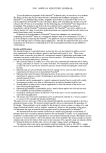
2001 ANNUAL SCIENTIFIC SEMINAR 337 CURDLAN: STYLE MEMORIZING POLYMER FOR HAIR FIXATIVE Katsunori Yoshida, Ph.D., Daigo Mizumoto, M.S., Tomoyuki Kawasoe, M.S., Yoshiharu Tsuji, M.S., Masaaki Uemura, M.S. and Toshio Yanaki, Ph.D. Shiseido Research Center, 2-2-1 Hayabuchi, Tuzuki, Yokohama, 224-8558, Japan Introduction A variety of synthetic and natural polymers have been developed as a hair fixative to meet various consumers' needs. One of the most popular materials is vinyl polymer, particularly, the copolymer of vinylpyrrolidone. Despite its superior ability to fixate hairstyle, the application feeling of the polymer is uncomfortably hard and tough. To improve the application feeling, some of natural polymers and their derivatives are proposed. In general, however, the ability of natural polymers to keep hairstyle nnder high humidity is unsatisfactory. Thus, a hair fixative polymer that gives soft and light application feeling but provides high humidity resistance is desired. In this •vork, we propose the use of curdian, a natural occurring polysaccharide,• as a novel hair fixative polymer that bears both soft application feeling and high humidity resistance. Experimental [- cu:oH ca.oa • o o purchased from Takeda Chemical Industry (Tokyo, ' , , [ Japan), and used as received. The chemical structure of k ' oH , o• 3,, curdian is shown in Figure 1. Figure 1. Chemical structure of curdian. Rheological measurements. Polymer films were prepared by drying their solutions at 25øC in clean bench for overnight. The curdlan film was prepared as the same manner' as described above except by drying its gel that was prepared by heating curdian sol at 80 øC for 30 min. The theological properties of films were measured by a dynamic viscoelastic an•alyzer RSA II (Rheometric Scientific F.E., Tokyo). Scanning electron microscopy (SElVl). Hair was dipped in polymer solution, and the excess amount of solution was combed out. The hair was dried at 80 øC for ,30 min, and the polymer film on hair surface was studied by SEM (S-4200, Hitachi, Tokyo). Humidity resistance ability (R %).2 Polymer solutions (0.5%, 0.4 g) were applied to hair tresses (160 mm long, 1 g). The hair tresses were curled and then dried at 80 øC for 30 min. The curled hair was hung in incubator (40 øC, 75% RH). The length of curled hair was measured in time course. The humidity resistance ability(R%) was evaluated by folloxving equation: R%= Lø 'Lt xlO0 (1) L o - L•

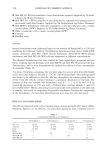
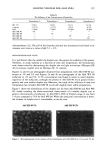
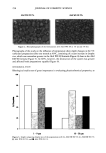
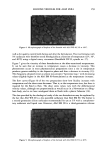
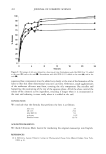
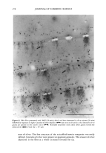
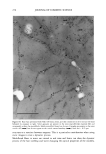
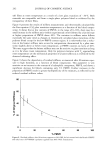
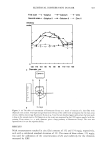
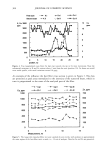
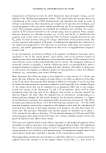
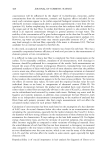
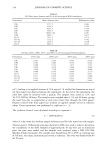
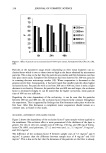
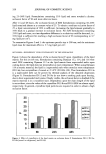
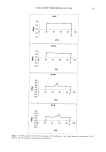
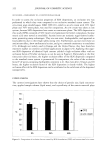
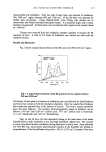
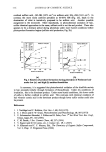
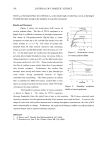
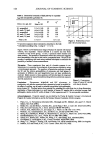
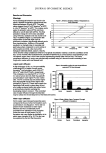
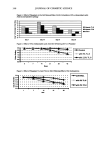
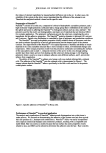
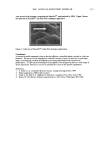
338 JOURNAL OF COSMETIC SCIENCE where Lo is the length of hair tress (160 mm), L• is the initial length of curled hair, and Lt is the length of curled hair after setting in the incubator at a specific time period. Results and Discussion Figure 2 shows the strain-stress (S-S) curves of various polymer films. The film of VP/VA copolymer is so fragile that it is difficult to measure its rheological properties. The stress of Polyquaternium-10 (PQ-10) film is linear proportion to strain up to 2%, and the film breaks when the stress reaches to I x 10 • Pa. The stress of cm'dlan film obtained from sol state linearly increases with increasing strain up to 2%, and the film breaks when the stress is 2 x 10: Pa. On the other hand, the curdlan film that prepared Dom gel state shows higher breakdown stress the stress of film is linear proportion to strain up to 3%, and the film breaks when the stress reaches to 4.4 x 10 v Pa. These results indicate that the film of curdian is more elastic than that of conventional hair fixative polymers. Furthermore, the curdian film becomes more strong and elastic when it goes through gel state before drying presumably because of higher intermolecular crosslinking. The elastic property of curdian film is confirmed by SEM observation curdlan film on hair shows no change even when the hair is bent, while VP/VA film is broken at the same condition. The humidity resistance ability of various polymers is shown in Figure 3. The values for VP/VA copolymer Curdian Gel 4 Cu • , o J 6 9 1 • . 15 Slrcln/O•6 Figure 2. Stress-strain curves for various polymer films. •o too t•o Time/rain Figure 3. Humidity resistance ability of various polymers. decrease drastically •vhen the curled hair is kept in the incubator. PQ-10 shows relatively good humidity resistance, but the application feeling of this polymer was tough and hard. In contrast, the shape of curled hair with curdlan demonstrates no change throughout measurement the value of R % shows substantially no change. Furthermore, the application feeling of curdlan was soft and light as required despite such a superior humidity resistance. References 1. A. Konno and T. Harada FoodHydvocolloids 5, 427 (1991). 2. T. Kawasoe et al. dpn. d. $oc. Uosmet. Ubem., 33, 119 (1999).
Purchased for the exclusive use of nofirst nolast (unknown)
From: SCC Media Library & Resource Center (library.scconline.org)