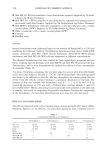
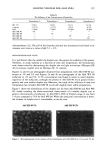
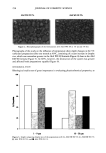
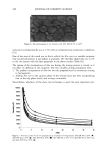
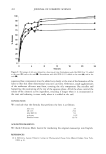
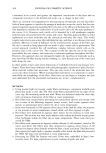
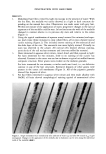
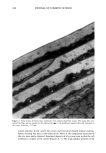
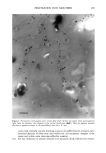
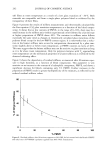
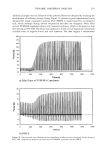
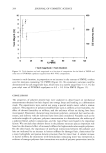
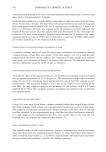
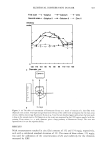
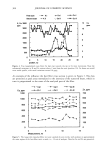
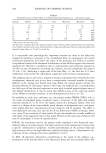
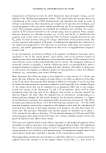
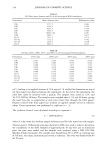
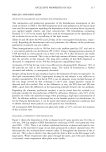
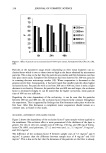
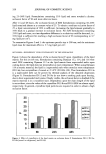
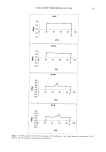
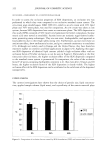
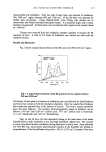
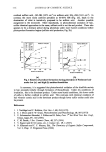
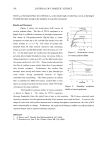
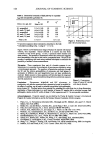
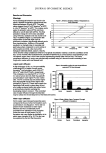
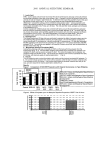
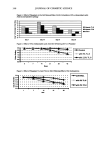
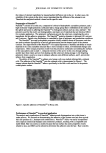
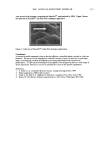
2001 ANNUAL SCIENTIFIC SEMINAR 335 measurement and irradiation. Only one side of each tress was exposed to irradiation. The 1200 cm 'l region, between 900 and 1300 cm 'l, of the IR trace was selected for further data processing. Using PeaksolveTM, curve fitting was carried out to deconvolute and isolate individual absorption bands. A Lorentzian shape with a linear baseline was assumed. All band areas were normalized with respect to the Amide I band at -1640 cm 4. Tresses were removed from the irradiation chamber regularly to monitor the IR spectrum of each. A total of 412 hours of irradiation was carried out with both the radiation sources. Results and Discussion Fig. 1 shows a typical deconvolution of the IR trace in the 900-1300 cm 'l region. 0.0,10 0 035 - ß i 0 030 - ß m, 0.025 - 1.0•111Bai•I 4.1tll Z. 1•.1 tilt '1 S. 1117 •111 3.1•473 cll• -I s. 12ZI 0.020 , , , , 900 1000 1100 1200 1300 1400 Wivenumber. am '• Fig. 1 A typical deconvolution of the IR spectrum in the region between 900 and 1300 cm 4 The history of each peak as a function of irradiation time was followed for both Piedmont and brown hair tresses in both the irradiation chambers. Only the results from Piedmont hair tresses are reported here in the interest of brevity. The brown tresses essentially show the same behavior. The tentative band assignments, based on literature, are as follows: 1041 cm 'l and 1229 cm 'l sulfonic acid 1073 cm 'l sulfinic acid or monoxide 1111 cm 'l disulfoxide and 1167 cm 'l thiosulfonate. Figs. 2a and 2b show the time dependent change in the peak areas of the bands identified above under irradiation at low and high humidities respectively. The contrast in terms of preferred product production during photolysis is clearly seen. Drier ambients (10-14% R/I, Fig. 2a) promote photochemical reaction at the disulfide site leading to preponderance of the thiosulfonate end product, -SO2-S- (1167 cm'l), instead of the more

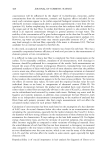
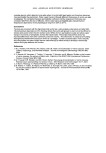
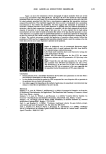
336 JOURNAL OF COSMETIC SCIENCE oxidized sulfinic acid, -SO-OH (1073 cm ']) or sulfonic acid, SO2 -OH (1041 cm']). In contrast, the more moist ambient prevalent at 60-65% RH (Fig. 2b), leads to the domination of what is tentatively proposed to be sulfinic acid. Another possible assignment is the monoxide. More importantly, in photochemical oxidation of hair, unlike chemical approaches to the same, sulfonic acid is not the end product. There also appears to be a dormant period during photolysis under more humid conditions before photoproduct formation begins (sulfinic acid production, Fig. 2b). 0.5 0.4- 122g cm '• [ Piedmont 10-14% RH 1167 '• 1111 cm • • ,•,,•.•,•, A • /// 100 2o0 300 4OO 5OO Duration of Irr.diatlon (h) Piedmont 80.-66% RH 0,5 -e- 1229 cm 't II /I-'- •o7• •m -- 0.2 o. 1 .. .• , 0 0 -• 0 100 2OO 30O 400 Duration of Irradiation (h) (a) (b) Fig. 2 Kinetics of product formation during photolysis of Piedmont hair under low (a) and high (b) ambient humidities In summary, it is suggested that photochemical oxidation of the disulfide moiety in hair proceeds initially through formation of thiosulfonate. Under dry conditions of irradiation, this is the dominant product. Under more humid conditions, this lower oxide of sulfur is further oxidized to sulfinic acid. This contrasts with chemical oxidation of hair wherein cysteic acid is the dominant product though lower sulfur oxides could also be present. References 1. J. Nachtigal and C. Robbins, Text. Res. ,L., 40, 454 (1970) 2. C.J. Dixon and D. W. Grant, Photochemistry andPhotobiology, 18, 387 (1973) 3. U. Schumacher-Hamedat, J. F6hles and H. Zahn, Proc. 7 th Int. Wool Text. Res. Cvnf, Tokyo, Japan, IV, 120 (1985) 4. C.M. Pande, d. Soc. Cosmet. Chern., 45, 257 (1994) 5. V. Signori and D. M. Lewis, int. d. Cosmet. Sci., 19, 1 (1997) 6. N. Kharasch and C. Y. Meyers, Eds., The Chemistry of Organic Sulfur Compounds, Vol. 2, Chap. 15. Pergamon Press (1966)
Purchased for the exclusive use of nofirst nolast (unknown)
From: SCC Media Library & Resource Center (library.scconline.org)