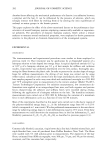
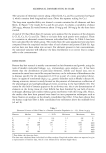
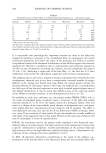
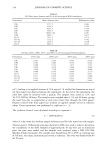
316 JOURNAL OF COSMETIC SCIENCE Table II PCS Data (mean diameter and PI) of the Investigated SLN Formulations Formulation Mean diameter (nm) Polydispersity index CPa 227 + 2 0.093 CPb 316 --- 4 0.182 CPc 405 ___ 3 0.236 CPd 518 q- 4 0.296 CPe 3000 q- 100 0.597 CPZ 208 q- 1 0.072 Dl12 167 q- 2 0.174 D114a 172 q- 2 0.192 D114b 193 q- 2 0.238 D116 206 q- 2 0.232 Table III LD Data (d50%, d90%, d95%, and d99%) of the Investigated SLN Formulations Formulation d50% (pm) d90% (pm) d95% (}•m) d99% (pm) CPa 0.187 0.364 0.405 0.478 CPb 0.306 0.486 0.539 0.642 CPc 0.388 0.742 1.675 2.252 CPd 0.620 4.210 5.669 8.024 CPe 4.248 7.238 8.120 9.848 CPZ 0.300 0.550 0.660 5.110 D112 0.135 0.310 0.393 0.547 D114a 0.117 0.299 0.365 0.480 D114b 0.134 0.343 0.433 0.581 D116 0.109 0.228 0.296 0.464 cm2), leading to an applied amount of 10.6 mg/cm 2. A visible film formation on top of the filter paper was observed during the experiment. At the end of the experiment, the solid film could be removed with a spatula. The samples were stored at 32øC and 50-55 % RH for 48 hours. The samples were weighed after 6, 24, and 48 hours, giving the water loss due to evaporation at each time (water flux through the filter paper). Beakers covered with filter paper but without on applied sample served as reference values. Every experiment was performed in triplicate (n -- 3). The occlusion factor F was calculated according to equation 1' F-- lO0*((A-B)/A) (1) where A is the water loss without sample (reference) and B is the water loss with sample. Therma/a,a/ysis. Differential scanning calorimetry (DSC) was used in order to determine the crystallinity of the SLN. Samples of approximately 10 mg were put in aluminum pans, the pans were sealed, and the samples were analyzed using a DSC 821/700e (Mettier-Toledo, Germany). The samples were heated from 20 ø to 90øC at a heating rate of 5 K/min. An empty aluminum pan served as reference. The oven was flushed with 80 ml N2/min.

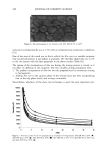
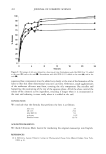
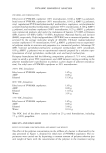
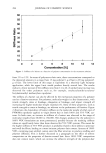
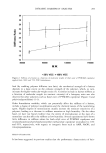
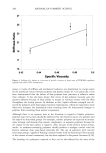
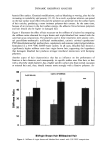
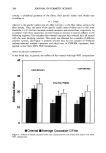
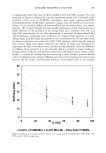
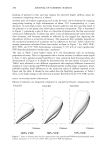
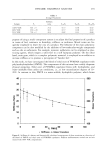
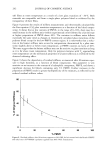
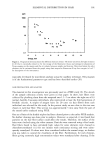
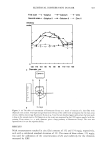
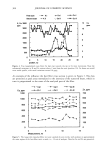
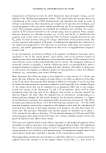
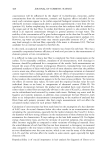
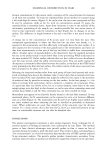
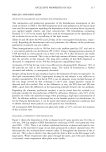
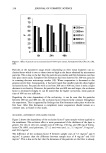
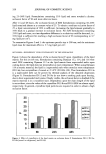
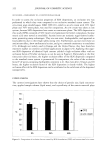
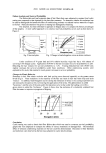
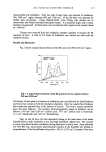
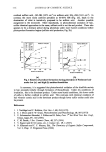
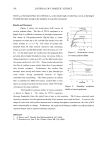
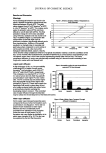
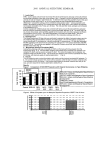
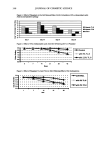
OCCLUSIVE PROPERTIES OF SLN 317 RESULTS AND DISCUSSION PRODUCTION PARAMETERS AND PARTICLE SIZE DETERMINATION The composition and production parameters of the formulations investigated in this study are shown in Table I. The SLN dispersions with cetyl palmirate as the matrix lipid were used for investigations regarding the dependency of the occlusion factor on particle size, applied sample volume, and lipid concentration. The formulations containing Dynasan 112-116 as the matrix lipid were used for investigations on the dependency of the occlusion factor on the crystallinity of the lipid matrix. Tables II and III show the PCS and LD data of the investigated formulations, respec- tively. Regarding the formulations with cetyl palmirate, the influence of the production parameters on particle size are evident. Three homogenization cycles at 500 bar lead to the smallest particles (247 nm) and to a very narrow particle size distribution (PI: 0.093). Using a homogenization pressure of 1500 bar leads to a low particle size as well (316 nm, PI: 0.182). However, the width of distribution is increased. This is due to the high amount of kinetic energy that is put into the particles at this pressure. The long-term stability of this SLN dispersion is decreased in comparison to the 500-bar formulation (unpublished data). A pressure of 150 bar for one cycle is less efficient for obtaining SLN. However, 76% of the particles are still in the nanometer range. The width of distribution is further increased and stability is consequently decreased. Simply cooling down the pre-emulsion leads to the formation of lipid microparticles. At this lipid concentration (40%), high-speed stirring for one minute is not sufficient to produce nanoparticles. For this batch, PCS is not an adequate sizing method because of the size range covered by this technique (3 nm-3 pm). Larger particles cannot be detected with this method. Due to the differences in size, the PCS data and LD data differ--apart from the differences in the measuring principle between the two methods. Regarding the ultrasonic production method, it can be stated that this method is in principle suitable for the production of SLN by definition. However, only 92% of the particles are within the nanometer range when processing a high lipid concentration of 40%. In addition, stability is decreased due to the broader particle size distribution. As for the Dynasan formulations, it can be stated that identical production conditions lead to almost identical mean particle size and particle size distribution. All investigated SLN formulations are physically stable at 32øC, well over the duration of the occlusion tests. OCCLUSION--DEPENDENCY UPON PARTICLE SIZE Figure 1 shows the dependency of the occlusion factor F upon particle size. For this in vitro test, 200-mg samples of SLN formulations consisting of 40% cetyl palmirate were used (CPa - CPe). There is an evident correlation between occlusion and particle size. Particles in the micrometer range do not show pronounced occlusive characteristics. For these particles, the occlusion factor remains under 15 throughout the duration of the in vitro test. This is due to the fact that these particles form a film on the filter paper with larger pores. Water evaporation takes place through the pores, and if the pore diameter is increased, water evaporation takes place more readily.
Purchased for the exclusive use of nofirst nolast (unknown)
From: SCC Media Library & Resource Center (library.scconline.org)