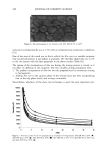
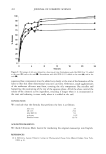
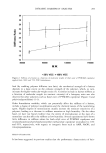
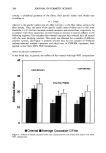
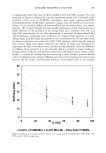
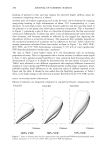
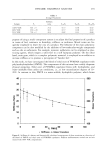
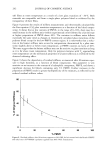
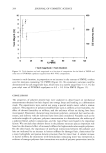
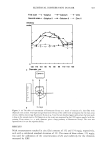
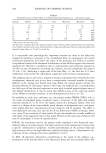
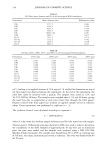
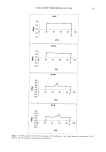
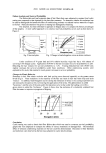
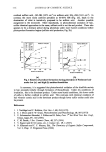
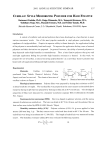
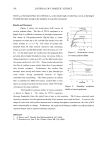
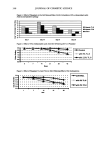
2001 ANNUAL SCIENTIFIC SEMINAR 349 Figure 6. Effect of Polyester TL-8 on Magnesium Ascorbyl Phosphate (MAP) Skin Whitening 0.5 01 ..... 0 7 14 21 28 '-e'-Control- 10% MAP I •5% MAP + 2.5% TL-8 '"'•--3% MAP + 2.5% TL-8 Days Figure 7. Effect of Polyester TL-8 on Skin Whitening Effect of Arbutin 3 7 14 21 28 Days '-e'-Control 10%Arbutin ........ 5% Arbutin and 2.5% TL-8 .' I References: 1. T. Ghosh and W. Pfister, Transdermal and Topical Delivery Systems: An Overview and Future Trends in Transdermal and Topical Drug Delivery Systems, T. Ghosh and W. Pfister, eds. Buffalo Grove, IL Interpharm Press (1997) p. 7. 2. M. Reiger. Factors Affecting Sorption of Topically Applied Substances, in Skin Permeation Fundamentals and Applications, J. Zatz, ed, Wheaton. IL: Allured Publishing Corp. (1993) p. 70. Chapter 2. 3. G. Kenney, A. Sakr, J. Lichtin. H. Chou and R. Bronough. In Vitro Skin Absorption and Metabolism of Padimate-O and Nitrosamine Formed in Padimate-O Containing Cosmetic Products, J Soc Cosmet Chem 46 (2) 117-127 (1995). 4. T. Carpenter. A. Howe. A. O'Connor, J. Orfanelli. R. Siegfried, Protection From Sun Protectors, DC1158 (3) 56- 59, 100-101 (1996). 5. T. Franz. P. Lehman, E. McGuire. In Vivo Methods for the Assessment of Percutaneous Absorption in Man, in Skin Permeation Fundamentals and Applications, J. Zatz. ed, Wheaton, IL: Allured Publishing Corp. (1993) pp 84-85. Discussion: The results from both studies indicate that high molecular weight, cross-linked polyesters are most effective at mitigating skin penetration of actives. By incorporating such polyesters into formulations containing actives that require distribution within the uppermost layers of the SC. the actives performance can be optimized. Deleterious effects attributed to further penetration of these actives into the viable dermis can also be avoided. Distribution of Actives in Lower Layers of the Stratum Comeum - Effect of Polyesters with Lactic Acid, Hydroquinone, Magnesium Ascorbyl Phosphate, and Arbutin. Lactic acid is reported to have activity as an exfoliant to enhance desquamation, but also as a skin lightening active. The incorporation of specifically designed polyesters with formulations containing lactic acid enhanced performance in both applications. The improvement in perceptible skin lightening effect contributed by inclusion of polyester TL-8 (hydroxyl terminated, 800 MW), was concentration-independent at between 2.5 and 5.0% concentration. The more polar, TL-8 polyester was shown to be significantly more effective than the less polar. fatty alkyl terminated polyester TC-8, in the study conducted with hydroquinone, The studies conducted with formulations containing 2.5% polyester TL-8 in combination with MAP and arbutin both compared lower concentration of active ingredient with polyester to significanfiy greater levels of the respective active ingredients in the control formulations. Low molecular weight linear polar poiyesters offer delivery strategy for water- soluble skin lightening actives, which can permit formulators to significantly reduce the concentration of active ingredients. reduce cost and irritation potential, while maintaining a high level of perceptible clinical performance.

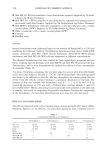
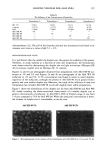
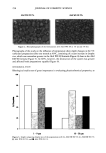
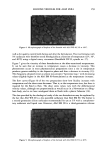
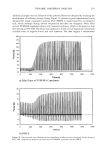
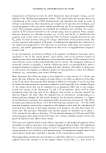
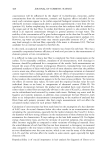
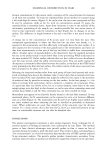
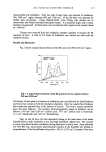
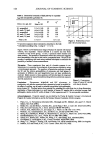
350 JOURNAL OF COSMETIC SCIENCE CONTROLLED RELEASE SYSTEMS FOR SKIN CARE APPLICATIONS Sam Shefer, Ph.D. and Adi Shefer, Ph.D. Salvona, LLC- Controlled Release Technologies • Abstract The major challenge in developing effective personal care and cosmetic products, on the physiological level, is the exposure of receptive site to effective levels of ingredients over a long period of time. Several studies have shown that active ingredients, commonly used for cosmecutical applications, including: vitamins, co-enzymes, enzymes, amino acids, and polypeptide, are more effective if they are available at effective level at the target site. This challenge can be addressed by either repetitive applications, or alternatively by utilizing advanced controlled release systems (CRS). CRS are designed to sustain the release, and target the active ingredients onto a specific site. Pharmaceutical CRS have significantly advanced drug efficiency and generated many successful commercial products. The knowledge and experience gained in the pharmaceutical field allows us to better understand systems, and design cost effective CRS to meet cosmetic and personal care products requirements. The system reported in this paper is based on sub-micron nanospheres specially design for skin care. In addition to its beauty and tactile properties the nanosphere-based product provides an efficient carder system for cosmeceutical actives to reach the deeper layer of the stratum cornium through the small size of the nanospheres and their hydrophobic properties that allow them to dissolve within the tissue and release their content. The results reported in this paper provide an overview of the rational in designing the product. Introduction Several research studies have demonstrated that the effect of specific active ingredients, such as: cosmecutical, on skin depends on the length of time the active is exposed to the tissue, at an effective level. The major challenges in enhancing the performance of various actives in skin care products are safety, stability, and efficacy. Advanced controlled release technologies may be a practical approach to address these issues. Common encapsulation technologies enable to retain active ingredients and maintain their integrity and stability over a long period of time. The system discussed in this paper was designed to provide a triggered release (release is activated by the consumer or through environmental change) and targeted release (release is targeted to specific action site). In addition to its delivery properties, the system retains the active in its natural form over extended period of time in the product base under accelerated stability tests. The objective of this paper is to discuss the rational approach to address the fundamental requirements in designing advanced controlled release systems (CRS) for skin care. This paper focuses on the development of nano-sphere technology with unique properties and performance features for skin care. Methods and Materials Salvona's proprietary nanospheres, NanoSal TM, are produced 2 by liquidation of a blend of hydrophobic polymers with the active to be released. The blend is stirred under high speed and high pressure and injected into a reactor containing a water-based emulsion of a blend of diblock polymers (both long molecular hydrophobic and hydrophilic chains). The slurry is transferred through a heat exchanger to reach a temperature of -5 ©C and lower for a short period of time. The suspension is allowed to reach equilibrium at room temperature. The resulting product of this process is a stable suspension. All components of the NanoSal TM including the blend of polymers and the emulsifying polymers are tailor made per properties of the active, and chosen to meet the final performance requirements of the product. • Salvona LLC - Controlled Release and Advanced Technologies, 65 Stults Rd, Dayton, NJ 08810-1523, Tel: 609- 655 0173, Fax: 609- 655 9291, Email: Sam@Salvona.com
Purchased for the exclusive use of nofirst nolast (unknown)
From: SCC Media Library & Resource Center (library.scconline.org)