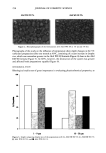
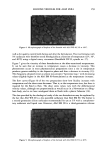
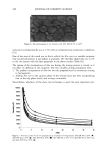
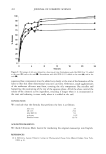
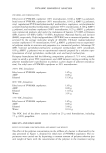
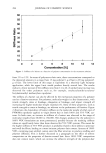
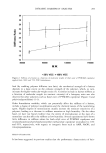
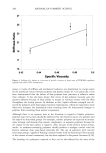
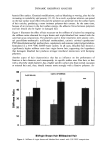
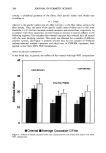
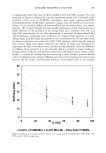
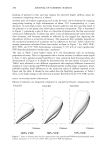
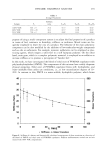
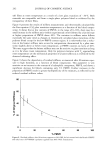
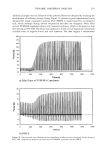
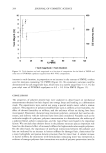
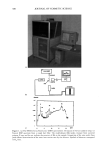
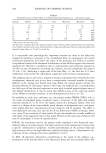
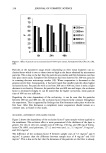
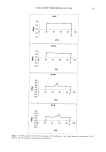
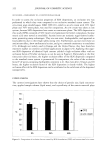
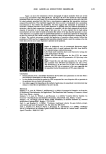
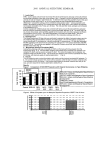
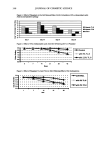
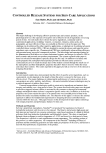
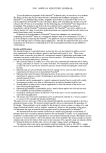
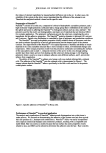
320 JOURNAL OF COSMETIC SCIENCE ing 25-30% lipid. Formulations containing 35% lipid and more revealed a distinct occlusion factor of 50 and more after six hours. After 24 and 48 hours, the occlusion factors of SLN formulations containing 10-20% lipid remained almost at a constant value of 25. To obtain a medium occlusion factor of 25, a lipid concentration of 10% is sufficient. Increasing the lipid amount gradually to 35% leads to a gradual increase in occlusion factor. For SLN formulations containing 35% lipid and more, no time-dependent difference in occlusivity could be detected, i.e., 35% lipid is sufficient for reaching a high occlusion factor of 65 (corresponding to 3.7 mg lipid per cm2). To summarize Figures 2 and 3: the optimum particle size is 200 nm, and the minimum lipid mass for maximum effect is 3.7 mg lipid per cm 2. OCCLUSION--DEPENDENCY UPON CRYSTALLINITY OF THE LIPID MATRIX Figure 4 shows the dependency of the occlusion factor F upon crystallinity of the lipid matrix. For this in vitro test, formulations containing Dynasan 112, 114, and 116 were used. SLN containing Dynasan 112 as the lipid matrix form supercooled melts upon cooling down the lipid does not recrystallize at room temperature. When using Dynasan 114 as matrix material, the lipid is a supercooled melt when stored at room temperature (D114a), but recrystallizes if stored at 4ø-8øC (D114b) (20). That formulation D114a is a supercooled melt can be proven by thermal analysis of the obtained dispersions (Figure 5). Formulations D112 and Dl14a do not show a melting peak upon heating, due to their supercooled melt status. Clearly visible, the occlusion factor is doubled if the matrix material is in a crystalline state. Dependency upon the chain length of the lipid is not evident, since the values of the crystalline D114b and D116 SLN are almost equal, respectively. In general, crystalline lipid particles are required in order to obtain a high occlusion factor. 35 30 25 20 15 10 5 0 24h 48h Figure 4. Effect of crystallinity of the lipid matrix on occlusion factor F (formulations Dl12, Dl14a, D114b [stored in refrigerator], and D116).

OCCLUSIVE PROPERTIES OF SLN 321 0,4 0,0 -0,2 -0,4 Dl12 20 40 60 80 [øC] lOO 0,4 0,2 o,o -0,2 -0,4 -0,6 D114a 20 40 60 80 100 [øC] D114b 0,8 0,6 0,4 • ,2 ,_, 0,0 -0,2 -0,4 -0,6 8'oJ 20 40 60 [oc] Dl16 lOO o,8 0,6 0,4 0,2 o,o -o,2 -o,4 -o,6 20 40 60 80 [oc] lOO Figure 5. DSC analysis for the determination of crystallinity of the lipid matrix (formulations Dl12, D114a, D114b [stored in refrigerator], and D116).
Purchased for the exclusive use of nofirst nolast (unknown)
From: SCC Media Library & Resource Center (library.scconline.org)