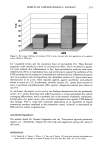
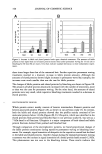
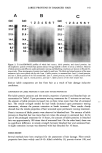
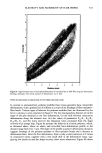
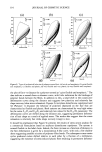
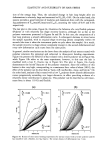
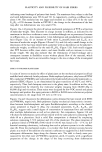
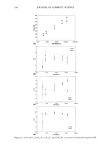
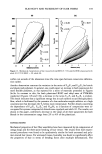
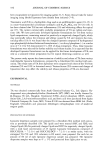
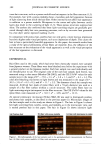
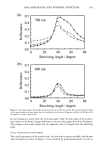
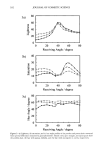
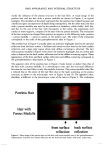
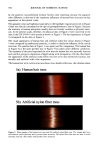
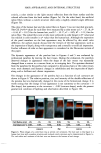
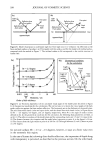
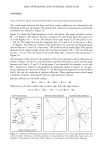
394 JOURNAL OF COSMETIC SCIENCE by the panelists was performed without further color matching, because the apparent color difference is also one of the important influences of internal hair structure on hair appearance in the present study. The apparent color and lightness (especially in the highlight region) perceived in Figure 4 does not directly correspond to the optical goniophotometric data in Figure 2 because the intensity in human perception usually does not linearly correlate to physical inten- sity. In the present study, therefore, the physical data in Figure 2 were converted to the data in the CIE L*a*b* color system as shown in Figure 3. The hair appearance in Figure 4 corresponds to the data in Figure 3. The visual appearances of human hair and artificial nylon hair tresses shown in Figure 5 were compared by professional panelists, in order to clarify the influence of the cuticle structure. The poreless hair of Figure 1 was again used for comparison. The human hair in Figure 5a is the same poreless hair in Figure 4 but taken under different conditions. The members of the panel expressed the view that the human hair was naturally lustrous and colorful, giving an impression of depth along with transparency. On the other hand, the appearance of the artificial nylon fibers was seen to be also intensively lustrous, but metallic and artificial with a flat impression. The human hair with cuticle structure shows clear double reflections: the colorless (more 5a) Human hair tress 5b) Artificial nylon fiber tress Figure 5. Photo images of (a) human hair tress and (b) artificial nylon fiber tress The human hair has a well-ordered cuticle structure and a poreless inner structure. The nylon fiber tress does not have a cuticle structure, but has a flat surface and poreless inner structure.

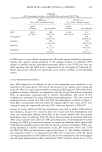
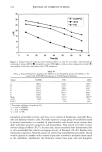
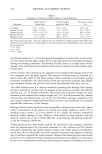
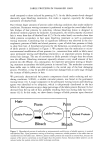
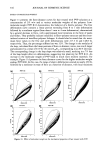
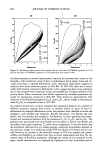
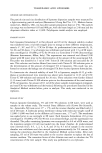
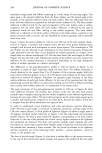
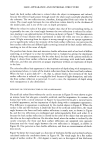
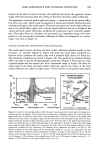
HAIR APPEARANCE AND INTERNAL STRUCTURE 395 strictly, a color similar to the light source) reflection from the front surface and the colored reflection from the back surface (Figure 5a). On the other hand, the artificial nylon fibers without a cuticle structure show only a slightly colored single reflection (Figure 5b). The color of the human hair and the nylon fibers in Figure 5 was not matched precisely. The CIE L*a*b* values for each fiber were measured by a color meter as L* -- 27.18, a* = 6.44, b* = 10.25 for the human hair, and L* -- 30.17, a* = 4.85, b* = 12.13 for the nylon fiber. The nylon fibers were a little more yellowish in color (larger in b* value) and less reddish in color (smaller in a* value) than the human hair. Although the expression of the panel members on the hair appearance may be affected by this small color difference, the authors mainly discuss here the textures of the hair appearance, such as the impression of depth, along with transparency and a metallic or artificial impression. Further influence of color on hair appearance is considered in the Discussion section of this paper. The dynamic appearance of the poreless hair in Figures 4 and 5 was evaluated by professional panelists by moving the hair tresses. During the evaluation, the panelists observed changes in appearance when the shape of the hair tresses was repeatedly changed from a convex to a concave form, as in swinging hair. The opinions obtained from the panelists for the poreless hair compared to the porous hairs or the nylon tresses were: more dramatic and dynamic changes in colorfulness and the impression of depth along with a brilliant and vibrant impression. The changes in the appearance of the poreless hair as a function of curl curvature are shown in Figure 6. The relative position, size, and intensity of the double reflections of the poreless hair are dramatically changed in the course of the formational change. It is worth noting that the change in hair appearance is not symmetry at the curvature = 0 (flat shape), but symmetry at the curvature = -0.02 (concave shape), under the present geometrical condition of lighting and observation described in Figure 10b. Curl Radius (cm): -20, -33, -50, 0.00, 50, 33, 20, Curvature (cm4): -0.05, -0.03, -0.02, 0.00, 0.02, 0.03, 0.05, concave flat convex Figure 6. Photo images of a curled hair tress at several curl curvatures. The hair used in this figure is a human hair tress with a poreless structure and inclined cuticle structure and is characterized in Figure la. The curl radius and curvature of the hair tress are shown at the bottom of each image.
Purchased for the exclusive use of nofirst nolast (unknown)
From: SCC Media Library & Resource Center (library.scconline.org)