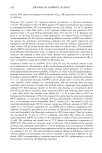
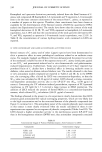
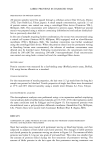
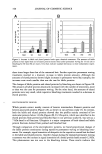
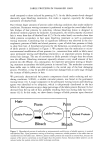
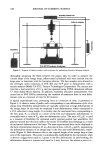
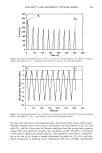
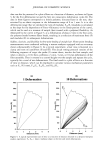
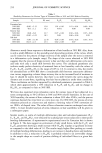
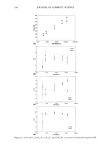
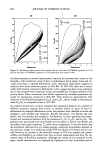
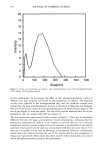
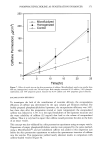
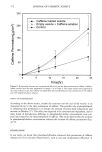
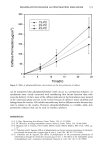
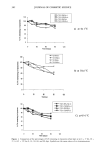
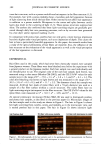
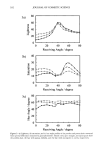
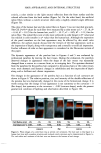
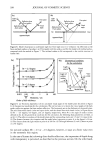
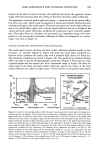
392 JOURNAL OF COSMETIC SCIENCE 3a) 80 60 0 20 40 60 80 Receiving Angle / degree 40 30 0 20 40 60 Receiving Angle / degree 80 80 3c) • 60 -- 40 • 20 0 0 20 40 60 Receiving Angle / degree 80 Figure 3. (a) Lightness, (b) saturation, and (c) hue angle profiles of the poreless and porous hairs converted from spectral reflectance measured by goniophotometer. Closed circle, open triangle, and open square show the poreless hair, the hair with porous medulla, and the hair with micropores in cortex, respectively.

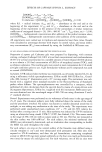
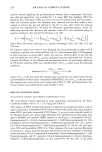
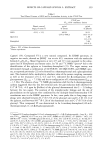
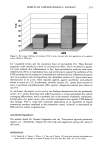
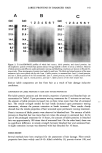
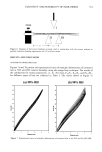
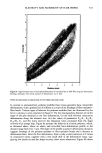
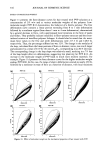
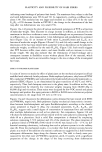
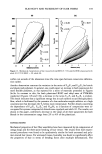
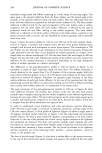
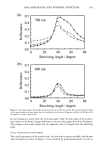
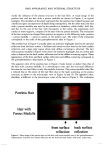
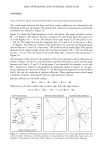
HAIR APPEARANCE AND INTERNAL STRUCTURE 393 clarify the influence of the porous structure in the hair fiber. A visual image of the poreless hair and the hair with a porous medulla are shown in Figure 4, as typical examples. The members of the panel expressed that the poreless hair looked lustrous and colorful and gave an impression of depth along transparency. On the other hand, the hair with a porous medulla was seen by the panelists as lusterless, white-chalky, dull, dry, and flat. In the case of the hair with micropores in the cortex, the expressions were similar or more negative, compared to the hair with the porous medulla. The evaluation of the hair samples was charged from positive to negative in the following order: poreless porous medulla = pores in cortex, in the present case. The order of the evaluation corresponds to the order of the goniophotometric data in Figure 3. The poreless hair in Figure 4 actually shows an intensive highlight zone by the specular reflection from the front surface, a brilliant and intensive color zone by the back surface reflection, and a deep color region where only diffuse scattering is observed. The hair with a porous medulla in Figure 4 also shows the intensive highlight, but an unclear pale color is observed at the back surface reflection and in the diffuse-scattering region. These appearances of the front and back surface reflections and diffuse scattering correspond to the goniophotometric data shown in Figure 3. The apparent color of the poreless hair in Figure 4 looks deeper or darker than that of the hair with a porous medulla. It is interesting to note that the structural difference between the two hair fibers is only the medulla structure. The porous medulla looks like a whitish line at the center of the hair fiber due to the light scattering at the porous structure, as shown in the microscopic view in Figure la and lb. The apparent color, therefore, is different in the macroscopic views of the hairs in Figure 4. The evaluation Poreless Hair Hair with Porous Medulla from surface back surface reflection reflection Figure 4. Photo image of the poreless hair and the hair with porous medulla used in the goniophotometric measurements. Colorless and colored reflections are the front and back surface reflections respectively.
Purchased for the exclusive use of nofirst nolast (unknown)
From: SCC Media Library & Resource Center (library.scconline.org)