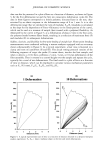
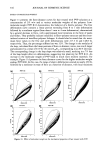
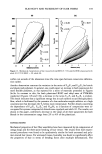
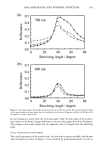
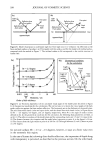
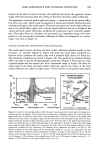
400 JOURNAL OF COSMETIC SCIENCE areas indicate the size and direction of the reflected image of the light source. The arrows correspond to an arrow in the light source shown in Figure 10b. When the model plate is of a convex form, the back surface reflection is located on the upper side of the front surface reflection, as in Figure 10a (more root end side in Figure 10b). This situation corresponds to the hair appearance at the curl curvature 0 in Figure 6. On the other hand, when the model plate is transformed from the convex to concave form, the location of the back surface reflection is moved to the opposite lower side (tip side) of the front surface reflection (curl curvature -0.02 in Figure 6). The size and direction of the reflected image of the light source also greatly depend on the curvature. During the change in the curvature of the model plate from positive (convex form) to negative (concave form), the reflected image is enlarged at first, divergent once in the middle of the process, and then reversed. That is, the relative position and size of the double reflections are dramatically and dynamically moved during the course of hair movement. This optical phenomenon is essentially the same as the reflection behavior observed in a rounded mirror. The symmetrical center of the optical phenomena is not observed at the curvature = 0, but observed at the curvature = -0.02, under the conditions shown in Figure 10b. These kinetic changes of the double reflections, as shown in Figure 6, must cause dramatic and dynamic changes in color and the impression of depth along with trans- parent appearance, leading to brilliant and vibrant impressions in the case of the poreless hair with cuticle structure. In the present study, the influence of the multiple optical interactions among the fibers is not considered, because of difficulties in the calculation. The present simple model, however, reasonably reproduces the optical behaviors of the front and back surface reflections in the actual appearance of the hair tresses, showing that the simple model is valid as a primary approximation for the present study. CONCLUSION It is suggested on the basis of our results that lustrous and colorful appearance, and the impression of depth along with transparency and vibrancy of hair, are achieved by meeting the following three conditions: 1. Poreless structure in the internal hair fiber, Due to the lack of lightscattering origins, the poreless structure allows the visible light to reach and reflect from the back surface, to be observed as an intensive and colored reflection together with surface reflection to give a higher contrast in lightness and saturation of hair color. 2. Well-ordered cuticle structure on the surface of hair fiber. A well-ordered cuticle structure leads to sharp reflections from front and back surfaces and also leads to separation of the two reflections by the inclined cuticle structure. These separated double reflections cause an overestimation of real depth or confusion in our depth perception as a kind of visual illusion, and lead to the impression of depth along with transparency. 3. Proper hair curvature and motion of the hair. Change in tress curvature and motion leads to dramatic and dynamic changes in color perception and the impression of depth along with transparency, leading to a more vibrant appearance. By fulfilling these conditions, the hair looks beautiful: lustrous, colorful, deep along with apparent transparency, brilliant, and vibrant in appearance.

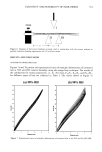
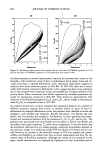
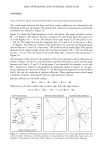
HAIR APPEARANCE AND INTERNAL STRUCTURE 401 APPENDIX CALCULATION OF VISUAL ANGLE BETWEEN FRONT AND BACK SURFACE REFLECTIONS The visual angle between the front and back surface reflections was obtained by the following numerical calculation. The geometrical conditions and parameters used for the calculation are defined in Figure 11. Figure 1 la shows the fixed parameters in the calculation. The angle of surface incline: Os -- 2.5 degrees. The distance between viewpoint (V) and model plate (the point V to A in the figure): dvA -- 30 cm. The distance from light source (L) to the point A: dLA = 100 cm. The angle between the imaginary lines L-A and A-V at the point A: OVAL = 45 degrees. The refractive indexes of the model plate (nl) and the surrounding media (nO) are fixed as 1.5 and 1.0, respectively. The thickness of the model plate (Dh) and the diameter of the spherical light source (DL) are fixed as follows: Dh = 0.01 cm (100 pm) and DL = 10 cm. The curl radius of the model plate (Rc) is varied in the calculation in Figure 10. The notations of the points on the geometry of the front and back surface reflections are shown in Figure 1 lb and 1 lc, and the distance between the points L and F and the angle between two lines L-F and V-F at the point F are described, for example, as dLF and OWL, respectively. Based on the geometrical conditions shown in Figure 11, the geo- metric equations are derived. In Figure 11, the following four equations are derived from Snell's law and the condition of specular reflection. These equations were solved using a personal computer utilizing the Newton approximation method. Specular reflection at the front surface: (Ovc• + O•vc) + Os = (O•c• + OcL?) - Os Refraction at the front surface (the incident light from the light source): nO sin (OcLx + OxcL - Os) = nl sin (OcxB - Os) 1 a) Fixed parameters Light source (L) D '\ ',,,,,, ......... View , '"',, &A ........ point ß '"'",, ,? '""' ........... ' ""= \ '"'"// A Center of the hair curl (C) lb) Front surface reflection L c 1 c) Back surface reflection Figure 11. Geometrical definitions and conditions for the calculation of the visual angle between the front and back surface reflections. (a) Fixed parameters in the geometry of the model plate, light source, and viewpoint. (b) Geometry of the front surface reflection. (c) Geometry of the back surface reflection.
Purchased for the exclusive use of nofirst nolast (unknown)
From: SCC Media Library & Resource Center (library.scconline.org)