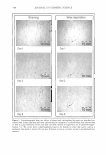
J. Cosmet. Sci., 57, 345-354 (September/October 2006) Use of image analysis techniques for objective quantification of the efficacy of different hair removal methods S. BIELFELDT, M. BRANDT, and K.-P. WILHELM, proDERM Institute for Applied Dermatological Research, D-22869 Schenefeld/Harnburg, Kiebitzweg 2, Germany. Accepted for publication February 9, 2006. Synopsis In the field of consumer-used cosmetics for hair removal and hair growth reduction, there is a need for improved quantitative methods to enable the evaluation of efficacy and claim support. Optimized study designs and investigated endpoints are lacking to compare the efficacy of standard methods, like shaving or plucking, with new methods and products, such as depilating instruments or hair-growth-reducing cos metics. Non-invasive image analysis, using a high-performance microscope combined with an optimized image analysis tool, was investigated to assess hair growth. In one step, high-resolution macrophotographs of the legs of female volunteers after shaving and plucking with cold wax were compared to observe short-term hair regrowth. In a second step, images obtained after plucking with cold wax were taken over a long-term period to assess the time, after which depilated hairs reappeared on the skin surface. Using image analysis, parameters like hair length, hair width, and hair projection area were investigated. The projection area was found to be the parameter most independent of possible image artifacts such as irregularities in skin or low contrast due to hair color. Therefore, the hair projection area was the most appropriate parameter to determine the time of hair regrowth. This point of time is suitable to assess the efficacy of different hair removal methods or hair growth reduction treatments by comparing the endpoint after use of the hair removal method to be investigated to the endpoint after simple shaving. The closeness of hair removal and visible signs of skin irritation can be assessed as additional quantitative parameters from the same images. Discomfort and pain rating by the volunteers complete the set of parameters, which are required to benchmark a new hair removal method or hair-growth-reduction treat ment. Image analysis combined with high-resolution imaging techniques is a powerful tool to objectively assess parameters like hair length, hair width, and projection area. To achieve reliable data and to reduce well known image-analysis artifacts, it was important to optimize the technical equipment for use on human skin and to improve image analysis by adaptation of the image-processing procedure to the different skin characteristics of individuals, like skin color, hair color, and skin structure. INTRODUCTION In modern western societies, both the absence and presence of hairs can be undesirable. Hence, it is not surprising that, on the one hand, hair removal techniques and growth inhibition actives to fight unwanted hairs are a growing market (1), while, on the other hand, the effort of the pharmaceutical and cosmetics industry in the development of 345

346 JOURNAL OF COSMETIC SCIENCE products to induce or improve hair growth increases. As a consequence, the development of methods to reliably quantify the efficacy of these products and methods is of increas ing interest. In classical dermatology, clinical scoring (2 ,3) and trichogram analysis by the plucking of hairs (4-6) are the methods usually used to assess hair growth patterns on the human scalp. They are suitable when the focus is on diagnosis of scalp hair diseases like alopecia. For assessment of depilation efficacy or hair growth inhibition, advanced imaging tech niques are more suitable and can be used on all body sites of interest, such as legs, axilla, and face. Standardized clinical photography and image analysis to assess hair growth in a non invasive way has been used since 1970 (7) and has improved continuously (8-12). To date, the computer-aided capturing of high-resolution images offers direct control of magnification, image section, and image quality. Modern, powerful, image-analysis software packages (13) enable the user to program tailor-made parameters for specific needs. Retrieval of single hairs in images and the repeated measurement of their length, width, and projection area are powerful tools to quantify hair growth. The closeness of a depilation method's giving a measure of the method's efficacy, the time until hairs become again visible after their removal, growth velocity, and even skin irritation can be quantified. Taking wet shaving and wax depilation as well known examples, we dem onstrate how depilation techniques or actives designed to reduce hair growth can be benchmarked with the help of improved image analysis. MATERIALS AND METHODS In two test panels, Group 1 consisting of ten and Group 2 consisting of nine female volunteers, between 25 and 65 years of age, hair removal methods were applied and investigated. As a pretreatment, the volunteers shaved their legs with disposable blades under the supervision of a technician seven days before starting the study, as a stan dardized starting point. On day 1, test areas of 3 cm x 3 cm were outlined on the inner sides of the lower legs, close to the tibia. Group 1 shaved one randomly assigned test area (right or left leg) the other leg was depilated with a cold wax (marketed product). In Group 2, only one test area was outlined on the lower leg (either right or left leg according to a randomization scheme). On day 1, the test area was depilated by using cold wax. In Group 1, images of the test areas were taken on study day 1 before hair removal, and on study days 2, 4, 7, and 9. In Group 2, images were taken on study day 1 before hair removal, directly after depilation, and then weekly over a period of four weeks. Macrophotographs (magnification: 5X) were taken with a high-performance stereomi croscope (Olympus SZX Series, Hamburg, Germany) equipped with a high-resolution CCD color camera (SIS Color View CC-12, 1.4 megapixel). An Olympus ring light connected to the objective tube (Olympus SZX Series, Hamburg, Germany) was used to enable homogeneous illumination. To be able to assess the same test area at all assessment times with an accuracy of better than 2 millimeters, a transparent template was prepared using permanent skin marks such as nevi, in or near the test area, as demarcation points. The template was a commercially available foil made of polyethylene with a thickness of 0.08 mm. In
Purchased for the exclusive use of nofirst nolast (unknown)
From: SCC Media Library & Resource Center (library.scconline.org)