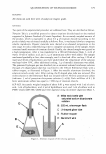
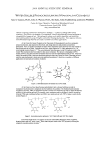
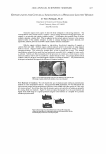
2006 ANNUAL SCIENTIFIC SEMINAR 409 INDENTOMETRIC OF SKIN Roger McMullen, Ph.D., Janusz Jachowicz, Ph.D. and Donald Prettypaul International Specialty Products) Wayne, NJ 07470 Introduction Mechanical properties of skin and its variability as a function of age or as a result of cosmetic treatments has been a central focus of research by cosmetic chemists and dermatologists for a very long time. Torsional analysis, cutometry or levarometry, gas bearing electrodynamometry, single-axis extensions tests, ballistometry, and indentometry were employed to determine basic mechanical parameters such as Young's modulus as well as more complex parameters such as skin extensibility in the dermal torque technique, Dynamic Spring Rate in Gas-Bearing Electrodynamometry, or cutaneous rigidity. In this work, we have carried out indentometric analysis of the forearm and facial skin of IO human panelists as well as six artificial skin models, which were prepared to simulate skin elasticity. The objective was to compare the mechanical properties of natural skin with that of the rubber models with the intention of future utilization of skin models for the evaluation of the mechanical effects ( elastic modulae, viscoelastic parameters, tackiness, etc) of cosmetic treatments such as skin tightening or firming agents, emollients, thickeners, etc. The advantages of using artificial skin are numerous and include the possibility of working with well-defined and reproducible materials, eliminating mechanical artifacts from the measurements caused by panelist movement, and eliminating the necessity of toxicological testing for experimental actives. Instrumentation The instrument employed was a texture analyzer, which is a mechanical tensiometer simulating the process of touch. The experiments were carried out on human subjects as well as on artificial skin models. They included indentometry tests performed by using spherical probes with various geometrical dimensions as well as stress relaxation and creep experiments. The experimental data were interpreted by using Hertz theory of contact mechanics and by calculation of fundamental parameters such as the modulus of elasticity according to the following equation (Figure 1 )[I]: Where P is the indentation force, o is the penetration depth, E* is the equivalent Young's modulus of skin elasticity, and R is the radius of the contacting probe. Viscoelastic properties of skin were modeled by the Kelvin-Voigt model, which consists of a spring, and parallel spring-and-dashpot system. The measurements were carried out by performing creep or stress relaxation measurements.

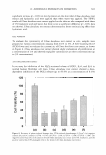
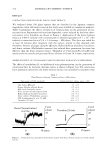
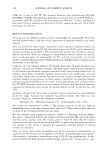
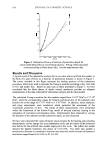
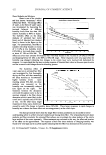
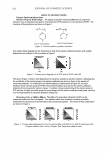
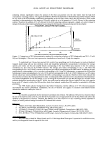
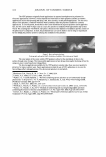
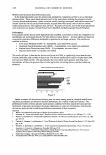
410 JOURNAL OF COSMETIC SCIENCE 0.06 0.05 0.04 0.03 0.02 0.01 0-+---..---..----.----.----.------1 0 0.0002 0,0004 0,0006 0.0008 0.001 0.0012 Strain(m) Figure 1 Indentation force as a function of penetration depth for a skin model(♦) and for in-vivo forearm skin (x). Fitting of the calculated curves according to Hertz theory (Eq. 1) to the experimental data. Results and Discussion A typical result of the indentation analysis for in-vivo skin and an artificial skin model, in the form of a plot of force as a function of penetration distance is shown in Figure 1. The curves included in this figure represent the loading portions of the indentation procedure, which were used to calculate the Young's modulae according to Eq. 1 for both in-vivo and model skin. Based on data such as those presented in Figure 1, we have concluded that the Hertz theory of elastic contact mechanics provides an adequate interpretation of the data collected for both human subjects and for skin models. The calculated Young's modulae for skin models ranged from 5.5·104 N/m2 to 17.7·104 N/m2, while the corresponding values for forearm and facial skin of ten panelists were found to be in the range of O. 7 · 104 N/m2 to 3. 3 · 104 N/m2 . In addition, stress relaxation and creep experiments were conducted, which permitted the assessment of the viscoelastic properties of skin. The results of these measurements were interpreted within the framework of the Kelvin-Voigt model of delayed elasticity leading to the calculation of viscosities and relaxation times. Indentometric data, obtained by varying the diameter of the indenter and the indentation depth, are also discussed. We have also calculated the values of elastic strain energies for the loading and unloading indentometric curves, energy loss in an indentation cycle, and the values of the hysteresis loss factors for the artificial skin models employed in this work. The softest skin model showed the highest hysteresis loss factor of 51.0±1.8%. For other skin models a monotonous decrease in viscoelastic character was observed, which in terms of hysteresis loss factor ranged from 36.9±3.6% to 25.1±5.2%.
Purchased for the exclusive use of nofirst nolast (unknown)
From: SCC Media Library & Resource Center (library.scconline.org)